

Written by: Sachin
Fact-checked by: Government Salary Research Desk
Last Updated: September 2026
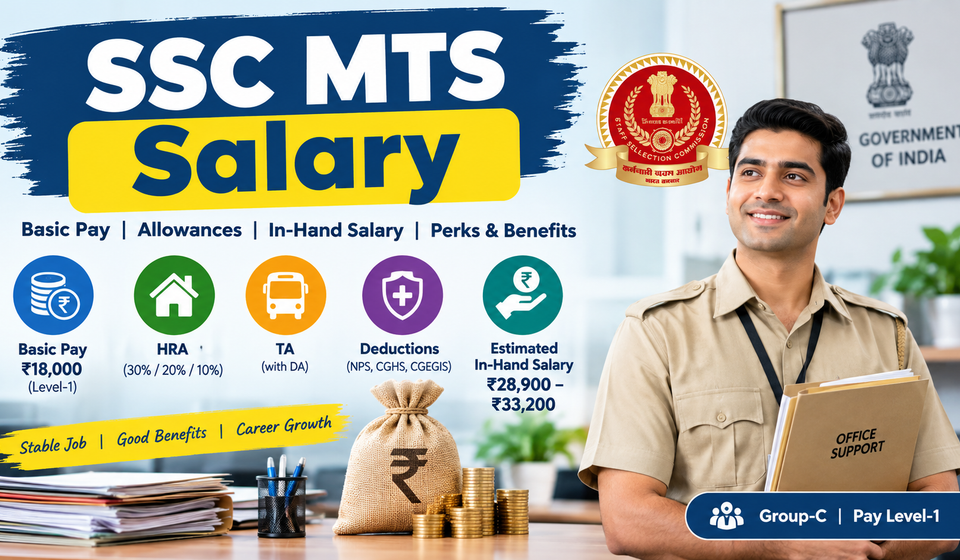
Quick Answer: An SSC MTS employee starts at a basic pay of ₹18,000 per month under Pay Level-1 of the 7th Central Pay Commission. Using the 60% DA rate effective from 1 January 2026 for calculation purposes, the estimated in-hand salary is approximately ₹28,900–₹33,200 per month, depending on the posting’s HRA slab and applicable Transport Allowance category. The July 2026 DA rate should be updated once the Department of Expenditure publishes the applicable official order.
Important note on figures: The 7th CPC basic pay of ₹18,000 is official. The DA rate used in this calculation is 60%, effective 1 January 2026, as confirmed by the Department of Expenditure. The July 2026 DA rate should be treated as unconfirmed until the Department of Expenditure publishes the formal order. Because DA is revised periodically and HRA depends on city classification, the in-hand figures in this article are estimates, not guarantees. Always verify with the latest government order or your salary slip.
SSC MTS Salary 2026: Key Facts
| Particular | Details |
|---|---|
| Post | Multi-Tasking Staff (Non-Technical) and Havaldar |
| Recruiting Body | Staff Selection Commission (SSC) |
| Pay Level | Level-1 |
| Starting Basic Pay | ₹18,000 per month |
| Pay Matrix Range | ₹18,000–₹56,900 |
| Grade Pay (pre-7th CPC) | ₹1,800 |
| DA Used for Calculation | 60% effective 1 January 2026 |
| July 2026 DA | Awaiting official notification |
| HRA Slabs | 30% / 20% / 10% (X / Y / Z cities) |
| TA Category | Based on applicable transport-allowance classification |
| Estimated In-Hand | ₹28,900–₹33,200 at 60% DA |
| Job Type | Group-C, Non-Gazetted, Central Government |
| Probation Period | Typically 2 years (subject to applicable service rules) |
| Official Website | ssc.gov.in |
What Is SSC MTS?
SSC MTS stands for Staff Selection Commission Multi-Tasking Staff (Non-Technical). It is a Group-C central government post recruited through the SSC MTS examination. Candidates who have passed Class 10 (Matriculation) are eligible to apply. The recruitment also includes the post of Havaldar, deployed in the Central Board of Indirect Taxes and Customs (CBIC) and the Central Bureau of Narcotics (CBN).
The MTS role is a general office support position — file handling, office maintenance, dispatch work, and assisting senior officials. It is not a clerical or supervisory role.
SSC MTS Salary Structure Explained
The SSC MTS salary is built on the 7th Pay Commission’s Pay Level-1 matrix, which runs from ₹18,000 to ₹56,900. The starting basic pay is ₹18,000.
From this basic pay, the following allowances are added:
- Dearness Allowance (DA): A percentage of basic pay, revised twice a year to offset inflation.
- House Rent Allowance (HRA): A percentage of basic pay, determined by the classification of the posting city (X, Y, or Z).
- Transport Allowance (TA): A fixed base rate plus DA thereon. TA adjusts with every DA revision.
From the gross salary, the following deductions are subtracted to arrive at the in-hand (net) salary:
- National Pension System (NPS): 10% of (Basic Pay + DA)
- CGHS: ₹250 per month for Pay Level 1–5 employees
- CGEGIS: ₹30 per month for Group C employees
The formula is:
Basic Pay + DA + HRA + (TA base + DA on TA) − (NPS + CGHS + CGEGIS) = In-Hand Salary
City-Wise In-Hand Salary Estimate (60% DA)
The main factors affecting SSC MTS take-home pay are the HRA slab, Transport Allowance category, DA rate and applicable deductions.
A note on TA classification: The HRA city classification (X/Y/Z) and the transport-allowance city classification are related but not automatically identical. Transport Allowance eligibility is based on the notified transport-allowance classification of your posting, not merely on its HRA category. The tables below use the higher-TA category (often corresponding to major metro postings) and the standard-TA category for illustration. Check the applicable classification for your specific posting.
Higher-TA Category (e.g., Major Metro Postings)
| Component | Calculation | Amount |
|---|---|---|
| Basic Pay | Official 7th CPC | ₹18,000 |
| DA (60%) | 60% × ₹18,000 | ₹10,800 |
| HRA (30%) | 30% × ₹18,000 | ₹5,400 |
| TA (Level 1–2, higher category) | ₹1,350 + 60% DA | ₹2,160 |
| Gross Salary | ₹36,360 | |
| NPS (10% of Basic + DA) | 10% × (₹18,000 + ₹10,800) | ₹2,880 |
| CGHS (Level 1–5) | Fixed | ₹250 |
| CGEGIS (Group C) | Fixed | ₹30 |
| Total Deductions | ₹3,160 | |
| Estimated In-Hand | ~₹33,200 |
Standard-TA Category — Y City
| Component | Calculation | Amount |
|---|---|---|
| Basic Pay | Official 7th CPC | ₹18,000 |
| DA (60%) | 60% × ₹18,000 | ₹10,800 |
| HRA (20%) | 20% × ₹18,000 | ₹3,600 |
| TA (Level 1–2, standard category) | ₹900 + 60% DA | ₹1,440 |
| Gross Salary | ₹33,840 | |
| Total Deductions | ₹3,160 | |
| Estimated In-Hand | ~₹30,700 |
Standard-TA Category — Z City
| Component | Calculation | Amount |
|---|---|---|
| Basic Pay | Official 7th CPC | ₹18,000 |
| DA (60%) | 60% × ₹18,000 | ₹10,800 |
| HRA (10%) | 10% × ₹18,000 | ₹1,800 |
| TA (Level 1–2, standard category) | ₹900 + 60% DA | ₹1,440 |
| Gross Salary | ₹32,040 | |
| Total Deductions | ₹3,160 | |
| Estimated In-Hand | ~₹28,900 |
Any subsequent DA revision will change the DA component and the DA component of Transport Allowance. Recalculate the in-hand salary using the applicable official rate once notified.
Read More: IPS Salary 2026: Complete Rank-Wise Pay Scale, Allowances, and In-Hand Salary
What Makes Up the Salary?
Basic Pay
The basic pay for SSC MTS is ₹18,000 per month at the entry level. This is the official 7th CPC figure and is not an estimate. The pay matrix allows for annual increments, which gradually increase the basic pay over the years.
Dearness Allowance (DA)
DA is a cost-of-living adjustment paid to government employees. It is calculated as a percentage of basic pay and revised twice a year (January and July). The DA rate used in this calculation is 60%, effective 1 January 2026, as confirmed by the Department of Expenditure.
At 60%, DA on ₹18,000 basic pay is ₹10,800 per month.
The DA rate for the July 2026 cycle should be updated once the Department of Expenditure issues the official order. Until then, any higher rate should be treated as a projection, not a confirmed figure.
House Rent Allowance (HRA)
Under the 7th CPC HRA framework, the rates increase to 30%, 20% and 10% for X, Y and Z cities when DA crosses 50%.
| City Category | HRA Rate | Amount on ₹18,000 Basic Pay |
|---|---|---|
| X City (Metro) | 30% | ₹5,400 |
| Y City | 20% | ₹3,600 |
| Z City | 10% | ₹1,800 |
The original 7th CPC HRA rates were 24%/16%/8%; the rates increase to 30%/20%/10% once the applicable DA threshold exceeds 50%. Older salary estimates may show lower in-hand figures because they use the earlier rates.
Transport Allowance (TA)
Transport Allowance consists of a fixed base rate plus DA thereon. For Pay Level 1–2 employees, the base rates are:
| TA Category | Base Rate | DA Component (at 60%) | Effective TA |
|---|---|---|---|
| Higher-TA category | ₹1,350 | 60% × ₹1,350 = ₹810 | ₹2,160 |
| Standard-TA category | ₹900 | 60% × ₹900 = ₹540 | ₹1,440 |
Unlike HRA, which steps up only when DA crosses specific thresholds, TA adjusts with every DA revision. This means your TA will automatically increase when the next DA hike is notified.
Deductions
Three mandatory deductions are subtracted from gross salary:
| Deduction | Amount (at 60% DA) | Basis |
|---|---|---|
| NPS | ₹2,880 | 10% of Basic Pay + DA |
| CGHS | ₹250 | Fixed for Pay Level 1–5 |
| CGEGIS | ₹30 | Fixed for Group C |
A note on CGEGIS: Some older articles quote CGEGIS as ₹1,500 per month. That figure is incorrect for Group C employees. The actual CGEGIS contribution for Group C is ₹30 per month, providing ₹30,000 insurance cover as per the applicable CGEGIS scheme rules. The 7th CPC recommended increasing these rates, but the Cabinet rejected the proposal, so the lower rates from the 1990s continue to apply. Refer to the official CGEGIS subscription table for confirmation.
SSC MTS Salary Slip: Illustrative Example
Below is an illustrative salary slip for an SSC MTS employee posted in a higher-TA category location at 60% DA. Your actual salary slip will differ based on your posting, the DA rate at the time, and any additional allowances or deductions applicable to your department.
| Earnings | Amount |
|---|---|
| Basic Pay | ₹18,000 |
| Dearness Allowance (60%) | ₹10,800 |
| House Rent Allowance (30%) | ₹5,400 |
| Transport Allowance (with DA) | ₹2,160 |
| Gross Pay | ₹36,360 |
| Deductions | Amount |
|---|---|
| NPS (10% of Basic + DA) | ₹2,880 |
| CGHS | ₹250 |
| CGEGIS | ₹30 |
| Total Deductions | ₹3,160 |
| Net Pay | ~₹33,200 |
This salary slip is issued monthly and is an important document for loan applications, tax filing, and verification purposes.
SSC MTS Havaldar Salary
The Havaldar post is also under Pay Level-1 with the same basic pay of ₹18,000. The core pay structure is the same as MTS in terms of DA, HRA, and TA, though department-specific allowances can differ. Havaldar employees may receive a uniform allowance in addition, depending on the department. The estimated in-hand salary range is therefore similar to that of MTS — approximately ₹28,900 to ₹33,200 per month at 60% DA, depending on posting.
The key difference is the nature of work: Havaldar roles involve field duties, physical tasks, and departmental responsibilities within CBIC or CBN, whereas MTS roles are primarily office-based support functions.
Illustrative SSC MTS Salary After 5 and 10 Years
The basic pay increases through annual increments under the 7th CPC pay matrix. Each year, the basic pay increases by one increment (approximately 3% of basic pay, rounded).
These are not future salary predictions. They are illustrative calculations using the 60% DA assumption and assuming no promotion or other changes. In practice, DA will change over time, which will affect the in-hand amount. Promotions, if any, would also change the basic pay and pay level.
| Years of Service | Approx. Basic Pay | Illustrative In-Hand (Z City, 60% DA) |
|---|---|---|
| Joining | ₹18,000 | ~₹28,900 |
| After 3 years | ₹19,300 | ~₹30,100 |
| After 5 years | ₹20,500 | ~₹31,300 |
| After 10 years | ₹23,500 | ~₹34,200 |
A promotion to a higher pay level would result in a higher basic pay and consequently a higher in-hand salary. The Pay Level-1 matrix extends up to ₹56,900, but this is the upper end of the Level-1 pay matrix, not a typical starting or near-term MTS salary. Actual progression depends on annual increments, promotions and applicable service rules.
Read More: IAS Salary 2026: Complete Pay Scale, Allowances & In-Hand Salary
SSC MTS Job Profile and Responsibilities
SSC MTS employees are the operational backbone of government offices. Their duties are non-clerical and support-oriented. Common responsibilities include:
- File movement: Carrying files and papers between departments and offices
- Record maintenance: Physical upkeep and organisation of office records
- Photocopying and scanning: Xerox, scanning, and sending faxes
- Dispatch work: Sending letters and documents within and outside the building
- Office cleanliness: Maintaining basic cleanliness of the workspace
- Assisting officials: Providing support to clerical staff and senior officers
- Watch and ward: Security-related duties in some postings
- Equipment operation: Operating and maintaining office equipment
- Opening and closing: Opening and closing office rooms on time
MTS employees generally work during regular government office hours, although working hours can vary by department and posting. The work is primarily office-based and support-oriented.
SSC MTS Posts List
The following posts are commonly offered under SSC MTS recruitment. Posts and designations can vary by recruitment notification and department.
- Peon
- Daftary
- Jamadar
- Junior Gestetner Operator
- Chowkidar
- Safaiwala
- Mali (Gardener)
- Watchman
- Operator
- Gatekeeper
- Office Attendant
The exact post depends on the department and office where you are posted, and the final list is determined by the applicable recruitment notification.
Possible Career Progression for SSC MTS
There is no single promotion ladder applicable to every MTS employee. Departmental recruitment rules, vacancies, qualifying service and departmental examinations determine the actual opportunities. The progression below is an illustrative example of possible career movement in some departments, not a guaranteed sequence for every MTS employee.
| Stage | Position | Approx. Timeline (Illustrative) |
|---|---|---|
| Entry | MTS | On joining |
| 1st Promotion | Lower Division Clerk (LDC) | After ~3 years (subject to departmental exam and vacancy) |
| 2nd Promotion | Upper Division Clerk (UDC) | After further experience and departmental exam |
| 3rd Promotion | Assistant | After several years of service |
| 4th Promotion | Section Officer | At a later stage of career |
Promotions bring higher pay levels, increased responsibilities, and less manual work. Many departments conduct internal examinations to facilitate these promotions. Clearing these exams can accelerate career growth, but promotion opportunities depend on departmental rules, vacancy availability, and performance.
SSC MTS Perks and Benefits
Beyond the monthly salary, SSC MTS employees receive:
- Retirement benefits under the National Pension System (NPS) — a contributory system with employee and government contributions
- Medical benefits under CGHS for the employee and dependents
- Leave benefits: Paid leave, casual leave, earned leave, and medical leave
- Job security: A regular Group-C central government post, with probation and confirmation governed by applicable departmental rules
- Post-retirement benefits: Provident fund, gratuity (where applicable), and NPS benefits
- Annual increments under the 7th CPC pay matrix
- Work-life balance: Regular government office hours and government holidays
SSC MTS vs Other SSC Jobs
| Exam | Approx. In-Hand Salary Range | Pay Level |
|---|---|---|
| SSC MTS | ₹28,900 – ₹33,200 | Level-1 |
| SSC CHSL | ₹30,000 – ₹40,000 | Level-2 to Level-4 |
| SSC CGL | ₹42,000 – ₹65,000+ | Level-4 to Level-8 |
SSC MTS has the lowest entry requirement (Class 10), while CHSL requires Class 12 and CGL requires a bachelor’s degree. The starting pay is lower than that of several higher-level SSC posts, but the position offers the benefits and career structure associated with regular central government service.
Sources & Official References
The salary figures and allowance rates in this article are based on the following sources. Where figures are estimates, they have been clearly labelled.
| Source | Relevance |
|---|---|
| Department of Expenditure, Ministry of Finance — DA orders | DA rate of 60% effective 1 January 2026 |
| Department of Expenditure — HRA rules | HRA slabs of 30%/20%/10% after DA crossed 50% |
| Department of Expenditure — Transport Allowance orders | TA base rates of ₹1,350 and ₹900, with DA component |
| CGHS contribution rates | ₹250 per month for Pay Level 1–5 |
| CGEGIS subscription rates | ₹30 per month for Group C; ₹30,000 insurance cover |
| SSC — MTS/Havaldar recruitment notification | Pay Level-1, basic pay ₹18,000 |
| National Pension System Trust | NPS contribution rules (10% of Basic + DA) |
Frequently Asked Questions
1. What is the SSC MTS salary in 2026?
Answer: The basic pay is ₹18,000 per month. Using the 60% DA rate effective 1 January 2026 for calculation, the estimated in-hand salary ranges from approximately ₹28,900 (Z city) to ₹33,200 (higher-TA, metro-type postings), depending on HRA slab and TA component. These figures are estimates until your actual salary slip is generated.
2. What is the highest salary in SSC MTS?
Answer: The Pay Level-1 matrix extends up to ₹56,900 basic pay. However, this is the upper end of the Level-1 pay matrix, not a typical starting or near-term MTS salary. Actual progression depends on annual increments, promotions and applicable service rules.
3. Is SSC MTS a good job?
Answer: For candidates who have completed Class 10 and are seeking a stable central government job with regular office hours, job security, and a possible promotion path, SSC MTS is a solid entry point. The starting pay is lower than that of several higher-level SSC posts, but the position offers the benefits and career structure associated with regular central government service.
4. Is MTS a permanent job?
Answer: SSC MTS is a regular Group-C central government post. Probation and confirmation conditions are governed by the applicable departmental service rules.
5. Does SSC MTS get a pension?
Answer: SSC MTS employees appointed under NPS are covered by a contributory retirement system. Employee and government contributions are made according to applicable NPS rules. It is not a traditional guaranteed-pension scheme — the retirement corpus depends on contributions and returns over the service period.
6. What is the DA rate for SSC MTS in 2026?
Answer: The DA rate used in this calculation is 60% of basic pay, effective 1 January 2026. The July 2026 DA rate should be treated as unconfirmed until the Department of Expenditure publishes the formal order.
7. What is the difference between SSC MTS and Havaldar salary?
Answer: There is no difference in the basic pay or pay level. Both are Level-1 posts with a starting basic pay of ₹18,000. The core pay structure is the same, though department-specific allowances such as uniform allowance may differ for Havaldar roles.
8. Is SSC MTS salary enough to live on in a metro city?
Answer: Whether this salary is sufficient depends on rent, household size, location and other personal expenses. The estimated in-hand salary of ₹30,000–₹33,200 in a higher-TA category posting can cover basic living expenses for a single person, but in expensive metro areas, it may be tight if you are supporting a family.
9. Does SSC MTS salary increase every year?
Answer: Yes, there is an annual increment under the 7th CPC pay matrix, which increases the basic pay by approximately 3% each year. Additionally, DA is revised twice a year, and promotions bring jumps to higher pay levels.
10. Can an MTS employee become a Section Officer?
Answer: There is no single promotion ladder applicable to every MTS employee. Through a combination of departmental exams, qualifying service, and vacancy availability, an MTS employee may progress to roles such as LDC, UDC, Assistant, and eventually Section Officer in some departments. Departmental recruitment rules determine the actual opportunities.
Final Takeaway
The SSC MTS salary in 2026 is built on a basic pay of ₹18,000 under Pay Level-1. Using the 60% DA rate effective January 2026 for calculation, the realistic in-hand range is approximately ₹28,900 to ₹33,200 per month depending on your posting. The most important things to remember when evaluating any salary figure you see online are:
- Check the DA rate used — older articles may use pre-50% DA figures and show an artificially low in-hand salary. The calculation uses 60% DA effective from 1 January 2026.
- Check the HRA rate used — the original 7th CPC rates were 24%/16%/8%; the rates increase to 30%/20%/10% once the applicable DA threshold exceeds 50%.
- Check the CGEGIS figure — ₹1,500 is wrong for Group C; the actual figure is ₹30 per month.
- Check the TA treatment — TA consists of a fixed base rate plus DA thereon, and adjusts with every DA revision.
- Remember that in-hand salary is an estimate until your actual salary slip is generated.
SSC MTS is a stable Group-C central government job with a possible promotion path. For Class 10-pass candidates seeking government employment, it offers job security, medical benefits, and a structured career within regular central government service.
Read More: Gratuity Calculator 2026: Estimate Your Gratuity Online (Formula & Rules)



[…] Read More: SSC MTS Salary 2026: In-Hand Pay, Pay Level, Allowances & Job Profile […]