

Written by: Sachin
Fact-checked by: Aviation & Salary Research Desk
Last updated: September 2026
Salary data checked: September 2026
Methodology: Salary figures are compiled from publicly reported airline compensation data, employee-reported salary platforms and aviation-industry reports. Figures may vary by rank, aircraft, airline, flying hours, allowances and employment terms.
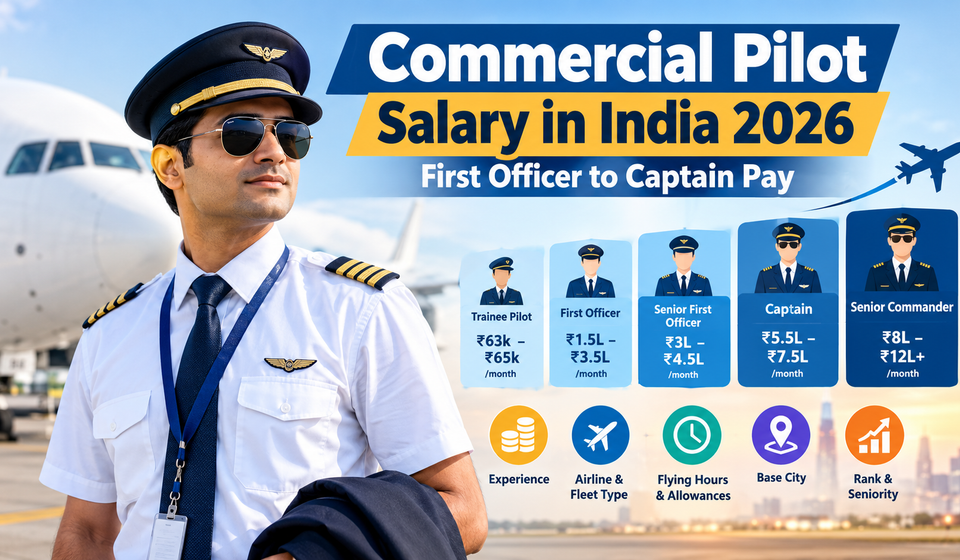
Quick Answer: Commercial pilot salary in India varies significantly by rank and airline. A newly released First Officer may earn around ₹1.5 lakh–₹3 lakh per month based on reported figures, while experienced Captains can reach ₹5.5 lakh–₹12 lakh+ in monthly compensation. A senior commander at Air India flying 55 hours a month is reported to earn ₹8.3 lakh per month in total monthly compensation under the airline’s 2026 revised pay structure.
Important distinction: A Commercial Pilot Licence (CPL) holder is not automatically an airline First Officer. After CPL training and type rating, pilots must undergo airline induction training (earning approximately ₹63,000–₹65,000/month) before being released as line First Officers.
This guide breaks down the reported salary data, the progression timeline, and the factors that influence how much a commercial pilot earns in India in 2026.
Commercial Pilot Salary by Rank (2026)
The table below shows typical monthly salary ranges based on publicly available recruitment data and compensation platforms.
| Rank / Position | Typical Monthly Salary | Source Basis |
|---|---|---|
| Trainee Pilot (Airline Training) | ₹63,000 – ₹65,000 | Employee-reported (AmbitionBox, Glassdoor) |
| Junior First Officer | ₹1.5 lakh – ₹2.5 lakh | Reported (News18, AmbitionBox) |
| First Officer (Released, 1000+ Hours) | ₹2.5 lakh – ₹3.5 lakh | Reported (ThePilot.in, News18) |
| Senior First Officer | ₹3 lakh – ₹4.5 lakh | Reported (ThePilot.in) |
| Captain (Narrow-body/Domestic) | ₹5.5 lakh – ₹7.5 lakh | Reported (News18) |
| Senior Commander (Wide-body/International) | ₹8 lakh – ₹12 lakh+ | Reported (Aviation A2Z, Lokmat Times) |
Salary data reliability note: These ranges are compiled from employee-reported platforms (AmbitionBox, Glassdoor) and industry reports. Individual salaries vary significantly based on airline, fleet type, base city, and hours flown. Actual compensation should be verified directly with the airline during recruitment.
Airline-Specific Pilot Compensation (2026)
The following table presents reported airline compensation and allowance data for major Indian carriers. Where official figures are unavailable, this is clearly noted.
Note on data gaps: For airlines where no verifiable salary figures are available, no estimates have been presented. Salary figures change frequently and vary by rank, fleet, and experience.
What Determines a Commercial Pilot’s Salary?
Several factors influence a pilot’s earnings. Understanding these can help you plan your career progression.
Flying Hours and Allowances. A significant portion of pilot compensation comes from flying allowances and layover allowances, which are variable. Air India provides guaranteed pay for 40 flying hours, with enhanced rates beyond 40 hours. A senior commander at Air India flying 55 hours a month is reported to earn ₹8.3 lakh per month in total monthly compensation, compared with ₹7.5 lakh previously under the revised structure.
Airline and Fleet Type. Pilots flying wide-body aircraft (Boeing 777, 787, Airbus A350) on international routes earn substantially more than those operating narrow-body aircraft on domestic routes. International layover allowances, higher flying activity, and fleet-specific allowances all contribute.
Rank and Seniority. The progression from First Officer to Captain is the single biggest salary jump. Under Air India’s revised framework, Air India Express is reported to serve as a primary pathway for command upgrades, with pilots gaining command experience at the low-cost carrier before progressing to wide-body operations at Air India.
Experience. Entry-level pilots during airline training earn approximately ₹63,000–₹65,000 per month. Salary grows sharply after line release and again after command upgrade.
Read More: Pashu Paricharak Salary / Anjana Om Kashyap Salary / CA Salary / CGDA Auditor Salary
Fixed Salary vs. Flying and Layover Allowances
A pilot’s total monthly earnings comprise several components. Understanding this structure is essential for interpreting salary figures correctly.
| Component | What It Covers | Variability |
|---|---|---|
| Base/Fixed Pay | Core monthly salary for the rank | Fixed |
| Flying Allowance | Per-hour payment for flying beyond guaranteed hours | Variable — depends on hours flown |
| Layover Allowance | Compensation for overnight halts away from base | Variable — IndiGo Captain: ₹3,000 per 10–24 hr layover |
| Deadhead Allowance | Payment for traveling to another airport without operating a flight | IndiGo Captain: ₹4,000 per scheduled block hour |
| Night Flying Allowance | Additional pay for flying between 0000–0600 hrs IST | IndiGo Captain: ₹2,000 per night hour |
| Productivity Bonus | Performance-linked incentive | Variable |
The table above uses IndiGo’s reported allowance structure as an illustrative example, as published in an internal circular reported by The Economic Times. Other airlines have different structures.
Career Progression and Timeline
Becoming a commercial pilot in India follows a structured path. The timeline below reflects typical progression, though individual timelines vary.
| Stage | Duration | Monthly Earnings |
|---|---|---|
| CPL Training | 18–24 months | N/A (training phase) |
| Type Rating | 2–4 months | N/A (training phase) |
| Airline Training | 2–6 months | ₹63,000–₹65,000 |
| Junior First Officer | 1–2 years | ₹1.5–2.5 lakh |
| First Officer (Released) | 2–4 years | ₹2.5–3.5 lakh |
| Captain Upgrade | After regulatory + airline requirements | ₹5.5–12 lakh+ |
Command upgrade requirements: Command upgrade requirements vary by airline and aircraft type. Pilots generally need to meet the applicable DGCA ATPL experience requirements, including 1,500 total flight hours, before meeting the regulatory experience threshold for an ATPL. However, meeting a regulatory requirement does not automatically mean a First Officer will immediately become a Captain. Per DGCA ATPL eligibility criteria, pilots must satisfy multiple hour categories including 1,500 total flight hours, 500 hours as Pilot-in-Command (or 250 hours under supervision), 100 hours of night flying, 75 hours of instrument time, and 250 hours of cross-country flying. Airlines can impose additional experience, training, and command requirements beyond these regulatory minimums.
Total Investment vs. Return: Illustrative Scenario
The total cost of becoming a commercial pilot in India in 2026 realistically ranges between ₹55 lakh and ₹65 lakh for the conventional CPL route (200 hours flying + ground school + exams). Type rating adds ₹15–30 lakh, bringing the total career-ready investment to approximately ₹75–95 lakh.
Illustrative ROI Scenario (not a guaranteed outcome):
Assumptions:
- Total training + type rating cost: ₹80 lakh (mid-range estimate)
- Education loan: ₹60 lakh at 11% annual interest, 7-year tenure
- Starting salary as Junior First Officer: ₹2 lakh/month (₹24 lakh annually)
- Employment begins 3 months after training completion
- Monthly EMI on loan: approximately ₹1.05 lakh
Illustrative calculation:
- Annual post-tax income: approximately ₹21 lakh before employee-specific deductions, based on the stated ₹24 lakh salary assumption
- Annual EMI outgo: ₹12.6 lakh
- Remaining annual cash flow: approximately ₹8.4 lakh (before living expenses)
Important: Actual annual take-home depends on the airline’s salary structure, taxable allowances, PF, insurance, professional tax and other deductions. It should not be assumed to equal the headline CTC or gross salary. Under these assumptions, loan repayment could extend beyond 5 years. The actual payback period depends heavily on: employment timing, airline, rank progression speed, salary growth, tax regime, and personal expenses. This is not a guarantee of income or repayment timeline.
Tax Treatment of Pilot Salary
Pilot salaries are taxed as regular salary income under the applicable income tax slab rates.
How salary TDS actually works: TDS on salary is deducted as per the applicable income tax slab, not at a flat rate. For FY 2026-27 (AY 2027-28), the new tax regime applies nil tax up to ₹4 lakh, with rates of 5% for ₹4–8 lakh, 10% for ₹8–12 lakh, 15% for ₹12–16 lakh, 20% for ₹16–20 lakh, 25% for ₹20–24 lakh, and 30% above ₹24 lakh. A pilot earning ₹30 lakh annually would have income taxed across multiple slabs, not entirely at 30%.
Key deductions for pilots:
- TDS: Deducted monthly based on projected annual income and declared investments
- Professional Tax: Applicable in certain states
- PF Contributions: Employee and employer contributions (if applicable)
- Insurance Premiums: Group medical and life insurance deductions
Pilots should consult a tax professional for personalised tax planning.
Commercial Pilot Salary in India: 2026 Outlook
The demand for pilots in India remains strong, though hiring patterns have been uneven. CAPA-Centre for Aviation India projects demand for over 22,400 commercial pilots by FY 2030.
Reported hiring context (2025–2026):
- IndiGo faced operational disruptions in December 2025, leading to a commitment to hire 100 pilots in January 2026 and a larger recruitment drive for over 1,000 pilots including trainee First Officers.
- Air India launched a major pilot recruitment drive in December 2025 for A320 and B737 fleets.
- Reports indicate pilot hiring was significantly slower in the first half of 2025, with recruitment primarily focused on experienced Captains rather than entry-level pilots.
The competition for experienced cockpit crew has driven salary increases. Air India’s 8–15% hike was explicitly aimed at retaining pilots amid competition from IndiGo and Middle Eastern carriers.
FAQs
1. What is the salary of a commercial pilot per month in India?
Answer: A Junior First Officer may earn ₹1.5–2.5 lakh per month, a released First Officer is reported at around ₹2.5–3.5 lakh, and a Captain may earn ₹5.5–7.5 lakh. Senior Commanders flying wide-body aircraft have been reported at ₹8–12 lakh+ in monthly compensation, depending on airline, aircraft, flying hours and allowances.
2. What is the starting salary of a newly released First Officer in India?
Answer: A newly released airline First Officer is reported to earn ₹1.5 lakh to ₹3 lakh per month (₹18–36 lakh annually). During airline training before line release, trainee pilots may earn approximately ₹63,000–₹65,000 per month.
3. Can a commercial pilot earn ₹1 crore per year in India?
Answer: Senior commercial pilots can cross ₹1 crore in annual compensation based on some publicly reported airline pay figures, particularly at senior command levels. However, this is not representative of the typical commercial pilot salary in India and depends heavily on airline, rank, aircraft, flying hours and allowances.
4. How long does it take to become a Captain?
Answer: After joining an airline as a First Officer, pilots generally need to meet the applicable DGCA ATPL experience requirements, including 1,500 total flight hours, before meeting the regulatory experience threshold for an ATPL. However, command upgrade depends on airline-specific requirements and can take 3–6 years. Under Air India’s revised framework, Air India Express is reported to serve as a primary pathway for command upgrades.
5. What factors affect a commercial pilot’s salary in India?
Answer: Key factors include rank (First Officer vs Captain), airline, aircraft type (narrow-body vs wide-body), flying hours per month, layover and night-flying allowances, and experience level. A pilot’s total monthly earnings combine fixed pay with variable flying and layover allowances, which is why two pilots of the same rank can earn different amounts in the same month.
6. Do pilots get travel benefits?
Answer: Many airlines provide travel privileges or staff-travel benefits, but eligibility and conditions vary by airline. For example, Air India employees and their nominated family members are eligible for concessional or free tickets under the Employee Leisure Travel policy, with up to 14 passages or return tickets per financial year.
Read More: Air Hostess Salary / PIFRA Registration / Neurosurgeon Salary / SPG Commando Salary

[…] Answer: No. BBA Aviation is a management degree and does not include pilot training or a Commercial Pilot Licence (CPL). To become a pilot, you need a separate CPL programme, typically after 10+2 with Physics and Mathematics. For salary expectations in that field, see our guide on Commercial pilot salary. […]