
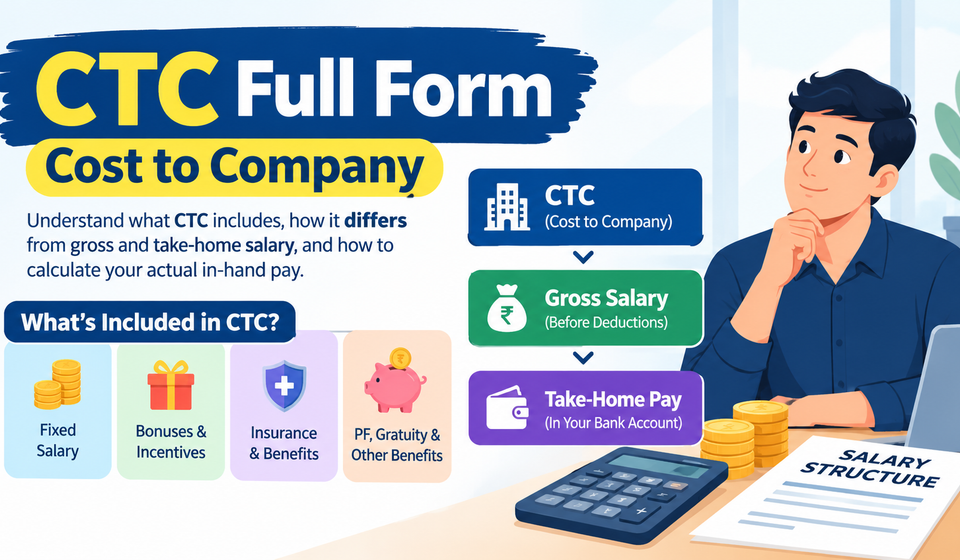

What Is CTC? (Quick Answer)
CTC full form is Cost to Company. It represents the total annual amount a company spends on an employee—including not just the salary you take home, but also employer contributions to provident fund, gratuity, insurance premiums, bonuses, and other benefits. In a typical salary structure, your take-home salary is lower than your CTC because CTC includes components you do not receive as cash in hand.
What Is CTC in Salary?
CTC, or Cost to Company, is the total annual expense an employer incurs to hire, retain, and compensate an employee. When a company offers you a package of, say, ₹12 lakh per annum, that ₹12 lakh is your CTC—not the amount that will appear in your bank account each month.
The term is widely used in job offers, offer letters, and salary negotiations across India. However, many employees—especially freshers—mistakenly assume their CTC is their in-hand salary. Understanding what CTC actually includes is essential for evaluating a job offer accurately and planning your personal finances.
Why Is It Called “Cost to Company”?
The name is literal: from the employer’s perspective, CTC is the cost of having you as an employee. It includes every rupee the company spends on you—whether you receive it directly (like basic salary) or indirectly (like the company’s contribution to your provident fund).
Key Components of CTC
CTC is typically made up of four broad categories:
1. Fixed Salary Components
These are the regular, recurring parts of your compensation:
- Basic Salary: The core, fixed component of your pay. It does not include bonuses or allowances. When you receive a salary hike, it is usually applied to your basic salary.
- House Rent Allowance (HRA): A component meant to cover your accommodation expenses. HRA is partially or wholly tax-free depending on whether you live in a rented house and other conditions.
- Special Allowances: Any amount that does not fall under other categories is classified as special allowance.
- Leave Travel Allowance (LTA) / Leave Travel Concession (LTC): Provided to cover travel expenses during leave. Its inclusion and tax treatment depend on employer policy and applicable tax conditions. Note: LTA/LTC is not a performance-linked component.
- Conveyance Allowance: Some employers provide this to cover work-related travel. Its inclusion and tax treatment depend on the specific salary structure and applicable rules.
- Medical Benefits: Medical reimbursements or health benefits may form part of some salary structures, subject to employer policy and tax regulations. This is not a universal component.
2. Variable Pay and Performance-Linked Components
These are not guaranteed—they depend on performance, company profitability, or other factors:
- Performance Bonuses / Incentives: Quarterly or annual bonuses linked to your performance or company targets.
3. Other Perks and Benefits
- Phone and Internet Allowance: Covers work-related communication expenses.
- Indirect Benefits: Benefits that increase your CTC but not your in-hand salary—for example, an employer-provided vehicle or subsidised loans.
4. Retirement and Statutory Benefits
- Employer’s Provident Fund (EPF) Contribution: Under the standard EPFO framework, the employer contribution is generally 12% of basic wages, dearness allowance, and retaining allowance, where applicable, subject to the applicable rules and wage limits. A portion may be allocated to the Employees’ Pension Scheme (EPS). This money goes into your retirement corpus—you don’t receive it in your monthly salary.
- Gratuity: A lump-sum benefit payable at retirement or upon separation, generally after five years of continuous service, subject to statutory exceptions such as death or disablement. Companies typically set aside around 4.8% of basic pay for gratuity.
- Insurance Premiums: Health and life insurance coverage provided by the employer.
CTC vs Gross Salary vs Take-Home Salary: What’s the Difference?
This is one of the most common sources of confusion. Here’s how these terms compare:
| Term | What It Means | Includes |
|---|---|---|
| CTC (Cost to Company) | Total annual cost to the employer | Gross salary + employer PF + gratuity + insurance + all benefits |
| Gross Salary | Total earnings before any deductions (components vary by payroll structure) | Basic salary + all allowances + employee portion of bonuses |
| Take-Home / Net Salary | What you actually receive in your bank account | Gross salary minus deductions (employee PF, income tax/TDS, professional tax) |
Key insight: In a typical salary structure, CTC is higher than gross salary, while take-home pay is lower after employee deductions.
Fixed CTC vs Variable CTC: What’s the Difference?
A critical distinction that many job seekers overlook is the split between fixed and variable components:
| Category | Definition | Performance-Linked? | Examples |
|---|---|---|---|
| Fixed CTC | Components that are not dependent on performance targets | No | Basic salary, HRA, special allowances, employer PF, gratuity |
| Variable CTC | Components that depend on performance or company results | Yes | Performance bonus, sales incentives, profit-sharing |
Why this matters: If your offer letter says ₹12 lakh CTC with a 20% variable component, your fixed CTC would be ₹9.6 lakh. If targets are not met, your actual earnings will be significantly lower. Always ask for the fixed-variable split before accepting an offer.
Important clarification: “Fixed” in this context means the component is not performance-linked, but it does not necessarily mean it is paid as monthly cash. For example, employer PF and gratuity are part of fixed CTC but are not part of your monthly take-home salary.
What Is Included in Fixed CTC and What Is Actually Paid Monthly?
This table directly answers the most common question job seekers have: “How much of my CTC will actually hit my bank account?”
| Component | Part of CTC? | Usually Paid Monthly as Cash? | Notes |
|---|---|---|---|
| Basic Salary | Yes | Yes | Core cash component |
| House Rent Allowance (HRA) | Yes | Yes | Cash, subject to tax rules |
| Special / Other Allowances | Yes | Yes | Cash |
| Performance Bonus | Yes (if included) | Not necessarily | Usually annual/quarterly, subject to targets |
| Employer PF Contribution | Yes | No | Goes to retirement corpus (EPF/EPS) |
| Gratuity Provision | Often | No | Paid at separation (subject to 5-year rule) |
| Employer Insurance | If included | No | Non-cash benefit |
| Employee PF Contribution | No (it’s a deduction) | No | Subtracted from gross salary, not part of CTC |
How to Calculate CTC: Formula and Exact Example
The Formula
The most straightforward way to express the CTC formula is:
CTC = Gross Salary + Employer Contributions + Employer-Provided Benefits Not Included in Gross Salary
Note: The exact components included in gross salary vary by payroll structure, so the formula serves as a general framework rather than an absolute definition.
Exact Illustrative Example: ₹12,00,000 CTC
Let’s create a precise, mathematically exact example that adds up perfectly:
| Component | Annual Amount | Type (Cash/Non-Cash) |
|---|---|---|
| Basic Salary | ₹6,00,000 | Cash (Fixed) |
| House Rent Allowance (HRA) | ₹2,40,000 | Cash (Fixed) |
| Special / Other Allowances | ₹1,60,000 | Cash (Fixed) |
| Performance Bonus | ₹74,000 | Cash (Variable) |
| Gross Salary (Cash) | ₹10,74,000 | – |
| Employer PF Contribution | ₹72,000 | Non-Cash (Retirement) |
| Gratuity Provision | ₹28,800 | Non-Cash (Retirement) |
| Insurance / Other Benefits | ₹25,200 | Non-Cash (Benefits) |
| Total CTC | ₹12,00,000 | Total Company Cost |
For illustration, this example assumes an employer PF contribution of 12% of the ₹6 lakh basic salary and does not account for wage-ceiling or other EPF-specific variations.
What does this mean for you?
- Your gross salary is ₹10,74,000 per year.
- Your monthly gross salary is ₹10,74,000 / 12 = ₹89,500.
- Your actual taxable income and deductions depend on the applicable tax rules and your individual circumstances.
- The ₹72,000 employer PF, ₹28,800 gratuity, and ₹25,200 insurance are not part of your take-home pay—they go towards your retirement and benefits.
How to Calculate Monthly Take-Home Salary From CTC
Many people assume CTC ÷ 12 = Monthly Salary. That is incorrect. The actual monthly in-hand salary is derived from the Gross Salary minus statutory deductions.
Using the example above:
- Annual Gross Salary = ₹10,74,000
- Monthly Gross Salary = ₹10,74,000 / 12 = ₹89,500
- Applicable Deductions (Illustrative):
- Employee PF (12% of ₹6,00,000 / 12) = ₹6,000
- Professional Tax = Varies by state (e.g., ~₹200/month in many states)
- Income Tax/TDS = Depends on your chosen tax regime (old or new), exemptions claimed, and overall taxable income.
Important note on tax: A ₹12 lakh CTC does not automatically mean ₹12 lakh of taxable income. Depending on the salary structure and other income, a resident individual whose taxable income falls within the applicable ₹12 lakh Section 87A threshold may qualify for the rebate under the new regime for AY 2026–27, subject to applicable conditions.
Final takeaway: Income-tax/TDS depends on the employee’s tax regime and individual circumstances. The final monthly in-hand amount cannot be determined from CTC alone. For an exact estimate, use the official Income Tax Department calculator or consult a qualified tax professional.
What Could Be the CTC for a ₹15,000–₹25,000 Monthly Take-Home Salary? (Illustrative Estimates)
Important disclaimer: These are broad illustrative ranges, not salary-conversion formulas. The actual CTC depends on the employer’s basic-pay ratio, PF structure, variable pay, gratuity, insurance, professional tax, and other benefits. These figures are not official salary benchmarks and should not be used to evaluate a specific job offer.
It is impossible to derive CTC precisely from take-home salary alone without knowing the specific structure. However, for general estimation, here are illustrative ranges based on common Indian salary structures:
| Approx. Monthly Take-Home | Approx. Annual CTC Range | Key Assumption |
|---|---|---|
| ₹15,000 | ₹2.2 – ₹2.6 Lakh | Standard PF structure, minimal variable pay |
| ₹18,000 | ₹2.7 – ₹3.1 Lakh | Standard PF structure, minimal variable pay |
| ₹20,000 | ₹3.0 – ₹3.5 Lakh | Standard PF structure, minimal variable pay |
| ₹25,000 | ₹3.8 – ₹4.5 Lakh | Standard PF structure, possible small variable component |
CTC for Freshers: What to Expect
For freshers entering the job market, CTC figures are highly variable and depend on several factors, including:
- Industry and sector (e.g., IT, banking, manufacturing, startups)
- Company size and reputation
- Location (metro vs. non-metro)
- Specific role and required skills
- Academic qualifications and interview performance
While fresher CTCs broadly span a wide spectrum—generally from around ₹2 lakh to ₹8 lakh per annum across different sectors—these are loose estimates, not definitive benchmarks. Always evaluate the full salary breakup rather than relying on industry averages.
Advice for freshers: Don’t get swayed by a high CTC number alone. Ask these questions before accepting an offer:
- What is the fixed vs variable split?
- What is the basic salary? (This affects your PF and gratuity)
- What is the estimated monthly take-home after all deductions?
Common Misconceptions About CTC
Misconception 1: “CTC = My Monthly Salary × 12”
Reality: CTC is not simply your monthly salary multiplied by 12. CTC includes employer contributions and benefits that you never receive as cash. Your actual annual take-home is lower.
Misconception 2: “Higher CTC Always Means Higher Earnings”
Reality: A high CTC can be misleading if it includes large variable components (which may not be paid) or substantial non-cash benefits. Two offers with the same CTC can have very different take-home salaries depending on the fixed-variable split.
Misconception 3: “CTC Includes Everything I Will Get”
Reality: CTC includes what the company spends on you, not what you receive. Employer PF, gratuity, and insurance premiums are part of CTC but are not paid to you as salary.
Misconception 4: “Gross Salary and CTC Are the Same”
Reality: Gross salary is a subset of CTC. CTC = Gross salary + employer contributions + other benefits.
Factors That Affect Your CTC Structure
Several factors influence how your CTC is structured:
- Company Policy: Each company has its own salary structure and benefits package.
- Industry Norms: Different industries have different standard components (e.g., IT companies often have higher variable pay).
- Role and Level: Senior roles typically have a higher proportion of variable pay and benefits.
- Location: HRA and other allowances may vary based on the city of employment.
- Applicable Laws: Labour laws, including EPFO and Gratuity Acts, affect statutory contributions.
Practical Advice: How to Evaluate a CTC Offer
Before accepting a job offer, take these steps:
- Ask for a detailed salary breakup—not just the CTC number.
- Identify the fixed vs variable components—understand what is not performance-linked.
- Calculate your estimated monthly take-home using the breakup, keeping in mind that tax depends on your personal regime.
- Compare offers on fixed take-home pay, not just CTC. A lower CTC with higher fixed pay may be better for cash flow.
- Understand the retirement benefits—employer PF and gratuity are valuable long-term benefits.
Frequently Asked Questions
1. What is the full form of CTC?
Answer: CTC stands for Cost to Company.
2. Is CTC the same as take-home salary?
Answer: No. In a typical salary structure, take-home salary is lower than CTC because CTC may include employer contributions, benefits, and other non-cash or variable components.
3. What is the difference between CTC and gross salary?
Answer: Gross salary is your total earnings before deductions (basic + allowances + bonuses). CTC includes gross salary plus employer contributions like PF, gratuity, and insurance.
4. What is the difference between fixed CTC and variable CTC?
Answer: Fixed CTC comprises components that are not dependent on performance (basic, HRA, PF). Variable CTC depends on performance (bonuses, incentives). Variable pay is not guaranteed.
5. How can I calculate my monthly in-hand salary from CTC?
Answer: Divide your annual gross salary by 12, then subtract employee PF contributions, professional tax, and income tax (TDS). CTC/12 is not your in-hand salary. Your final tax depends on your chosen regime and personal circumstances.
6. Does CTC include PF?
Answer: Yes. The employer’s contribution to your Provident Fund (subject to EPFO rules on basic wages) is included in your CTC.
7. What is CTC for freshers?
Answer: CTC for freshers varies significantly by industry, company, location, and role. Instead of relying on fixed averages, always evaluate the specific offer breakup.
8. Why is my take-home salary less than my CTC?
Answer: Because CTC includes non-cash components (employer PF, gratuity, insurance) and your gross salary is reduced by deductions like your own PF contribution, income tax, and professional tax.
Written by: Sachin
Role: Shourya Singh
Published: September 2026
Last Updated: September 2026
Note: For live publication, author details should reflect a real, verifiable individual. If this is a placeholder, please replace with your actual author’s credentials.
Sources and References
- Employees’ Provident Fund Organisation (EPFO): Standard contribution rates and wage ceilings.
- Ministry of Labour & Employment, Government of India: Payment of Gratuity Act, 1972 (general five-year rule and statutory exceptions).
- Income Tax Department, Government of India: TDS provisions, Section 87A rebate, and applicable tax regimes for AY 2026–27.
- Kotak Bank. “CTC Full Form: What It Means & How It Affects Your Home Loan.” Kotak Bank Stories in Focus.
- CAclubindia. “CTC Full Form in Salary: Is It Same as Gross Salary?” LinkedIn.
- ClearTax. “CTC in Salary: Full Form, Meaning, Structure, Examples, How to Calculate?”
Disclaimer: The figures and estimates provided in this article are for illustrative and educational purposes only. Actual CTC structures, deductions, and take-home salaries vary by company, industry, role, location, and applicable laws. Always refer to your official offer letter and consult a qualified financial or tax advisor for personalized advice.
Read More: LPA Full Form: Meaning, Calculation & What It Really Means for Your Salary


-
-
-
-
-
-
-
-
-
-
-
-
-
Show Comments[…] many items are part of your CTC, they are excluded from your gross salary because they are either employer-side costs or […]
[…] LPA CTC ≠ ₹2 LPA cash salary. The cash you receive will always be less than the CTC figure because employer contributions (like PF and gratuity) are included in CTC but do not come to […]
[…] Read More: CTC Full Form: What Is Cost to Company and What Does It Mean for Your Salary? […]
[…] Read More: CTC Full Form: What Is Cost to Company and What Does It Mean for Your Salary? […]
[…] is a realistic salary structure for a ₹5 LPA CTC package. Basic salary is set at 40% of CTC — a common structure in many private […]
[…] Cabin crew salary cannot be converted from CTC to exact in-hand pay without knowing the airline’s salary structure, allowances and […]
[…] cited an average starting package of ₹12–13 LPA for the programme. The reported average CTC for this drive stands at ₹13.41 LPA, with the highest domestic offer at ₹27.50 LPA from Capital […]
[…] pay-scale starting basic (₹48,480), the four advance increments, the pay scale, and the Mumbai CTC (₹21.97 lakh) are confirmed in the official SBI PO 2026 notification. Monthly gross and in-hand […]
[…] the employer structures employer PF, gratuity, variable pay, professional tax and other components. CTC is not a standardized salary […]
[…] after typical deductions (PF, professional tax). Actual take-home depends on your employer’s CTC structure, tax regime, and location. Government roles may include benefits that increase total […]
[…] CTC vs Gross vs Net vs In-Hand Salary can help you estimate how much of your salary actually reaches […]
[…] includes employer PF, gratuity, and variable pay, which are not paid out monthly. See our guide on CTC full form and gross salary meaning for the full […]
[…] Annual figures are approximate conversions and should not be interpreted as guaranteed CTC or in-hand salary. These ranges are compiled from employee-reported data on AmbitionBox and […]