
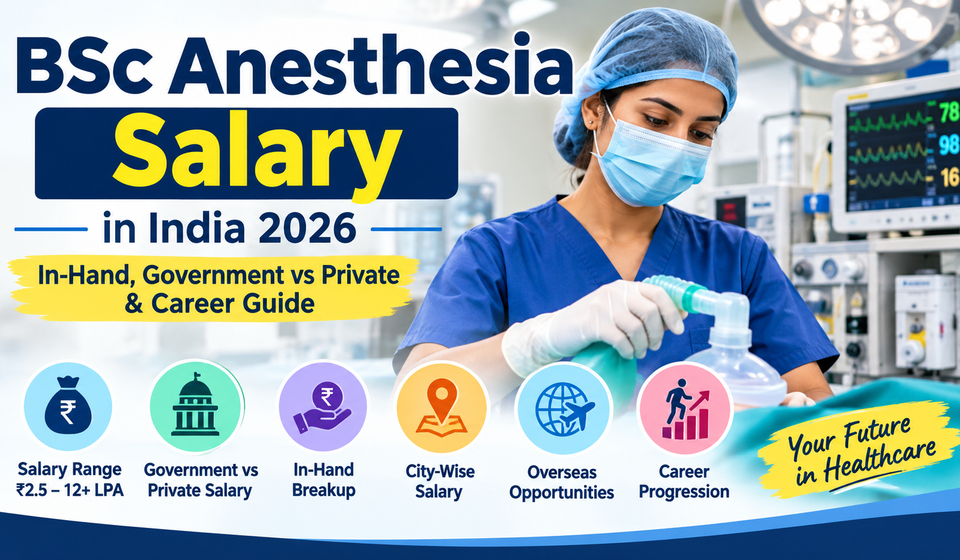
BSc Anesthesia Salary in India 2026: Government vs Private, In-Hand Breakup & Career Guide

Published: September 2026 | Last Updated: September 2026
Author: Sachin
Fact-Checked By: SalaryPoint Research Desk
Quick Answer: BSc Anesthesia Salary
A BSc Anesthesia graduate in India commonly reports earning between ₹2.5 lakh and ₹4.5 lakh per annum as a fresher, based on aggregated employee-reported data and job listings. With 3–7 years of experience, this rises to ₹5–7.5 LPA. At the senior end — typically 8+ years with specialized skills — some professionals report earning ₹8–12 LPA or more, though this is an experienced/senior-level estimate and not a typical salary for most graduates in this field.
The actual monthly in-hand salary is lower than the CTC divided by 12, because CTC includes employer PF contributions, gratuity, and other components that are not paid out monthly. For an illustrative ₹4 LPA CTC, the monthly in-hand salary is approximately ₹29,000 after PF, professional tax, and other deductions — though this varies significantly depending on the employer’s salary structure.
Government and private hospitals follow different compensation structures. Regular government posts may offer 7th CPC pay scales and applicable allowances, while private hospital salaries vary substantially by employer, city, contract type, and experience.
Important clarification: Salary depends on the exact degree title and the specific job recruited for. BSc Anesthesia Technology and BSc Anesthesia & Operation Theatre Technology overlap in some career paths, but they should not automatically be treated as identical qualifications. Some institutions offer a 3-year BSc Anesthesia Technology programme, while others offer a 4-year BSc Anesthesia & Operation Theatre Technology programme. Government recruitment notifications, including those from AIIMS, list both qualifications as acceptable for certain posts. Employers may recruit for either qualification depending on the role.
What Does “BSc Anesthesia Salary” Actually Mean?
When people search for “BSc Anesthesia salary,” they are usually looking for one of three things:
- CTC (Cost to Company) — The total annual package the employer spends on you, including employer PF, gratuity, and insurance.
- Gross Salary — CTC minus employer PF and gratuity. This is your salary before tax and employee deductions.
- In-Hand Salary — The amount actually credited to your bank account each month after all deductions.
These three numbers are very different. An article that says “BSc Anesthesia salary is ₹4 LPA” is usually referring to CTC. This guide breaks down all three so you know exactly what to expect.
BSc Anesthesia Salary by Experience Level
The following table shows annual CTC ranges based on experience. These figures are compiled from multiple sources including employee-reported salary data on AmbitionBox and Glassdoor, job listings, and salary survey reports.
Source Legend:
- Official — Government pay matrix, recruitment notifications
- Employee-Reported — Aggregated data from AmbitionBox, Glassdoor
- Industry Estimate — Salary survey reports, job market analysis
- Illustrative — Calculated example based on stated assumptions
| Experience Level | Annual CTC Range | Data Basis |
|---|---|---|
| Fresher (0–2 years) | ₹2.5 – ₹4.5 LPA | Employee-Reported + Job Listings |
| Mid-level (3–7 years) | ₹5 – ₹7.5 LPA | Employee-Reported + Industry Estimate |
| Senior (8–10 years) | ₹8 – ₹10 LPA | Industry Estimate (Senior-End) |
| Expert (10+ years) | ₹12+ LPA | Industry Estimate (Senior-End) |
Sources: AmbitionBox employee-reported data for hospitals such as Cloudnine (₹3.2–3.5 LPA) and Fortis Healthcare (₹3.5–3.9 LPA); Careers360 salary data for BSc Anesthesia; aggregated job listings for 2025–2026. The ₹8–12+ LPA figures represent senior-end estimates for experienced professionals with specialized skills and should not be interpreted as typical salaries for most graduates.
What Freshers Actually Earn
Employee-reported salary data from AmbitionBox and Glassdoor shows that anesthesia technologists in Indian hospitals typically earn between ₹20,000 and ₹30,000 per month in the early years. A ₹25,000 monthly salary translates to approximately ₹3 LPA CTC.
Some specific examples from employee-reported data:
- Cloudnine Hospital: ₹3.2–3.5 LPA (1–5 years experience)
- Fortis Healthcare, Bengaluru: ₹3.5–3.9 LPA (3–6 years experience)
- MIOT International: ₹2.0–2.4 LPA (3 years experience)
These are employee-reported figures and may not represent all employers or cities.
Read More: VAO Salary / ICDS Supervisor Salary / Para SF Commando Salary / Ajit Doval Salary
Government vs Private Hospital Salary
One of the most common questions is whether government or private hospitals pay more. The answer depends on the specific post, pay level, and stage of your career. Government salaries follow the 7th CPC pay matrix, while private salaries vary widely by employer, city, and contract type.
| Sector | Indicative Monthly Starting Salary | Data Basis |
|---|---|---|
| Government (7th CPC posts) | ₹25,000 – ₹47,000+ (varies by pay level) | Official pay matrix + illustrative calculation |
| Government (contractual) | ₹18,000 – ₹30,000 | Employee-reported + job listings |
| Private hospitals | ₹15,000 – ₹28,000 (fresher) | Employee-reported + job listings |
Government starting salaries vary substantially depending on the specific post and pay level. Regular 7th CPC posts at Level 5 have an illustrative in-hand of approximately ₹46,000 per month, while contractual positions may start significantly lower. Private hospital salaries vary by employer, city, and contract type. These ranges are indicative estimates based on available data.
Government Hospital Salary — Pay Matrix Basis
Recent government recruitment notifications show anesthesia-related technician and technologist posts at different 7th CPC levels, including Levels 4, 5, and 6, depending on the post and recruiting institution. The following figures are drawn from official government pay matrix sources and recruitment notifications:
| Pay Level | Basic Pay (7th CPC) | Typical Posts |
|---|---|---|
| Level 4 | ₹25,500 – ₹81,100 | Anaesthesia Technician |
| Level 5 | ₹29,200 – ₹92,300 | Anaesthesia Technical Assistant / OT Assistant |
| Level 6 | ₹35,400 – ₹1,12,400 | Neuroanaesthesia Technologist |
Sources: 7th CPC Pay Matrix — Official Gazette notification mapping pre-revised pay scales to 7th CPC Pay Levels. AIIMS Office Memorandum dated 31 July 2023 confirms Operation Theatre Assistant at Level-5, with B.Sc (Anesthesia & Operation Theatre Technologist) and B.Sc (OT Technology/B.Sc (Anesthesia Technology) listed as essential qualifications. NIMHANS Recruitment 2026 lists Neuroanaesthesia Technologist at Level-6 with an initial basic pay of ₹35,400 per month.
Level 5 example calculation (illustrative):
| Component | Monthly Amount |
|---|---|
| Basic Pay (Level 5 entry) | ₹29,200 |
| DA (approx. 50% of Basic) | ₹14,600 |
| HRA (approx. 18% of Basic for Y-class city) | ₹5,256 |
| Transport Allowance | ₹1,800 |
| Gross Salary | ₹50,856 |
| NPS Deduction (10% of Basic + DA) | ₹4,380 |
| Professional Tax | ₹200 |
| Approximate In-Hand Salary | ₹46,276 |
This is an illustrative calculation based on a Level 5 entry. Actual DA rates, HRA percentages (which vary by city classification: X = 27%, Y = 18%, Z = 9%), and other allowances are subject to periodic revision by the government. The illustrative in-hand figure is approximately ₹46,300 per month under the assumptions above. Actual take-home can differ materially based on posting location, applicable DA/HRA rates, transport allowance, and deductions.
In-Hand Salary Breakup: What an Illustrative ₹4 LPA CTC Actually Means
This is the most important section for anyone planning their finances. Below is an illustrative example for a ₹4 LPA CTC. It is not a universal calculation — actual in-hand salary depends on the employer’s specific salary structure, city, and applicable deductions.
Assumptions for This Example
- Basic Salary: 40% of CTC = ₹1,60,000/year (₹13,333/month)
- HRA: 20% of Basic = ₹32,000/year (₹2,667/month)
- Special Allowance: ₹1,48,000/year (₹12,333/month)
- Employer PF: 12% of Basic = ₹19,200/year (₹1,600/month)
- Gratuity: 4.81% of Basic = ₹7,696/year (₹641/month)
- Gross Salary: CTC − Employer PF − Gratuity = ₹3,73,104/year (₹31,092/month)
Monthly Deductions
| Component | Monthly Amount |
|---|---|
| Employee PF (12% of Basic) | ₹1,600 |
| Professional Tax | ₹200 |
| Illustrative TDS assumption | ₹0 |
| Total Deductions | ₹1,800 |
TDS depends on the individual’s total income, tax regime, and applicable deductions. The ₹0 figure is an assumption for this illustrative example only and is not a universal rule.
Monthly In-Hand Salary
₹31,092 − ₹1,800 = ₹29,292 per month
Annual Take-Home: ₹3,51,504
This is approximately ₹29,300 per month — not ₹33,333, which is what ₹4 LPA divided by 12 would suggest. The difference of over ₹4,000 per month comes from employer PF, gratuity, and deductions.
Illustrative Salary Structure: CTC to In-Hand
The following table uses the same illustrative salary structure throughout. These examples are intended only to show how CTC can translate into gross and take-home pay. Actual salary structures differ by employer, and in-hand figures may be higher or lower.
| Annual CTC | Approx. Monthly Gross | Approx. Monthly In-Hand* |
|---|---|---|
| ₹2.5 LPA | ₹19,500 | ₹18,000 |
| ₹3 LPA | ₹23,500 | ₹21,500 |
| ₹4 LPA | ₹31,100 | ₹29,000 |
| ₹5 LPA | ₹39,000 | ₹36,000 |
| ₹6 LPA | ₹46,800 | ₹43,000 |
*Illustrative estimates only. These examples use the same salary structure throughout; actual in-hand figures vary by employer.
City-Wise Salary Comparison
Salaries for BSc Anesthesia professionals vary significantly by city, reflecting differences in cost of living, hospital density, and demand. The following ranges are indicative estimates based on employee-reported data and job listings.
| City | Fresher Salary Range | Experienced Salary Range |
|---|---|---|
| Bengaluru | ₹2.5 – 4.5 LPA | ₹5 – 10 LPA |
| Delhi NCR | ₹2.5 – 4.5 LPA | ₹5 – 10+ LPA |
| Mumbai | ₹2.5 – 4.5 LPA | ₹5 – 9+ LPA |
| Hyderabad | ₹2.2 – 4 LPA | ₹4.5 – 9+ LPA |
| Chennai | ₹2.5 – 4 LPA | ₹4.5 – 8+ LPA |
| Pune | ₹2.5 – 4 LPA | ₹4.5 – 8+ LPA |
| Tier-2 cities | ₹1.8 – 3 LPA | ₹3 – 6 LPA |
Sources: Aggregated from job listings, employee-reported salary data, and salary survey reports for 2025–2026. These are indicative ranges, not official figures. The ₹10+ LPA figures represent senior-end estimates for experienced professionals in metro cities.
Important consideration: When comparing offers, consider rent, transport, food, and other living expenses in addition to CTC.
Overseas Opportunities: A Carefully Qualified Overview
Indian BSc Anesthesia graduates may explore overseas opportunities, but anesthesia roles are regulated differently in each country. The pathways below are general overviews and should not be treated as equivalent to an Indian BSc Anesthesia Technology qualification. Readers should verify current requirements directly with the relevant regulatory authority.
UAE
Role: Anesthesia Technologist / Technician
Regulatory Body: Dubai Health Authority (DHA), Ministry of Health (MOH), or Department of Health – Abu Dhabi (DOH)
Applicants typically need a Bachelor’s degree in Anesthesia Technology (or an equivalent qualification), plus two years of post-qualification experience. The DHA licensing process involves DataFlow primary source verification, a computer-based exam, and a valid professional license from the home country. Monthly salaries for anesthesia technicians in Dubai job listings typically range from AED 4,000 to AED 7,000.
United Kingdom (NHS)
Role: Operating Department Practitioner (ODP) / Anaesthetic Practitioner
Regulatory Body: Health and Care Professions Council (HCPC)
Internationally qualified professionals must apply through the HCPC international route. NHS Band 5 Anaesthetic Practitioners currently earn £32,073 to £39,043 per annum. Salaries are set under the Agenda for Change pay system and are subject to annual review.
Canada and Australia
Anesthesia Assistant roles in Canada typically require completion of an accredited certification programme, which may not be directly equivalent to an Indian BSc qualification. In Australia, Anaesthesia Technicians are classified as an unregulated profession; no formal registration is required, though some institutions may require voluntary membership with AAAHP.
Important note: Overseas opportunities exist, but licensing processes can take 6–18 months and involve significant costs. Each country’s regulatory pathway should be verified with the relevant authority before making relocation decisions.
Read More: SBI PO Salary / Commercial Pilot Salary / Pashu Paricharak Salary / Anjana Om Kashyap Salary
Career Progression and Higher Education
A BSc Anesthesia degree offers pathways for advancement through experience and additional qualifications.
Job Roles and Indicative Salary Progression
| Job Role | Indicative Salary Range |
|---|---|
| Anesthesia Technician | ₹2 – 4 LPA (entry) |
| Senior Anesthesia Technologist | ₹4 – 8 LPA |
| Chief OT Technician | ₹5 – 9 LPA |
| OT Manager / Supervisor | ₹6 – 10 LPA |
| Anesthesia Assistant | ₹4 – 7 LPA |
Indicative ranges based on employee-reported data and industry estimates. Actual figures vary by employer, city, and experience.
Higher Education Options
- MSc in Anesthesia Technology — may qualify candidates for senior technologist and teaching roles
- MBA in Healthcare Management — can open pathways to hospital administration and OT management
- Certifications — BLS, ACLS, PALS, and specialized training in cardiac, neuro, or pediatric anesthesia
- NCAHP Registration — The National Commission for Allied and Healthcare Professions (NCAHP) Act, 2021 provides a registration framework for allied health professionals. The NCAHP officially classifies “Anaesthesia Assistants and Technologists” and “Operation Theatre (OT) Technologists” under the category of “Surgical and Anesthesia related technology”.
Government Job Pathways
Government hospitals and institutions like AIIMS, JIPMER, NIMHANS, and state health departments recruit BSc Anesthesia graduates through direct recruitment. Pay scales follow the 7th CPC matrix, with promotions through departmental channels. Eligible government positions may provide structured benefits and retirement provisions, though the specific benefits depend on the post and recruiting authority.
Factors That Affect Your Actual Salary
The salary ranges in this article are indicative. Your actual offer will depend on:
- Hospital reputation — Corporate hospitals may offer different compensation than smaller nursing homes
- City — Metro cities may offer higher salaries, though living costs are also higher
- Specialization — Cardiac, neuro, and transplant anesthesia roles may pay differently than general anesthesia
- Certifications — Additional certifications may increase your value to employers
- Negotiation — The initial offer is not always final
- Shift work — Night shifts and emergency duties may come with shift differentials
- Sector — Government and private roles have different compensation structures and career conditions
Is BSc Anesthesia a Good Career Choice?
This depends on individual goals and circumstances. Here is a balanced assessment:
Potential advantages:
- Many surgical procedures require anesthesia support, creating consistent demand
- The course duration is shorter than MBBS
- Working hours vary by employer, role, and shift requirements
- Overseas opportunities may exist for those willing to meet licensing requirements
- Eligible government positions may provide structured benefits and retirement provisions
Potential limitations:
- Starting salaries are modest (₹2.5–4.5 LPA)
- Growth may be slower than MBBS or nursing in some settings
- Rotational shifts and emergency duties may be required
- Private sector job security varies
- This is a technologist role, not a physician role — it does not lead to becoming a doctor
If your goal is to work in healthcare and support anesthesia and surgical procedures, BSc Anesthesia provides a specialized allied-health pathway. If your goal is to become a doctor, you need to pursue MBBS.
FAQs
1. What is the starting salary of a BSc Anesthesia graduate in India?
Answer: Freshers commonly report CTCs of ₹2.5–4.5 LPA, based on employee-reported data and job listings. Monthly take-home pay can vary considerably depending on the salary structure, deductions, and employer. The exact figure depends on the city, hospital type, and negotiation.
2. Is BSc Anesthesia salary higher in government or private hospitals?
Answer: It depends on the specific post and pay level. Government 7th CPC posts offer structured pay scales with DA, HRA, and retirement benefits. Private hospitals can offer competitive starting salaries, but pay varies substantially by hospital, city, contract type, and experience. The better choice depends on your priorities.
3. What is the in-hand salary for ₹4 LPA CTC in BSc Anesthesia?
Answer: Approximately ₹29,000 per month in the illustrative example above. However, this depends entirely on the employer’s salary structure. The actual in-hand salary could be higher or lower depending on basic salary percentage, PF contributions, and applicable deductions.
4. Can BSc Anesthesia graduates work abroad?
Answer: Overseas opportunities exist, but each country has different regulatory requirements. UAE, UK, Canada, and Australia all have demand for anesthesia professionals, but licensing processes and qualification recognition vary. Verification with the relevant regulatory authority is essential.
5. Which is better: BSc Anesthesia or GNM?
Answer: Starting salaries vary by employer, location, and qualification. BSc Anesthesia is more specialized toward anesthesia and operating-theatre settings, while GNM provides a broader nursing pathway. According to employee-reported data on AmbitionBox, GNM Nurses in India typically earn ₹2.7–3.1 LPA on average.
6. Can I do BSc Anesthesia after 12th?
Answer: Yes. You generally need at least 45% in 10+2 with Physics, Chemistry, and Biology (40% for SC/ST). Admission requirements vary by institution and may involve merit or entrance exams.
Final Takeaway
BSc Anesthesia is a specialized healthcare career with salaries ranging from approximately ₹2.5 LPA for freshers to ₹12+ LPA for senior professionals at the experienced end, based on aggregated employee-reported and industry data. The main factors that can influence your salary include:
- Sector — private and government roles have different compensation structures and career conditions
- Specialization — cardiac, neuro, and transplant anesthesia may offer different pay scales
- Overseas opportunities — UAE, UK, Canada, and Australia have different regulatory pathways
- Understanding your CTC — always calculate in-hand salary, not just the annual package
- Negotiation — the first offer is rarely the final offer
With relevant clinical experience, additional certifications, and suitable qualifications, professionals can build a longer-term career in anesthesia technology.
Disclaimer: Salary figures in this article are indicative ranges based on employee-reported data (AmbitionBox, Glassdoor), job listings, government recruitment notifications, and industry reports for 2025–2026. Actual compensation varies by employer, city, experience, and negotiation. Government pay scales are subject to revision through Pay Commission recommendations. Overseas salary and licensing information is a general overview and should be verified with the relevant regulatory authority. This article does not constitute personalized financial or career advice.
Internal Link Opportunities:



[…] More: BSc Anesthesia Salary / VAO Salary / ICDS Supervisor Salary / Para SF Commando […]
[…] Read More: Army Public School Teacher Salary / BSc Forensic Science Salary / GP Rating Salary / BSc Anesthesia Salary […]