
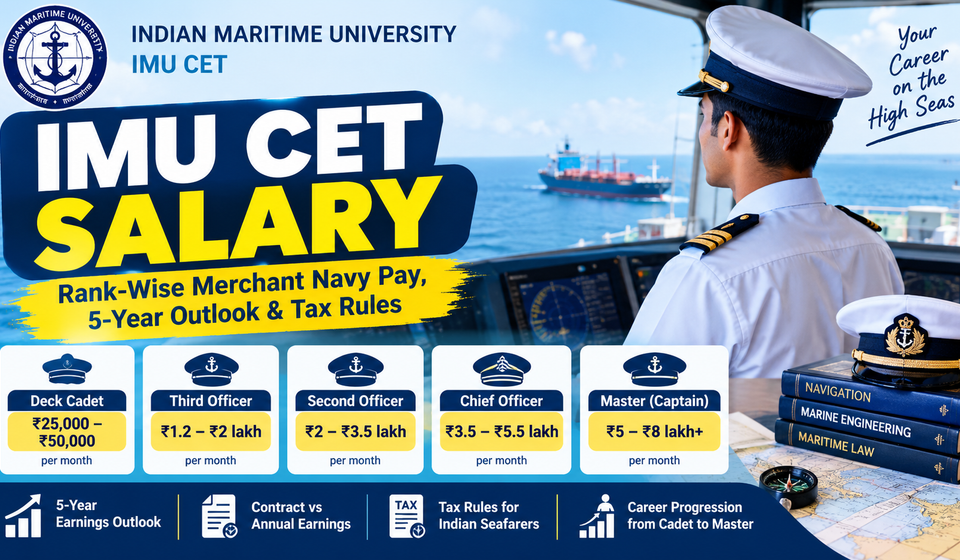
IMU CET Salary 2026: Rank-Wise Merchant Navy Pay, 5-Year Outlook & Tax Rules

Editorial Trust Box
Salary Data Checked: 8 October 2026
Last Updated: 8 October 2026
Primary Salary Source: Directorate General of Maritime Administration (DGMA), Government of India
Admission Source: Indian Maritime University 2026–27 Prospectus
Tax Source: Income Tax Department / CBDT Circular No. 13/2017
Salary Type: Indicative contract/stipend figures. Actual pay varies by employer, vessel type, flag state, and contract terms.
Review Frequency: Salary and regulatory information should be rechecked when DGMA, IMU or tax authorities publish new rules or figures.
After following the IMU-CET nautical officer pathway, a Deck Cadet may earn an indicative ₹25,000–₹50,000 per month during training, a Third Officer earns ₹1.2–₹2 lakh per month, and a Master (Captain) earns ₹5–₹8 lakh or more per month , according to the Directorate General of Maritime Administration (DGMA), Government of India. These are indicative figures and actual contracts vary considerably by company, vessel type, and flag state.
This guide uses DGMA figures as the primary benchmark, answers the 5-year salary question, explains why a monthly shipboard salary is not the same as annual earnings, clarifies the actual tax position for Indian seafarers, and provides an honest look at placement and career progression.
Quick Answer: IMU CET Salary at a Glance
| Rank | Indicative Monthly Contract Pay (DGMA) | Pay Type |
|---|---|---|
| Deck Cadet | ₹25,000 – ₹50,000 | Cadet training stipend |
| Third Officer | ₹1.2 – ₹2 lakh | Officer contract pay |
| Second Officer | ₹2 – ₹3.5 lakh | Officer contract pay |
| Chief Officer | ₹3.5 – ₹5.5 lakh | Senior officer contract pay |
| Master (Captain) | ₹5 – ₹8 lakh+ | Master-level contract pay |
| Senior Master | ₹8 – ₹10 lakh+ | Senior Master-level contract pay |
Source: DGMA Nautical Officer Career — Your Voyage to the Bridge .
Critical caveat: A precise in-hand salary figure cannot be calculated without knowing the specific contract terms. Actual in-hand depends on contract structure, tax residency, company deductions, insurance, provident fund arrangements, and whether the officer is in an onboard or paid-leave period. There is no single “in-hand salary” for a rank — only ranges that vary by employer.
What Is IMU CET?
IMU CET (Indian Maritime University Common Entrance Test) is the entrance examination for admission to specific maritime programmes at Indian Maritime University and DGS-approved institutes. The IMU 2026–27 prospectus confirms that IMU-CET rank is compulsory for B.Sc (Nautical Science), B.Tech (Marine Engineering), B.Tech (Naval Architecture & Ocean Engineering), B.Tech (Naval Architecture & Ship Building), and DNS (Diploma in Nautical Science) programmes.
Important distinction: For the salary progression described in this article — Deck Cadet → Third Officer → Second Officer → Chief Officer → Master — the relevant courses are B.Sc Nautical Science (3 years) and DNS (1 year) . These are the deck officer pathways.
B.Tech Marine Engineering (4 years) follows the engine officer route: Junior Engineer → Fourth Engineer → Third Engineer → Second Engineer → Chief Engineer.
Naval Architecture & Ocean Engineering and Naval Architecture & Ship Building programmes lead to different maritime engineering and shore-based careers and do not follow the deck officer progression to Master. The salary figures in this article apply primarily to the nautical/deck officer career path unless otherwise stated.
ETO distinction: Electro Technical Officer (ETO) admission does not require IMU CET. ETO is a separate pathway regulated under DG Shipping, open to candidates with a degree or diploma in Electrical/Electronics Engineering. The ETO pathway involves a 4-month pre-sea course and is distinct from the IMU-CET deck officer route.
IMU CET Salary After 5 Years
There is no fixed five-year salary after IMU CET because career progression depends on sea time, certification, examinations and employer promotion. However, based on DGMA’s published rank-wise benchmarks, a seafarer who has accumulated sufficient sea service and cleared competency examinations within five years may be at the Second Officer level and, in faster progression cases, may reach Chief Officer level .
| Scenario | Rank at ~5 Years | DGMA Indicative Monthly Pay | Pay Type |
|---|---|---|---|
| Standard progression | Second Officer | ₹2 – ₹3.5 lakh | Officer contract pay |
| Accelerated progression | Chief Officer | ₹3.5 – ₹5.5 lakh | Senior officer contract pay |
A seafarer who reaches the Second Officer level is within the DGMA indicative range of ₹2–₹3.5 lakh per month, while a Chief Officer is listed at ₹3.5–₹5.5 lakh per month . These are rank-based contract figures, not guaranteed five-year earnings.
What determines where you land at 5 years:
- Sea time accumulated: Continuous sea time is the biggest factor. The Master (FG) examination requires 36 months of approved sea service as an Officer of Watch, including at least 12 months as Chief Officer . Officers who accumulate sea time faster progress faster.
- Competency examination performance: Each rank requires clearing specific CoC examinations. Officers who pass exams first attempt progress 1–2 years faster than those who take multiple attempts .
- Employer promotion policy: Shipping companies have their own promotion cycles and vacancy availability.
- Contract duration and joining gaps: More continuous sailing means faster sea time accumulation. Long gaps between contracts delay progression .
Important: These figures represent monthly contract pay, not 12-month annual salary. A Second Officer earning ₹2.5 lakh/month on a 6-month contract earns ₹15 lakh for that contract period, not ₹30 lakh annually. See the contract vs annual salary section below.
Why Monthly Shipboard Pay Is Not the Same as Annual Salary
A common error in merchant navy salary content is multiplying the monthly shipboard salary by 12 to arrive at an “annual salary.” This is misleading.
Merchant navy officers are generally paid under employment contracts whose duration and leave-pay arrangements vary by company, vessel and contract terms. Therefore, monthly onboard pay should not automatically be treated as 12 months of guaranteed annual income.
| Common Error | Correct Approach |
|---|---|
| “₹1–3 lakh/month → ₹12–36 lakh/year” | A 9-month contract at ₹2 lakh/month = ₹18 lakh for that contract period, not ₹24 lakh |
| “₹6–10 lakh/month → ₹72 lakh–₹1.2 crore/year” | A Master on a 6-month contract at ₹7 lakh/month earns ₹42 lakh for that contract, not ₹84 lakh |
Key point: When you see a monthly salary, look at the contract length, not 12 months. Then factor in leave pay terms, if applicable, and any joining gaps between contracts. Actual annual earnings depend on contract duration, paid/unpaid leave, joining gaps and company terms.
Read More: Eurasian CEO Salary / Electro Technical Officer Salary / WB Primary Teacher Salary / UPNL Salary
IMU CET Salary for Freshers: What You Actually Earn as a Cadet
The first money a merchant navy officer receives is a cadet stipend during sea training, not a full officer salary. The DGMA benchmark for a Deck Cadet is ₹25,000–₹50,000 per month .
| Stage | Duration | Monthly Pay |
|---|---|---|
| Pre-sea training (DNS route) | 1 year | No salary; course fees apply |
| Pre-sea training (B.Sc NS route) | 3 years | No salary; course fees apply |
| Sea training as cadet | 12–18 months | ₹25,000 – ₹50,000 (DGMA benchmark) |
| After Certificate of Competency | — | Officer salary begins (Third Officer scale) |
Source: DGMA Nautical Officer Career — Entry Pathways .
The Complete Career Progression: From IMU CET to Master
The path from IMU CET to a senior officer rank is structured and governed by official sea-time requirements and competency examinations. Understanding this progression is essential before evaluating any salary figure.
IMU CET → IMU/DGS-approved course → Pre-sea training → Sea-time as cadet → Certificate of Competency (CoC) examination → Junior Officer → Senior Officer → Master
Course-Specific Entry Requirements
| Criterion | DNS | B.Sc Nautical Science |
|---|---|---|
| Pre-sea training | 1 year | 3 years |
| Sea time required | 18 months | 12 months |
| Age limit | 17–21 years | 17–25 years |
| PCM aggregate | 60% | 60% |
| English | 50% in 10th or 12th | 50% in 10th or 12th |
| Marital status | Unmarried | Unmarried |
| Sponsorship | Mandatory | Not mandatory at admission |
| Vision | As per DGS/IMU medical standards for the relevant programme | As per DGS/IMU medical standards for the relevant programme |
Source: DGMA Nautical Officer Career — Choose Your Entry Pathway; IMU Prospectus . Sea-time requirements for DNS: 18 months structured sea service for Second Mate (FG) eligibility . B.Sc Nautical Science: 12 months seagoing service including 6 months supervised bridge watchkeeping .
Official Sea-Time Requirements for Promotion
| Rank Progression | Minimum Sea Service Required |
|---|---|
| Deck Cadet (DNS route) → Second Mate (FG) | 18 months of structured cadet sea service with approved TRB |
| Deck Cadet (B.Sc NS route) → Second Mate (FG) | 12 months seagoing service including 6 months supervised bridge watchkeeping |
| Second Mate (FG) → Chief Mate (FG) | 18 months of approved watchkeeping sea service as OOW |
| Chief Mate (FG) → Master (FG) | 36 months sea service as OOW, including at least 12 months as Chief Officer |
Source: M.S. Notice 12 of 2005 (DNS cadet sea-time); M.S. Notice 8 of 2008 (B.Sc NS sea-time); DGMA career pathway — Chief Mate and Master requirements. These are minimum regulatory requirements, not guaranteed timelines.
Indicative Salary by Rank
| Rank | Indicative Monthly Pay (DGMA) |
|---|---|
| Deck Cadet | ₹25,000 – ₹50,000 |
| Third Officer | ₹1.2 – ₹2 lakh |
| Second Officer | ₹2 – ₹3.5 lakh |
| Chief Officer | ₹3.5 – ₹5.5 lakh |
| Master | ₹5 – ₹8 lakh+ |
| Senior Master | ₹8 – ₹10 lakh+ |
Source: DGMA Nautical Officer Career — Indicative Monthly Salary Progression .
Note: Promotion depends on sea time completion, competency examination success, and employer requirements. The sea-time requirements above are minimum regulatory requirements, not guaranteed timelines.
Tax Treatment: What Indian Seafarers Actually Pay
The claim that merchant navy income is “tax-free” is not legally accurate as a blanket statement. The correct position is more nuanced.
Under Section 6 of the Income-tax Act, 2025 — which came into force on 1 April 2026, replacing the Income-tax Act, 1961 — the residential status rules for seafarers continue without substantive change. A citizen of India who leaves India for employment outside India or as a crew member of an Indian ship is treated as a resident only if their stay in India is 182 days or more during the relevant tax year. The alternative 60-day + 365-day test does not apply to this category .
For an Indian-citizen seafarer who qualifies as non-resident, remuneration attributable to services actually rendered outside India on a foreign-going ship is ordinarily outside the scope of Indian total income. The legal basis is the restricted scope of a non-resident’s total income under the Income-tax Act, 2025, read with the salary source rules.
CBDT Circular No. 13/2017 specifically clarifies that salary accrued to a non-resident seafarer for services rendered outside India on a foreign-going ship — whether Indian-flag or foreign-flag — is not included in total income merely because it is credited to the seafarer’s NRE account maintained with an Indian bank .
| Claim | Actual Position |
|---|---|
| “Merchant navy salary is tax-free” | Not a statutory exemption under Section 10. Income is outside scope because of residential status + place of service. |
| “Fewer than 182 days in India = tax-free” | Being non-resident is necessary but not sufficient. The salary must also be for services rendered outside India on a foreign-going ship. |
| “NRE account credit means taxable in India” | CBDT Circular 13/2017 clarifies that salary credited to an NRE account is not automatically taxable merely because it is credited in India . |
Correct framing:
Indian seafarers who qualify as non-residents and whose salary is attributable to services rendered outside India on a foreign-going ship may have that income outside the scope of Indian taxable income. This depends on residential status, the place where services are rendered, the vessel and contract arrangement, and applicable tax rules. Consult a tax professional for personalised advice.
IMU CET Placement 2026: What Can Actually Be Verified
IMU campuses do not publish comprehensive official placement statistics on their websites. Third-party sources report placement rates in the range of 90–95% for B.Tech Marine Engineering cadets, but this figure is not confirmed by the university itself and varies by batch and whether students have cleared all backlog papers.
A DGMA speech at an IMU Kolkata passing-out ceremony referenced a specific batch where 89% of 240 cadets had been placed, while placement results were still awaited from some maritime agencies. This is a verified government-source figure for one specific batch — not a universal placement rate.
| What to Avoid | What to Use Instead |
|---|---|
| “IMU campuses report 90–99% placement” | “Placement depends on course, campus, sponsorship and company recruitment. Verified figures should be checked for the specific programme and batch.” |
| Generic “highest package” claims | No official IMU placement report supports these figures. Only cite named, official batch-year placement data. |
Recruiters that visit IMU campuses include: Anglo-Eastern Ship Management, MSC, Fleet Management, Maersk, NYK Line, Synergy Marine, Executive Ship Management, and Bernhard Schulte Shipmanagement.
Read More: Village Field Assistant Salary / Village Accountant Salary / Merchant Navy Salary / Paramedical Salary
Sponsorship: What It Actually Guarantees
A sponsorship provides a clearer pathway to shipboard training, but it is not an unconditional guarantee. The DGMA pathway confirms that DNS admission requires mandatory company sponsorship .
Correct framing:
A valid sponsorship can provide a clearer pathway to shipboard training, but candidates should check the sponsor’s written terms regarding training placement, stipend, bond and employment.
Sponsored cadets may receive higher stipends and more structured training, but the specific terms — including bond obligations and employment conditions — vary by sponsor. Read the contract carefully before accepting a sponsorship.
IMU CET Eligibility 2026 (Brief Reference)
| Criterion | DNS | B.Sc Nautical Science |
|---|---|---|
| Age | 17–21 years | 17–25 years |
| Education | 10+2 with PCM | 10+2 with PCM |
| PCM Aggregate | Minimum 60% | Minimum 60% |
| English | 50% in 10th or 12th | 50% in 10th or 12th |
| Marital Status | Unmarried | Unmarried |
| Vision | As per DGS/IMU medical standards for the relevant programme | As per DGS/IMU medical standards for the relevant programme |
| Sponsorship | Mandatory | Not mandatory at admission |
| Medical | DGS-approved doctor certificate required | DGS-approved doctor certificate required |
Source: DGMA Nautical Officer Career — Entry Pathway Requirements .
IMU CET Salary: Frequently Asked Questions
1. What is the starting salary after IMU CET?
Answer: After following the IMU-CET nautical officer pathway, a Deck Cadet may earn an indicative ₹25,000–₹50,000 per month during sea training . After obtaining your Certificate of Competency, your salary moves to the Third Officer scale of ₹1.2–₹2 lakh per month.
2. Is merchant navy salary tax-free for Indian seafarers?
Answer: Not automatically. Under the Income-tax Act, 2025, if you qualify as a non-resident and your salary is for services rendered outside India on a foreign-going ship, that income may be outside the scope of Indian taxable income. This is not a blanket exemption — it depends on your residential status, where the services are rendered, and the vessel/contract arrangement . Consult a tax professional.
3. Does ETO require IMU CET?
Answer: No. ETO admission does not require IMU CET. It is a separate DG Shipping-regulated pathway for candidates with a degree or diploma in Electrical/Electronics Engineering. IMU CET is required for B.Sc (Nautical Science), B.Tech (Marine Engineering), B.Tech (Naval Architecture), and DNS programmes.
4. How much can I earn 5 years after IMU CET?
Answer: There is no fixed five-year salary. A seafarer who has accumulated sufficient sea time and cleared competency examinations may be at the Second Officer level (₹2–₹3.5 lakh per month) and, in faster progression cases, may reach Chief Officer level (₹3.5–₹5.5 lakh per month) , depending on progression speed . These are monthly contract pay figures, not guaranteed annual earnings.
5. How much does a Third Officer earn in merchant navy?
Answer: The DGMA indicative range for a Third Officer is ₹1.2–₹2 lakh per month . Actual pay varies by company, vessel type, and flag state. This is contract pay, not necessarily 12 months of earnings.
6. What is the difference between contract pay and annual salary in merchant navy?
Answer: Contract pay is the monthly salary paid while you are onboard the vessel. Merchant navy officers are generally paid under employment contracts whose duration and leave-pay arrangements vary by company, vessel and contract terms. Your annual earnings depend on contract duration, leave pay terms, and any gaps between contracts. Multiplying monthly pay by 12 overstates actual annual earnings.
Final Takeaway
IMU CET salary is best understood as a rank-based progression anchored to government benchmarks, not as a single tax-free number. A Deck Cadet starts at ₹25,000–₹50,000 per month, progressing to ₹1.2–₹2 lakh as Third Officer, ₹3.5–₹5.5 lakh as Chief Officer, and ₹5–₹8 lakh+ as Master . At the five-year mark, a seafarer who has accumulated sufficient sea time and cleared competency examinations may be at the Second Officer level and, in faster progression cases, may reach Chief Officer level. This progression applies to the nautical/deck officer route via B.Sc Nautical Science or DNS — not to B.Tech Marine Engineering or Naval Architecture programmes, which follow different career paths. The tax position is favourable but not automatic — it depends on residential status and where services are rendered. The merchant navy offers strong earning potential, but the financial reality is contract-based, not a fixed monthly salary paid year-round.
Read More: Merchant Navy Deck Cadet Salary / Hotel Management Course Salary / BBA Aviation Salary



[…] More: IMU CET Salary / Eurasian CEO Salary / Electro Technical Officer Salary / Village Accountant […]
[…] More: MNS Salary / IMU CET Salary / Eurasian CEO Salary / Electro Technical Officer […]
[…] Read More: Mail Guard Salary / Enrolled Agent Salary / BSc Nautical Science Salary / IMU CET Salary […]