

Published: October 1, 2026
Last Updated: October 1, 2026
Salary Data Checked: October 1, 2026
Author: Sachin
Quick Answer
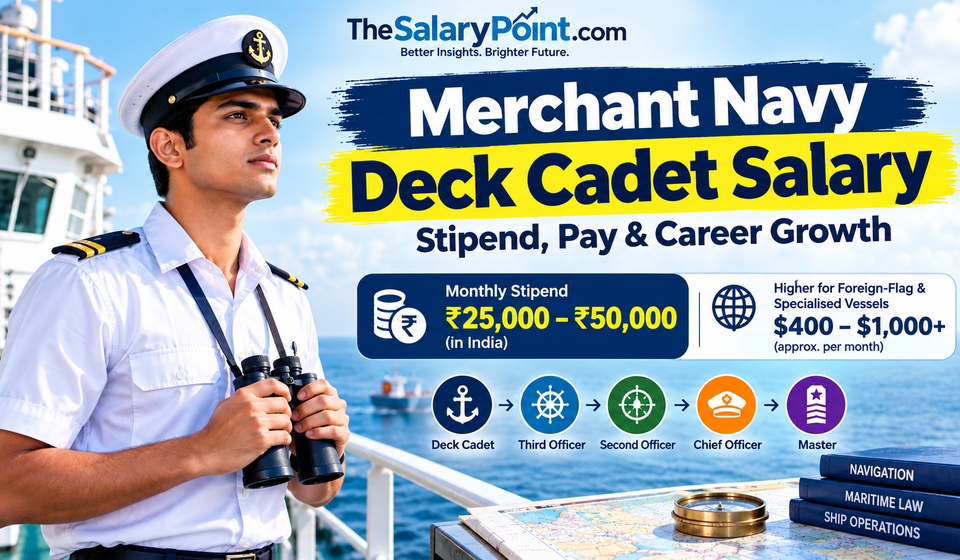
Merchant Navy deck cadet salary in India generally ranges from ₹25,000 to ₹50,000 per month during the shipboard training period. Some foreign-flag vessels and specialised vessel categories report higher cadet stipends, with figures extending to around ₹60,000–₹68,000 or more per month in some cases.
However, a deck cadet’s payment during training is better described as a training stipend, rather than the salary of a qualified deck officer.
After completing the required sea service, passing the relevant 2nd Mate Certificate of Competency (CoC) examination and meeting certification requirements, a cadet can progress to Third Officer, where reported monthly earnings are substantially higher.
Actual pay depends on the shipping company, vessel type, flag, contract, sea-time arrangement and prevailing market conditions.
SalaryPoint note: Salary figures in this article are indicative. Employee-reported salaries, industry estimates and company-reported figures can differ significantly from an actual employment offer.
Merchant Navy Deck Cadet Stipend in 2026
A deck cadet is normally paid while completing the required shipboard training. The amount can vary considerably between employers and vessel categories.
| Category | Monthly Stipend (USD) | Approx. Monthly INR | Source Type |
|---|---|---|---|
| Indian shipping companies | $300–$700 | ₹25,000–₹50,000 | Employee/industry reported |
| Foreign shipping companies | $400–$800 | ₹34,000–₹68,000 | Employee/company reported |
| Oil/Chemical tankers | $500–$900 | ₹42,000–₹76,000 | Industry estimate |
| LNG/LPG carriers | $600–$1,000 | ₹50,000–₹85,000 | Industry estimate |
Important note about the higher ranges
The tanker and LNG/LPG figures above should not be interpreted as the normal stipend for every deck cadet.
These higher ranges are based on limited market reports and vessel-specific industry estimates. They can vary according to the vessel, company, contract and type of specialised training involved.
For most candidates researching a realistic starting point, ₹25,000–₹50,000 per month is a more useful general benchmark than the highest figures shown in specialised-vessel reports.
Always confirm the stipend and employment terms with the sponsoring company before joining a course or accepting a berth.
What Determines a Deck Cadet’s Stipend?
There is no single nationwide deck cadet salary. Several factors influence the amount a cadet receives.
1. Type of Ship
Vessel type can affect the stipend.
Oil and chemical tankers and LNG/LPG carriers may offer higher compensation in some cases because of specialised operations, additional training and the nature of the cargo.
Bulk carriers and container vessels may have different stipend structures.
However, vessel type alone does not determine pay. The employer and individual contract remain important.
2. Shipping Company
The sponsoring or employing company is one of the most important factors.
Reported figures for companies can vary between salary platforms because they may represent different locations, contracts, experience levels or employment arrangements.
For example, Glassdoor data for Anglo-Eastern has reported an average deck cadet monthly pay of approximately ₹25,000, based on submitted salary reports. AmbitionBox has reported an annual salary range of approximately ₹4.5–₹5 lakh for Anglo-Eastern Group deck cadet roles.
These figures should be treated as employee-reported market information rather than guaranteed company pay scales.
3. Flag of the Vessel
Foreign-flag employment can sometimes offer a higher stipend than comparable Indian-flag arrangements.
But foreign flag does not automatically mean higher pay.
The actual amount can depend on:
- Employer
- Vessel type
- Contract terms
- Route
- Currency
- Cadet sponsorship arrangement
- Market conditions
Foreign-going employment can also have different Indian tax implications depending on the seafarer’s residential status and circumstances.
4. Sponsorship vs Self-Funded Training
Company sponsorship can provide a pathway to a cadet berth, subject to the company’s eligibility requirements and sponsorship terms.
Self-funded candidates may have to arrange their own berth after completing the required pre-sea training. Until a cadet secures a shipboard position, there may be no shipboard stipend.
This is an important distinction when comparing maritime institutes and courses.
Read More: Hotel Management Course Salary / BCA Salary / BBA Aviation Salary / Airport Worker Salary
Stipend vs Salary: What Does a Deck Cadet Actually Earn?
During shipboard training, a deck cadet generally receives a training stipend.
The cadet is not yet a fully qualified deck officer.
Typical training responsibilities can include:
- Supervised watchkeeping
- Assisting with cargo operations
- Deck maintenance
- Safety drills
- Navigation-related training
- Shipboard familiarisation
- Completion of the Training Record Book (TRB)
- Structured Shipboard Training Programme requirements
The Directorate General of Shipping (DGS) pathway involves structured sea training before a candidate progresses toward officer certification.
This is different from a conventional shore-based salary package.
A shore-based employee may have components such as:
- Basic salary
- HRA
- Employer PF contribution
- Gratuity
- Variable pay
- Bonus
A deck cadet’s onboard payment is generally simpler and contract-based.
For a broader explanation of salary structures, see our guides on CTC full form and gross salary meaning.
Company-Wise Deck Cadet Stipend Data
The following figures are reported market data and should not be treated as official salary scales.
| Company/Category | Reported Monthly Amount | Source |
|---|---|---|
| Anglo-Eastern Ship Management | ~₹25,000/month average | Glassdoor-reported data |
| Anglo-Eastern Group | ₹4.5–₹5 lakh/year | AmbitionBox-reported data |
| Company-sponsored cadets | ₹12,000–₹30,000 during certain pre-sea arrangements | Employee/industry reports |
| Foreign-flag sponsored cadets | $400–$800 onboard | Employee/industry reports |
Why do these numbers differ?
Salary websites may combine different employment stages.
For example, an annual figure may include:
- Pre-sea training
- Shipboard training
- Different contract periods
- Different vessel types
- Different locations or employment arrangements
Therefore, do not compare an annual salary figure directly with an onboard monthly stipend without checking what the reported figure represents.
Merchant Navy Salary Progression: Deck Cadet to Master
The deck cadet position is the beginning of the officer pathway.
After completing the required training and certification, a candidate can progress through the deck officer ranks.
| Rank | Indicative Monthly Earnings | Key Requirement |
|---|---|---|
| Deck Cadet | ₹25,000–₹50,000 | 12th PCM + approved nautical training |
| Third Officer | ₹1.2–₹1.8 lakh | 2nd Mate FG CoC |
| Second Officer | ₹1.5–₹3 lakh | Required sea service as Third Officer |
| Chief Officer | ₹4–₹6 lakh | Mate FG CoC |
| Master/Captain | ₹8–₹15 lakh | Master FG CoC |
Source note: The officer salary figures are indicative market reports compiled from maritime industry publications, crewing information and other market sources. They are not official DGS pay scales.
Actual compensation can vary substantially by:
- Company
- Vessel type
- Vessel size
- Flag
- Contract
- Rank
- Experience
- Market conditions
How Long Does It Take to Become a Captain?
There is no single fixed timeline from Deck Cadet to Master.
Progress depends on:
- Required sea service
- Examination clearance
- Certification
- Medical fitness
- Availability of berths
- Company promotion policy
- Individual career progression
Deck Cadet → Third Officer
A candidate completes the required shipboard training, meets the sea-time requirements and clears the 2nd Mate (Foreign Going) Certificate of Competency examination.
The overall pathway from joining maritime education to becoming a Third Officer can take several years because it includes both academic/pre-sea education and sea training.
Third Officer → Second Officer
Promotion generally requires the prescribed sea service as a watchkeeping officer and satisfaction of the relevant company and regulatory requirements.
Second Officer → Chief Officer
The officer needs the required sea service and must meet the requirements for the Mate (Foreign Going) CoC.
Chief Officer → Master
Further sea service and the required certification and examination pathway are necessary before progressing to Master.
The Directorate General of Shipping oversees competency examinations and certification in India. Sea service is documented through relevant maritime records, including the Continuous Discharge Certificate (CDC) and applicable training documentation.
Merchant Navy Tax: Is a Deck Cadet Salary Tax-Free?
This is one of the most misunderstood parts of merchant navy salary discussions.
A merchant navy salary is not automatically tax-free simply because the employee works on a ship or receives money in an NRE account.
Indian tax treatment depends on facts including:
- Residential status
- Number of days spent in India
- Where the services are actually performed
- Nature of the voyage
- Employer
- Contract
- Salary receipt arrangements
- Supporting documentation
Residential Status
The commonly discussed 182-day threshold can be relevant when determining whether an individual qualifies as a non-resident, but residential status under Indian tax law depends on the applicable statutory conditions.
Therefore, simply counting days without examining the other conditions is not enough in every case.
Where the Work Is Performed
For a non-resident Indian seafarer, remuneration attributable to services actually rendered outside India on a foreign-going ship may, depending on the facts, fall outside the scope of Indian taxable income.
The analysis involves the provisions governing the scope of total income and the source of salary income, along with applicable CBDT guidance.
Section 10(6)(viii)
Section 10(6)(viii) concerns salary received by a non-resident foreign national who is a member of a ship’s crew, subject to the conditions specified in the provision.
It should not be treated as a general exemption applicable to every Indian seafarer.
Indian seafarers generally need to examine their residential status and the source/place of services under the applicable provisions instead.
Possible Tax Treatment for Different Situations
| Situation | Possible Tax Treatment |
|---|---|
| Indian seafarer on foreign-going vessel and qualifies as non-resident | Salary attributable to services performed outside India may fall outside Indian taxable income, subject to facts |
| Indian seafarer working on an Indian-flag/coastal arrangement | Income may generally be taxable in India |
| Foreign-going employment but individual remains resident | Indian tax treatment may be different and salary may be taxable |
| Salary credited to NRE account | NRE credit alone does not automatically determine taxability |
Important Tax Disclaimer
The tax treatment of seafarer income is fact-specific. Residential status, service location, voyage, employer, contract, receipt of salary and supporting records can all matter.
This article is for general information and is not tax advice. Before relying on a tax exemption, consult a qualified tax professional who can examine your individual circumstances.
Documents Seafarers Should Maintain for Tax Records
A seafarer should maintain relevant documentation, such as:
- Continuous Discharge Certificate (CDC)
- Seafarer’s Employment Agreement (SEA)
- Passport and relevant travel records
- Sign-on and sign-off records
- Salary statements
- Bank statements
- NRE account records, where applicable
- Employment and voyage documentation
These records can help establish the facts relevant to residential status and the period and location of employment.
Indian TDS treatment can also vary according to the employer, payment structure, residential status and applicable tax rules.
Foreign-flag employment by itself does not guarantee that no Indian tax will apply.
Read More: ACS Officer Salary / Territorial Army Salary / PSU Salary / MSc Nursing Salary
How to Become a Deck Cadet After 12th
Candidates generally enter the deck officer pathway after completing 10+2 with the required science subjects and meeting the applicable maritime eligibility requirements.
Academic Eligibility
The eligibility criteria can include:
- 10+2 with Physics, Chemistry and Mathematics (PCM)
- Minimum required aggregate marks
- Required English marks
- Applicable age requirements
- Required medical fitness
- Required eyesight standards
- No colour blindness, subject to applicable medical standards
Exact eligibility can change by admission cycle and programme, so candidates should verify the current requirements with IMU and DG Shipping-approved institutions before applying.
Main Entry Routes
1. Diploma in Nautical Science (DNS)
DNS is a pre-sea nautical training route followed by structured shipboard training.
The pathway can lead toward the B.Sc. (Applied Nautical Science) qualification after the applicable academic and sea-training requirements are completed.
2. B.Sc. Nautical Science
B.Sc. Nautical Science is a longer undergraduate programme covering subjects such as:
- Navigation
- Ship stability
- Meteorology
- Maritime law
- Cargo operations
- Seamanship
- Marine safety
It is followed by the applicable cadet sea-time requirements.
Does Company Sponsorship Matter?
Yes. Sponsorship is an important part of the Indian deck cadet pathway.
A typical sponsorship process may involve:
- Online application
- Academic screening
- Aptitude test
- Interview
- Medical fitness assessment
- IMU-CET/admission requirements
- Training and subsequent berth arrangements under the applicable sponsorship terms
Companies associated with cadet recruitment can include major ship-management organisations and Shipping Corporation of India, but the availability of sponsorship and berth placement should always be confirmed for the specific admission year.
A sponsorship letter should not be interpreted as a universal guarantee of uninterrupted employment or future promotion.
Medical and STCW Requirements
Deck cadets must meet the applicable medical and maritime safety requirements.
Depending on the training pathway and current DGS requirements, relevant STCW training can include:
- Basic Safety Training (BST)
- Proficiency in Survival Craft and Rescue Boats (PSCRB)
- Advanced Fire Fighting (AFF)
- Medical First Aid (MFA)
- Medical Care
- GMDSS
- Radar/ARPA
- ECDIS
- Bridge Resource Management (BRM)
- Ship Security Officer (SSO)
The exact course, validity and revalidation requirements can change.
Candidates should therefore check the latest DG Shipping circulars and approved training requirements before enrolling.
Deck Cadet Payslip: How Much Is Actually Received?
A cadet’s onboard payment can include the agreed stipend and, where applicable, additional payments.
For illustration only:
| Component | Illustrative Amount |
|---|---|
| Gross stipend | $500 |
| Overtime, if applicable | $50–$150 |
| Total earnings | $550–$650 |
| Contract-specific deductions | $20–$50 |
| Illustrative net amount | $500–$600 |
This is not a standard merchant navy payslip.
Actual overtime, deductions and allowances depend on the employment contract and company.
Potential deductions or contributions can include:
- TDS, where applicable
- Professional tax, where applicable
- PF, where applicable
- ESI, where applicable
- Contract-specific deductions
Some onboard facilities such as accommodation and meals may be provided as part of the employment arrangement, but the exact terms should be confirmed with the employer.
Deck Cadet Salary vs Other Maritime Entry-Level Jobs
| Role | Indicative Monthly Stipend/Salary |
|---|---|
| Deck Cadet | ₹25,000–₹50,000 |
| Engine Cadet | ₹25,000–₹50,000 |
| GP Rating | ₹15,000–₹30,000 |
| ETO Trainee | ₹30,000–₹60,000 |
These are indicative 2026 market benchmarks, not official industry-wide pay scales. Actual compensation can vary by employer, vessel, contract and experience.
Frequently Asked Questions
1. Is deck cadet a good job?
Answer: Deck cadet is an entry-level position in the merchant navy’s deck officer pathway. The initial training stipend is considerably lower than the reported earnings of qualified officers, but the role provides a route toward higher officer ranks after the required sea service, examinations and certifications.
The career also involves long periods at sea, separation from family, physically demanding duties and continuous professional training.
Therefore, candidates should evaluate both the financial progression and the working conditions before choosing the career.
2. What is the lowest salary on a merchant ship?
Answer: Entry-level rating positions can have lower compensation than officer-track cadet positions.
Some market reports place trainee GP Rating earnings around ₹12,000–₹18,000 per month, with reported progression to approximately ₹20,000–₹35,000 for Ordinary Seaman and ₹35,000–₹55,000 for Able Seaman.
These are indicative figures and can vary by company, vessel and contract.
3. Is a deck cadet an officer?
Answer: A deck cadet is a trainee on the officer pathway, but is not yet a fully qualified deck officer.
The cadet works under the supervision of qualified officers and completes the required shipboard training.
After completing the applicable sea time and certification requirements and passing the required CoC examination, the candidate can progress to Third Officer.
4. How can I become a deck officer after 12th?
Answer: The broad pathway is:
1. Complete 12th with the required PCM subjects and marks.
2. Meet the English and medical requirements.
3. Qualify for the applicable IMU admission process.
4. Join an approved DNS or B.Sc. Nautical Science programme.
5. Obtain company sponsorship where required.
6. Complete the prescribed shipboard training.
7. Complete the required sea service and training records.
8. Clear the 2nd Mate (FG) CoC examination.
9. Obtain the required certification.
10. Progress to Third Officer subject to applicable requirements and employment.
5. Do deck cadets get paid during leave?
Answer: Not necessarily.
Payment during leave depends on the employment contract and company policy. Many cadet arrangements link the stipend to the period of onboard training, meaning a cadet may not receive the same monthly stipend while on leave.
For example, if a cadet receives ₹40,000 per month and is onboard for eight months, the annual onboard stipend would be approximately:
₹40,000 × 8 = ₹3.2 lakh
This does not mean the cadet necessarily receives ₹40,000 for all 12 months.
Always check the contract for leave pay, contract duration and sign-on/sign-off arrangements.
6. Is the deck cadet stipend tax-free?
Answer: Not automatically.
Taxability depends on factors such as residential status, place of service, voyage, employer, payment arrangements and documentation.
A seafarer who qualifies as a non-resident may, depending on the facts, have remuneration for services performed outside India fall outside the scope of Indian taxable income.
However, simply working on a foreign-flag ship or receiving salary in an NRE account does not by itself establish a tax exemption.
Consult a qualified tax professional before relying on a particular tax treatment.
Final Takeaway: Merchant Navy Deck Cadet Salary 2026
The merchant navy deck cadet salary in India is generally around ₹25,000–₹50,000 per month during shipboard training, based on the market ranges reviewed for this article.
Some foreign-flag and specialised-vessel arrangements report higher figures, including approximately $400–$1,000 per month, but these should be treated as vessel- and contract-specific figures rather than the normal stipend for every cadet.
The larger financial difference comes after qualification and promotion. Indicative market reports place Third Officer earnings around ₹1.2–₹1.8 lakh per month, while reported ranges for senior ranks can reach several lakh rupees per month.
The merchant navy therefore has a structured progression from:
Deck Cadet → Third Officer → Second Officer → Chief Officer → Master
But salary should not be the only consideration. Candidates should also examine training costs, sponsorship terms, sea-time requirements, leave arrangements, medical standards, certification requirements and the realities of spending extended periods at sea.
For candidates comparing maritime earnings with shore-based employment, our 3 LPA in-hand salary and 5 LPA in-hand salary guides provide useful benchmarks.
SalaryPoint Methodology
SalaryPoint separates the figures in this article into three broad categories:
Official/regulatory information: Used for eligibility, certification and maritime training requirements where supported by DG Shipping or IMU documentation.
Employee/company-reported information: Salary figures reported through platforms such as Glassdoor and AmbitionBox. These figures can reflect individual contracts and should not be treated as official pay scales.
Industry estimates: Market ranges reported by maritime publications, crewing sources and industry material. These are particularly variable for specialised vessels such as tankers and LNG/LPG carriers.
Because merchant navy compensation is contract- and vessel-specific, there is no single official nationwide deck cadet salary for 2026.
Important Disclaimer
Salary figures in this article are indicative and are not guaranteed employment offers.
Actual stipend or salary may depend on the shipping company, vessel type, vessel flag, contract terms, rank, sea time, employer policies and prevailing market conditions.
Tax treatment is particularly fact-specific and should not be determined from a general salary article. Readers should consult a qualified tax professional for individual tax advice.
For eligibility, certification and admission requirements, candidates should verify the latest information directly with DG Shipping, Indian Maritime University and the relevant approved maritime institute before making financial or educational decisions.
Read More: BSc Optometry Salary / BSc Cardiac Technology Salary / Army Public School Teacher Salary