
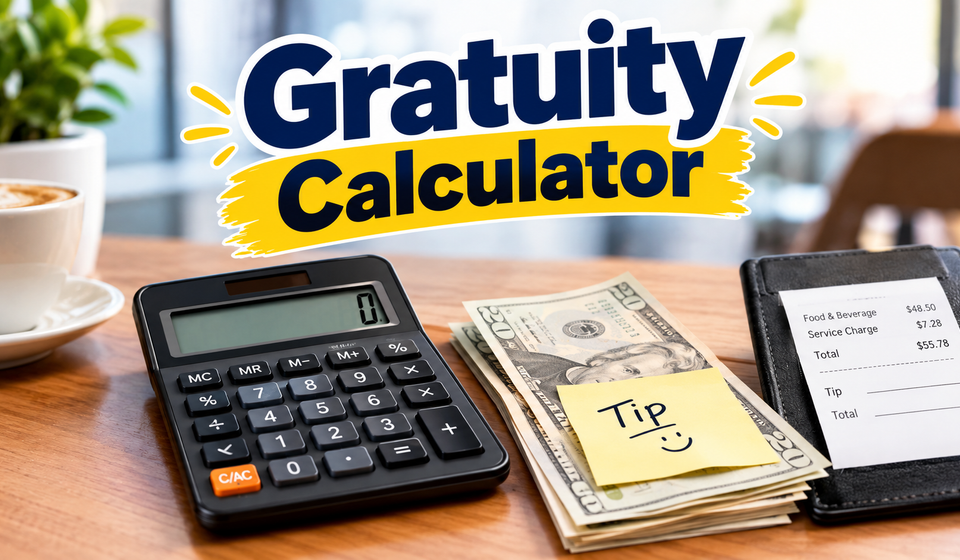

Calculate your estimated gratuity using your eligible wages and years of service. Enter your details below to get an estimate, then see the formula, eligibility rules, and tax treatment explained simply.
📊 Gratuity Calculator
Note: For the live version, this section should contain a working HTML/JavaScript calculator.
| Input Field | Enter Your Details |
|---|---|
| Monthly eligible wages (₹) | [__________] |
| Completed years of service | [____] |
| Additional months of service | [____] |
| Employee category | [Dropdown: Government / Private (Covered) / Private (Not Covered)] |
Gratuity Calculator
Estimate your gratuity based on eligible wages and years of service.
⚠️ This is an estimate, not a final employer settlement. The actual amount depends on the applicable wage definition, service records, and employer payroll interpretation. See calculator assumptions below.
⚡ Quick Answer
Under the traditional statutory formula, gratuity is estimated as: (Wages × 15 × Years of Service) ÷ 26
Example: If your monthly wages are ₹50,000 and you've worked for 10 years — (50,000 × 15 × 10) ÷ 26 = ₹2,88,462 (estimated).
⚠️ 2026 Update: The Code on Social Security, 2020 came into effect on November 21, 2025. This changes the definition of "wages" used for gratuity calculation. The amount considered may differ from the older Basic + DA approach. See the 2026 section for details.
The Gratuity Formula (Explained Simply)
Traditional Payment of Gratuity Act Formula — For Eligible Employees Covered Under the Act
Gratuity = (Wages × 15 × Years of Service) ÷ 26
| Component | What It Means |
|---|---|
| Wages | Under the traditional Payment of Gratuity Act calculation, this was generally based on Basic Salary + DA. For calculations governed by the Social Security Code from 21 November 2025, the applicable statutory definition of "wages" must be applied instead of assuming that Basic + DA is always the complete calculation base. |
| 15 | 15 days' wages for each completed year of service |
| 26 | Number of working days in a month (excluding Sundays) |
📌 Important: The traditional formula uses Basic + DA. From November 21, 2025, the Social Security Code's definition of "wages" may change what is included. Check with your HR department for the applicable wage components.
For Employees Outside the Statutory Framework
Employees in establishments not covered by the Payment of Gratuity Act may have gratuity determined by their employment contract and applicable law. The formula is not automatically the same as the statutory one. Check your contract or consult HR.
Example Calculations
| Monthly Wages | Years of Service | Employer Type | Estimated Gratuity |
|---|---|---|---|
| ₹30,000 | 7 years | Covered | ₹1,21,154 |
| ₹50,000 | 10 years | Covered | ₹2,88,462 |
| ₹1,00,000 | 15 years | Covered | ₹8,65,385 |
Calculated using the statutory formula under the Payment of Gratuity Act, 1972
Worked Example
If your wages are ₹55,000 and you've completed 15 years:
(15 × 55,000 × 15) ÷ 26 = ₹4,75,962
Gratuity Eligibility — Who Qualifies?
Gratuity generally becomes payable after 5 years of continuous service with the same employer — subject to the applicable statutory provisions and exceptions.
| Eligibility Rule | Details |
|---|---|
| Minimum service | 5 years of continuous service (generally) |
| Employer coverage | Establishment must meet statutory coverage conditions |
| Exceptions | Death or permanent disablement — gratuity is payable regardless of tenure |
What "Continuous Service" Means
Under the Payment of Gratuity Act, continuous service includes:
- Uninterrupted service with the same employer
- Service interrupted by sickness, accident, leave, or authorised absence
- Service deemed continuous under statutory provisions (including the 240-day/190-day rules)
⚠️ Important distinction: Eligibility to receive gratuity (generally 5 years of continuous service) and calculation of years for the formula are separate concepts. The rounding rule (6+ months = 1 full year) applies only after you have qualified for gratuity — it does not, by itself, make you eligible.
Rounding Rules — How Part-Years Are Handled
Once you're eligible, completed years are calculated as follows:
| Your Service | Rounded To |
|---|---|
| 7 years 5 months | 7 years |
| 7 years 6 months or more | 8 years |
| 14 years 5 months | 14 years |
| 14 years 7 months | 15 years |
Example: If you've worked for 9 years and 7 months, your service rounds to 10 years for calculation purposes.
Gratuity Rules in 2026 — What's Changed
The Social Security Code, 2020 (Effective November 21, 2025)
The Code on Social Security, 2020 came into effect on November 21, 2025. This changes how gratuity is calculated.
| Change | What It Means |
|---|---|
| "Wages" definition changed | Section 2(88) of the Code defines wages differently. Payments outside the specified components are not considered for gratuity. |
| Fixed-term contract employees | Fixed-term employees directly engaged under a fixed-term employment contract: The Ministry's 2026 FAQ states that gratuity is payable on a pro-rata basis where the employee has completed one year of service under the contract, subject to the applicable provisions. |
| Effective date | Gratuity calculations from November 21, 2025 are governed by the Code's wage provisions. |
📌 Bottom line: The amount considered for gratuity may differ from the older Basic + DA approach. Check with your HR department for how your employer applies the new rules.
Source: Ministry of Labour & Employment, Government of India — Social Security Code 2026 FAQs
Tax on Gratuity — Section 10(10) of the Income Tax Act
Gratuity Tax Exemption in 2026
Gratuity tax exemption depends on your employee category and the applicable provisions of Section 10(10) of the Income Tax Act.
| Employee Category | Tax Exemption Treatment |
|---|---|
| Central / State Government employees | Tax treatment under Section 10(10) differs from that applicable to non-government employees. For AY 2026–27, the Income Tax Department's validation rules use a ₹25 lakh figure for Central and State Government categories. Check the applicable category and current tax provisions before filing. |
| Employees covered by the Payment of Gratuity Act | Exempt up to the lower of: actual gratuity received, eligible gratuity as per formula, or the statutory limit (₹20 lakh for many categories) |
| Other employees (not covered) | Exempt up to the lower of: actual gratuity received, half-month salary for each year of service, or the statutory limit |
Key Points to Remember
| Point | Explanation |
|---|---|
| Government employees | The exemption treatment and monetary limits are governed by specific provisions under Section 10(10). For AY 2026–27, a ₹25 lakh figure is used for Central/State Government categories. |
| ₹20 lakh limit | Applies to many non-government employees — it's a lifetime aggregate limit |
| Lifetime limit | The exemption limit is an aggregate lifetime limit across all employers for most non-government employees. Previous gratuity exemptions may reduce what's available for subsequent claims. |
| Taxable portion | Any amount above the applicable exemption limit is taxed as per your income tax slab |
📌 Always verify your specific category and applicable limit with a tax professional or refer to the Income Tax Department's official notifications.
Source: Income Tax Department, Government of India — Section 10(10) provisions and AY 2026–27 validation rules
Common Mistakes to Avoid
| Mistake | Why It's Incorrect |
|---|---|
| Using gross salary instead of wages | The formula uses "wages" as defined — under the traditional method, that's Basic + DA, not your full CTC. |
| Assuming 5 years automatically qualifies | Eligibility depends on the applicable statutory provisions governing continuous service and the circumstances of separation. |
| Confusing eligibility with calculation rounding | The rounding rule applies after you qualify — it doesn't make you eligible. |
| Forgetting the lifetime tax limit | Exemption claimed from previous employers may reduce what's available to you now. |
Calculator Assumptions — Please Read
- The result is an estimate, not a final employer settlement.
- Wage components are determined according to the applicable law (which changed in November 2025).
- Service eligibility is subject to statutory conditions and employer records.
- Tax treatment is separate from the gratuity calculation.
- Employer payroll records may produce a different final amount.
- Always verify with your HR department or a qualified professional.
Why "4.81% of CTC" Appears in Salary Breakups
You may see gratuity shown as roughly 4.81% of CTC in salary offers. This comes from:
15 ÷ 26 × 12 ÷ 365 ≈ 4.81%
But gratuity is not automatically 4.81% of your total CTC. The 4.81% figure is commonly used as an annual gratuity provision in salary structures; it does not mean that 4.81% of your total CTC is necessarily the gratuity payable to you. The actual amount depends on:
- Which wage components are considered
- Your actual years of service
- The applicable statutory rules
Always refer to the statutory formula for the actual calculation.
What If Your Employer Doesn't Pay?
If you're eligible and your employer delays payment:
| Your Rights | Details |
|---|---|
| Payment deadline | Under the Payment of Gratuity Act, gratuity is generally payable within 30 days from the date it becomes due, subject to the applicable statutory provisions. |
| Interest on delay | Employer may be liable to pay interest on the delayed amount |
| File a claim | You can approach the Controlling Authority under the Act |
Final Takeaway
Use this calculator to estimate your gratuity, but always verify with:
- Your employer's HR or payroll department
- The applicable statutory framework (Payment of Gratuity Act or Social Security Code)
- Current tax rules under Section 10(10)
💡 Pro tip: When planning your resignation, check your service period against the rounding rules — but remember, eligibility and calculation are separate concepts.
FAQs: Gratuity Calculator
1. How is gratuity calculated in 2026?
Answer: Using the formula (Wages × 15 × Years of Service) ÷ 26 for covered employers. However, the Social Security Code (effective Nov 21, 2025) changed the definition of "wages," so the amount considered may differ from the older Basic + DA method. Check with your HR department.
2. What is 15 and 26 in the gratuity formula?
Answer: 1. 15 = 15 days' wages for each completed year of service
2. 26 = Number of working days in a month (excluding Sundays)
3. Is gratuity calculated on basic salary or CTC?
Answer: Under the traditional method, it's calculated on Basic + DA, not your full CTC. Under the Social Security Code (Nov 2025), the wage definition has changed — check with your HR department.
4. How much gratuity is tax-exempt in 2026?
Answer: It depends on your employee category:
1. Central/State Government employees: For AY 2026–27, the Income Tax Department's validation rules use a ₹25 lakh figure. Check the applicable category and current tax provisions.
2. Other employees (covered by Act): Exempt up to the statutory limit (₹20 lakh for many categories)
The exemption is an aggregate lifetime limit — previous claims reduce what's available.
5. How many years of service are required for gratuity?
Answer: Generally, 5 years of continuous service is required, subject to the applicable statutory provisions. Fixed-term employees directly engaged under a fixed-term contract may qualify on a pro-rata basis after 1 year as per the Ministry's 2026 FAQ. Death or disablement are exceptions.
6. Is gratuity taxable?
Answer: 1. Government employees: Tax treatment under Section 10(10) differs from non-government employees; check the applicable AY 2026–27 limits.
2. Private sector employees: Exempt up to the applicable limit; any amount above is taxable
7. Can I receive gratuity before completing 5 years?
Answer: Generally no — except in cases of death or permanent disablement. Fixed-term contract employees under the new Code may qualify on a pro-rata basis after 1 year.
8. Does the gratuity tax exemption reset with every job?
Answer: No — for most non-government employees, it's an aggregate lifetime limit. Exemption claimed from one employer reduces what's available from future employers.
9. What's the ₹20 lakh / ₹25 lakh limit I keep hearing about?
Answer: For many non-government employees, the limit is ₹20 lakh. For Central and State Government employees, the AY 2026–27 validation rules use a ₹25 lakh figure. Always verify your specific category with official sources.
Official Sources
| Source | Specific Reference / Link |
|---|---|
| Payment of Gratuity Act, 1972 | India Code — Payment of Gratuity Act |
| Code on Social Security, 2020 | Ministry of Labour & Employment — Social Security Code |
| Social Security Code FAQs (2026) | Ministry of Labour & Employment — 2026 FAQs on Gratuity |
| Income Tax Act — Section 10(10) | Income Tax Department — Tax on Gratuity |
Read More: LPA Full Form: Meaning, Calculation & What It Really Means for Your Salary

[…] Read More: Gratuity Calculator 2026: Estimate Your Gratuity Online (Formula & Rules) […]
[…] Read More: Gratuity Calculator 2026: Estimate Your Gratuity Online (Formula & Rules) […]
[…] posts may not include pension, gratuity, or the same allowances as regular government posts. Always read the recruitment notification […]