
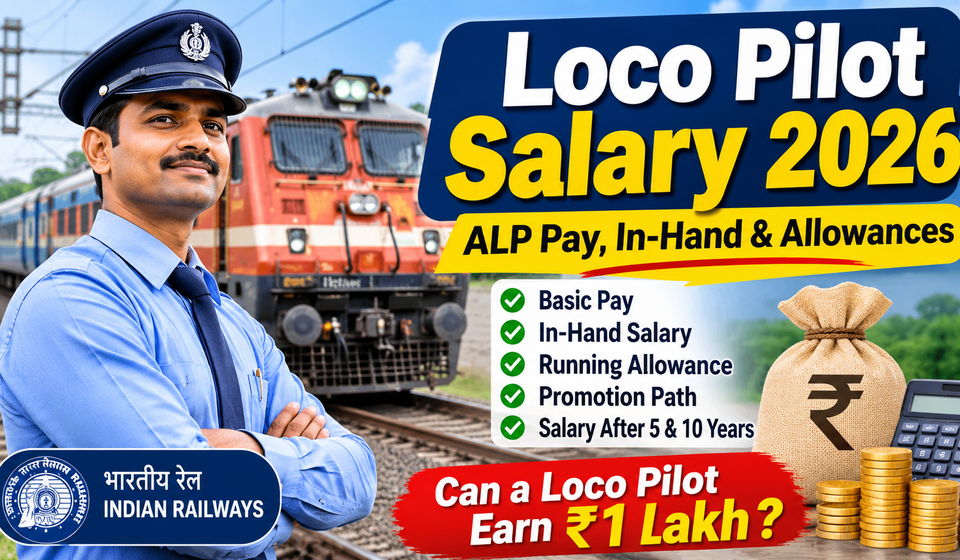

A loco pilot’s salary in Indian Railways is not a single fixed number. The entry post — Assistant Loco Pilot (ALP) — carries a basic pay of ₹19,900 at Pay Level 2 of the 7th Central Pay Commission matrix. But a running-staff payslip also includes dearness allowance (DA), house rent allowance (HRA), transport allowance, and — most importantly — a kilometrage (running) allowance that varies every month with the distance run.
That is why two loco pilots at the same basic pay can take home very different amounts. One may earn a fixed-pay in-hand of roughly ₹30,000–₹36,000, while another on a heavy running schedule adds a five-figure kilometrage sum on top. This guide separates the official figures from the estimates, explains the ALP-to-Loco-Pilot promotion ladder, and shows why the “loco pilot salary per month” question has more than one correct answer.
Quick Answer: Loco Pilot Salary at a Glance
| Item | Detail |
|---|---|
| Entry post | Assistant Loco Pilot (ALP) |
| Pay Level (ALP) | Level 2, ₹19,900 initial basic pay |
| Dearness Allowance | 63% of basic, effective 1 July 2026 (Railway Board RBE No. 91/2026, dated 30 October 2026) |
| HRA (ALP, Level 2) | ₹1,990 (Z) to ₹5,970 (X) per month |
| Kilometrage allowance (ALP) | ₹430 per 100 km (Railway Board RBE No. 25/2026) |
| Estimated fixed-pay in-hand (ALP) | About ₹30,000–₹36,000 before tax and before running allowance |
| Promotion grades | Loco Pilot (Goods / Passenger / Mail) — all currently Level 6 (Grade Pay ₹4,200) |
| Top running grade | Loco Pilot (Mail/Express), Level 6, ₹606 per 100 km KMA |
| Highest reported in-hand | ₹77,000–₹88,000+ for high-speed / Mail LP with full running allowance (employee-reported, not official) |
Important: The ₹30,000–₹36,000 ALP figure is an estimate of fixed-pay take-home. It assumes a particular DA rate and city class, and it excludes kilometrage. Actual pay depends on posting, running kilometres, and the DA order in force.
What Determines a Loco Pilot’s Monthly Salary?
A running-staff payslip has two engines: fixed pay and running allowance.
1. Fixed Pay (The Predictable Part)
Fixed pay follows the standard central-government structure:
- Basic pay — the 7th CPC matrix cell. ALP starts at ₹19,900. Annual increment moves it up roughly 3% of basic.
- Dearness Allowance (DA) — a percentage of basic, revised periodically. Railway employees have a separate DA order. Effective 1 July 2026, railway DA is 63% under Railway Board RBE No. 91/2026 (dated 30 October 2026).
- House Rent Allowance (HRA) — 30% of basic in X-class cities, 20% in Y-class, 10% in Z-class. For an ALP, that is ₹5,970 / ₹3,980 / ₹1,990 respectively.
- Transport Allowance (TA) — roughly ₹900–₹1,350 per month at this level, depending on city class and DA on TA.
- Deductions — NPS contribution (10% of basic + DA), CGHS, CGEGIS. For an ALP, total deductions are commonly estimated around ₹3,500–₹4,000 per month under NPS.
After deductions, an ALP’s fixed-pay in-hand lands around ₹30,000–₹36,000. This is the number a loco pilot can count on before running kilometres are added.
Worked Example: ALP Fixed-Pay Calculation (Z-Class City, 63% DA)
| Component | Monthly Amount (₹) | Basis / Assumption |
|---|---|---|
| Basic pay | 19,900 | Level 2, initial cell |
| DA (63%) | 12,537 | RBE No. 91/2026, w.e.f. 1 July 2026 |
| HRA (10%, Z-class) | 1,990 | 10% of basic |
| Transport allowance | ~900 | City-class dependent; DA on TA included |
| Gross fixed pay | ~35,327 | Before deductions |
| NPS (10% of basic + DA) | 3,244 | Employee contribution |
| CGHS / CGEGIS | ~280–370 | Approximate; varies by entitlement and coverage |
| Estimated net fixed pay | ~₹31,700–₹31,800 | Excludes running allowance and income tax |
This is an illustrative calculation, not an actual payslip. Assumptions: Z-class city, NPS subscriber, no income-tax deduction at source. In an X-class city, HRA would be ₹5,970, raising gross fixed pay to ~₹39,757 and net to ~₹36,000 before tax. CGHS and CGEGIS amounts vary by employee entitlement and should not be treated as universal figures.
2. Running Allowance (The Variable Engine)
Running allowance — also called kilometrage allowance (KMA) or mileage allowance — is paid per 100 km run. It is the component that makes running staff different from every other railway employee at the same pay level.
Revised Kilometrage Allowance Rates for Loco Running Staff (2026)
| Category | Grade Pay / Level | KMA per 100 km (₹) | ALK per 160 km (₹) |
|---|---|---|---|
| Loco Pilot (Mail) | 4200 / Level 6 | 606 | 969 |
| Loco Pilot (Passenger) / Sr. Motorman | 4200 / Level 6 | 600 | 960 |
| Loco Pilot (Goods) | 4200 / Level 6 | 594 | 951 |
| Sr. Assistant Loco Pilot | 2400 / Level 4 | 447 | 715 |
| Assistant Loco Pilot | 1900 / Level 2 | 430 | 688 |
Source: Railway Board letter dated 20 March 2026 (RBE No. 25/2026), reproduced by All India Railwaymen’s Federation. Revised rates effective retrospectively from 1 January 2024, following DA reaching 50%. Actual monthly allowance depends on admissible kilometres and applicable duty rules.
A busy loco pilot on long-distance links can add tens of thousands of rupees in running allowance in a heavy month. In a light month, the same pilot may earn far less. This is why any single “loco pilot salary per month” figure is incomplete without stating the running assumption.
Read More: B Pharmacy Salary / Blinkit Delivery Boy Salary / EMRS TGT Salary / Lawyer Salary / SSC CHSL Salary
ALP vs Loco Pilot (Goods, Passenger, Mail): The Promotion Ladder
A common misunderstanding is that Indian Railways recruits “loco pilots” directly. It does not. The Railway Recruitment Boards (RRBs) recruit Assistant Loco Pilots (ALP) at Level 2. Loco Pilot (Goods), Loco Pilot (Passenger), and Loco Pilot (Mail/Express) are promotion grades.
A second misunderstanding is that each promotion brings a higher pay level. In the current structure, the promotion grades — Goods, Passenger, and Mail — are all clustered into Pay Level 6 (Grade Pay ₹4,200). The All India Loco Running Staff Association has formally argued that this clustering violates the 7th CPC principle that a promotion should involve a move to a higher pay level. Whether that changes in future cadre restructuring is a live industrial-relations issue, not a settled fact.
The practical progression looks like this:
| Stage | Pay Level | Basic Pay (₹) | Approx. in-hand including running (₹) |
|---|---|---|---|
| Assistant Loco Pilot (ALP) | Level 2 | 19,900 | 28,000–38,000 |
| Loco Pilot (Goods) | Level 6 | 35,400 | 45,000–60,000 |
| Loco Pilot (Passenger) | Level 6 | 35,400 | 60,000–75,000 |
| Loco Pilot (Mail/Express) | Level 6 | 35,400 | 77,000–88,000+ |
In-hand figures are estimates that include running allowance and vary with kilometres, city class, and duty pattern. Basic pay at Level 6 is ₹35,400 at the entry cell; the differences in take-home across Goods, Passenger, and Mail are driven mainly by running kilometres and duty type, not by basic pay level.
ALP vs Loco Pilot Salary: Key Differences
| Comparison | Assistant Loco Pilot (ALP) | Loco Pilot (Goods/Passenger/Mail) |
|---|---|---|
| Pay Level | Level 2 | Level 6 |
| Entry basic pay | ₹19,900 | ₹35,400 |
| DA (63%) | ₹12,537 | ₹22,302 |
| HRA (Z-class) | ₹1,990 | ₹3,540 |
| Gross fixed pay (Z-class) | ~₹35,327 | ~₹61,000 |
| KMA per 100 km | ₹430 | ₹594–₹606 |
| Recruitment route | Direct RRB ALP exam | Promotion from ALP |
| Typical experience | Entry level | 5+ years (estimate, varies) |
Gross fixed pay figures are estimates at 63% DA and Z-class HRA. NPS and other deductions apply. ₹35,400 represents the entry basic-pay cell of Level 6. Actual basic pay after promotion depends on the employee’s existing pay and applicable pay-fixation rules — it is not automatically ₹35,400 for every promote.
Promotion timing is not fixed by a single rule. Vacancy availability, seniority, and departmental requirements determine the pace. One recruitment guide estimates ALP to LP (Goods): 5–8 years, and LP (Goods) to Passenger: 3–5 years, with Passenger-to-Mail based on seniority and merit. Employee reports suggest some ALPs move faster — in the range of 2–4 years — depending on learning progress and vacancies. Treat all promotion timelines as estimates, not entitlements.
Salary After 5 Years and 10 Years: What to Expect
There is no official published “5-year salary” or “10-year salary” for loco pilots, because pay depends on promotion speed, running kilometres, and DA orders in force at the time. What can be said with confidence is the direction of travel:
| Experience | Salary progression | Why it varies |
|---|---|---|
| Joining | ALP, Level 2, basic ₹19,900 | Fixed by 7th CPC matrix |
| After 5 years | Depends on increments and promotion | Annual increment ~3% of basic; promotion to Level 6 if vacancy and seniority permit |
| After 10 years | Depends on grade, pay fixation, and running duty | Basic pay may have moved several cells within Level 6; running allowance varies monthly |
| Senior career | Level 6 matrix (up to ₹1,12,400 basic) plus applicable running allowance | Top of Level 6 reached by increments; running kilometres remain the dominant variable |
What this means in practice: a loco pilot who is promoted early and runs long-distance links will earn substantially more at the 5-year or 10-year mark than a colleague who remains at ALP level or runs shorter routes. There is no guaranteed salary at a particular experience milestone.
Employee-Reported Salary Data (Separate Section)
Third-party platforms collect self-reported salaries. On AmbitionBox (73 salaries, accessed November 2025), the reported range for loco pilots with 6–23 years’ experience is ₹14.8 lakh–₹18.1 lakh annually.
These are employee-reported figures, not official pay scales. They may include running allowance, overtime, and other variable components. They are useful for career-planning context but should not be treated as a guarantee of take-home at any specific year of service. Reported ranges that attempt to isolate a single experience milestone (such as “10 years”) are difficult to reconcile with broader ranges and are therefore not reproduced here.
Can an Experienced Loco Pilot Earn ₹1 Lakh Per Month?
Yes — in some reported earnings scenarios, but not as a guaranteed salary or official maximum.
A new ALP’s fixed-pay in-hand is roughly ₹30,000–₹36,000. To cross ₹1 lakh per month, a loco pilot typically needs a combination of:
- Promotion to Level 6 (Loco Pilot Goods/Passenger/Mail), raising basic pay to the Level 6 entry cell.
- A heavy running schedule that adds a substantial kilometrage allowance on top of fixed pay.
- Seniority that brings higher matrix cells within Level 6 (the level runs up to ₹1,12,400 basic at the top).
Employee reports describe gross pay of ₹75,000 per month for a loco pilot in his mid-20s, and ₹60,000–₹70,000 including running allowance for another. A senior Mail/Express or high-speed loco pilot with full running allowance is reported in the ₹77,000–₹88,000+ range, and some experienced loco pilots report ₹1 lakh or more per month.
Key distinction: gross earnings, taxable income, and actual bank-credit salary are not the same. Running allowance is partly taxable, and NPS/income-tax deductions reduce the amount that reaches the bank account. The ₹1 lakh figure is achievable for senior running staff with heavy kilometrage — it is not a guaranteed salary or an official maximum.
Is Loco Pilot a Group B or Group C Post?
Assistant Loco Pilot is a Group C post. Loco Pilot (Goods, Passenger, Mail) at Level 6 is also Group C in the railway classification. The Group B/C distinction in railways is a matter of cadre classification and promotion rules, and it is frequently confused in online salary articles. For salary purposes, the relevant fact is the pay level, not the Group label.
Read More: Software Engineer Salary / NDA Salary / Graphic Designer Salary / Cyber Security Salary / Mail Guard Salary
How to Become a Loco Pilot After 12th
The direct recruitment route is through the RRB ALP examination. According to the RRB ALP CEN 01/2026 notification (notification dated May 2026), eligibility requirements include:
- Educational qualification: Matriculation/SSLC plus an ITI certificate in a relevant trade, or a relevant Diploma.
- Age limit: generally 18–30 years as on the cut-off date, with relaxations for SC/ST (5 years), OBC-NCL (3 years), and other reserved categories as per government norms.
- Selection process: CBT 1, CBT 2, CBAT (Computer-Based Aptitude Test), Document Verification, and Medical Examination. From CEN 01/2026 onwards, CBT-2 Part A and CBAT carry 50% weightage each for final merit (revised Railway Board procedure).
After selection, the candidate joins as an ALP at Level 2 and begins practical training. Promotion to Loco Pilot grades follows seniority, safety record, and departmental requirements. For official details, refer directly to the RRB ALP CEN 01/2026 notification published on the official RRB websites (e.g., rrbcdg.gov.in, rrbsecunderabad.gov.in). Do not rely on recruitment blogs for eligibility clauses — the notification is the authoritative source.
Loco Pilot Salary Slip: Illustrative Monthly Breakdown
The following is an illustrative example, not an actual employee payslip. It assumes an ALP in a Z-class city, 63% DA, NPS subscriber, and a moderate running schedule of 800 km in the month (an illustrative assumption, not a standard monthly entitlement or universal duty pattern).
| Earnings | Amount (₹) | Deductions | Amount (₹) |
|---|---|---|---|
| Basic pay | 19,900 | NPS (10% of basic + DA) | 3,244 |
| DA (63%) | 12,537 | CGHS | ~250 (varies) |
| HRA (10%) | 1,990 | CGEGIS | ~30–120 (varies) |
| Transport allowance | ~900 | Income tax (if applicable) | Varies |
| Running allowance (illustrative, 800 km) | 3,440 | ||
| Gross earnings | ~38,767 | Total deductions | ~3,524–3,614 |
| Estimated net salary (rounded) | ~₹35,200 |
Running allowance calculation: 800 km × ₹430/100 km = ₹3,440. 800 km is an illustrative assumption, not a standard monthly entitlement — actual running allowance depends on admissible kilometres under duty rules. CGHS and CGEGIS amounts vary by employee entitlement. This example excludes income tax, which may apply depending on total annual income and tax regime. Net salary is a rounded estimate (exact arithmetic range: ₹35,153–₹35,243).
Running Allowance and Tax: A Common Point of Confusion
Running allowance is not fully tax-free. Under Income Tax Rule 2BB, qualifying transport allowances for employees working in transport systems are exempt subject to:
- 70% of the qualifying allowance, and
- A maximum exemption of ₹10,000 per month, and
- The condition that the employee is not receiving daily allowance for the relevant duty.
Describing the exemption simply as “₹10,000 of running allowance is tax-free” is inaccurate — the 70% condition and the monthly ceiling both matter. Loco pilot unions have been demanding an increase in the exemption limit, which has not been revised since 2010. For anyone estimating take-home pay, this matters: a large running-allowance month can push part of the allowance into taxable income, reducing the net addition to take-home compared with a simple gross calculation.
Why Two Loco Pilots with the Same Basic Pay Take Home Different Amounts
The variation comes from five factors:
- Kilometres run — the dominant variable. A pilot on a long-distance Mail link runs far more kilometres than a shunting pilot.
- City class — HRA is 30% / 20% / 10% of basic depending on X / Y / Z classification.
- DA rate in force — DA is revised periodically; using the wrong DA rate changes the estimate substantially.
- Duty type — night duty, breach of rest, and outstation allowances add further variable components.
- Tax and NPS deductions — NPS at 10% of basic + DA, plus income tax on the taxable portion of running allowance.
This is why SalaryPoint follows a transparent salary-estimation approach: every in-hand figure should state its assumptions — DA rate, city class, running kilometres, and whether it includes or excludes running allowance.
Salary Data and Calculation Methodology
This article uses the following approach:
- Basic pay is based on the 7th Central Pay Commission pay matrix.
- DA is based on the applicable Railway Board order (currently RBE No. 91/2026, 63% effective 1 July 2026). Railway employees have a separate DA order from general central-government employees.
- KMA rates are based on Railway Board instructions (currently RBE No. 25/2026, letter dated 20 March 2026, effective retrospectively from 1 January 2024).
- HRA depends on city classification (X/Y/Z) and eligibility.
- In-hand figures are illustrative estimates, not guaranteed salaries. Every estimate states its assumptions — DA rate, city class, NPS deduction, and whether running allowance is included.
- Employee-reported salary figures (e.g., AmbitionBox data) are separately identified from official pay information and are not treated as official pay scales.
- Illustrative examples (salary slip, running allowance calculation) are labelled as illustrative and are not actual employee payslips.
- Promotion timelines are estimates based on recruitment guides and employee reports, not official entitlements.
Official sources referenced:
- Railway Board RBE No. 91/2026 (DA revision to 63%, effective 1 July 2026)
- Railway Board RBE No. 25/2026 (Revised KMA rates, letter dated 20 March 2026)
- RRB ALP CEN 01/2026 notification (May 2026)
- Income Tax Rule 2BB (transport allowance exemption)
- 7th Central Pay Commission pay matrix
- Indian Railways / Railway Board official websites
- AmbitionBox employee-reported salary data (accessed November 2025)
Salary data checked: November 2026. Last updated: November 2026.
This article is for information and career-planning purposes. It is not personalised financial advice. Always verify current pay scales, DA rates, and tax rules with official sources before making decisions.
FAQs
1. What is the basic pay of an Assistant Loco Pilot?
Answer: ₹19,900 per month at Pay Level 2 of the 7th CPC matrix. This is the figure printed in the RRB recruitment notice.
2. What is the in-hand salary of a fresh ALP?
Answer: Estimated at roughly ₹30,000–₹36,000 per month on fixed pay alone, before running allowance and before tax. The exact figure depends on DA rate, city class, and deductions. See the worked example above.
3. Do loco pilots get running allowance on top of basic pay?
Answer: Yes. Kilometrage allowance is paid per 100 km run and is a major variable component of a running-staff payslip. An ALP currently draws ₹430 per 100 km; a Mail Loco Pilot draws ₹606 per 100 km. Rates are per Railway Board RBE No. 25/2026.
4. Is Loco Pilot (Mail/Express) a higher pay level than Loco Pilot (Goods)?
Answer: Under the current structure, no — Goods, Passenger, and Mail Loco Pilots are all placed in Pay Level 6 (Grade Pay ₹4,200). The difference in take-home comes mainly from running kilometres and duty pattern, not from basic pay level.
5. Can an ALP become a loco pilot without promotion?
Answer: No. The RRB recruits only ALPs. Loco Pilot (Goods/Passenger/Mail) is a promotion grade reached through departmental promotion based on seniority, vacancies, and safety record.
6. Is running allowance tax-free?
Answer: Not fully. Under Income Tax Rule 2BB, 70% of the qualifying allowance is exempt, subject to a maximum of ₹10,000 per month, and only if the employee is not receiving daily allowance for the relevant duty. Large running-allowance months can attract tax.
7. What is the DA rate for railway employees in 2026?
Answer: 63% of basic pay, effective 1 July 2026, under Railway Board RBE No. 91/2026 (dated 30 October 2026). Railway employees have a separate DA order from general central-government employees.
Read More: Enrolled Agent Salary / BSc Nautical Science Salary / AME Salary / MNS Salary / IMU CET Salary