

Last Updated: October 11, 2026
BSc Nautical Science is a 3-year undergraduate degree that prepares you for a career as a Deck Officer in the Merchant Navy. The salary progression is unlike most Indian careers: you start modestly as a Deck Cadet, but the DGMA’s indicative monthly salary for a Third Officer is ₹1.2–₹2 lakh. Tax treatment depends on your residential status — a seafarer’s Indian income-tax position depends on the applicable residency rules, the nature and source of the income, and the circumstances of the employment. Spending time outside India does not, by itself, guarantee tax exemption.
This guide breaks down indicative salary ranges at every rank (based on the DGMA’s nautical officer career guide), explains how seafarer pay works (contract-based, not a fixed monthly salary), covers the Indian income-tax framework under the Income Tax Act, lists fees at government and private colleges, and answers whether this course is worth pursuing in 2026.
Quick Answer: BSc Nautical Science Salary at a Glance
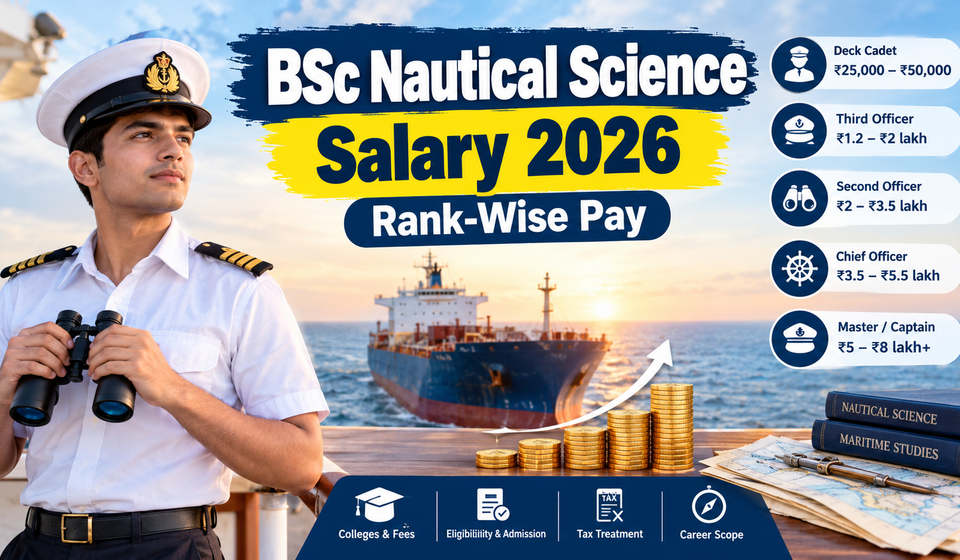
The following indicative monthly salary ranges are based on the DGMA’s nautical officer career guide.
| Rank | Indicative Monthly Salary (₹) | Experience Stage |
|---|---|---|
| Deck Cadet (training) | 25,000–50,000 | During sea training |
| Third Officer | 1.2–2 lakh | First licensed officer rank |
| Second Officer | 2–3.5 lakh | 2–5 years |
| Chief Officer | 3.5–5.5 lakh | 5–10 years |
| Master / Captain | 5–8 lakh+ | 10+ years |
These are indicative salary ranges, not guaranteed industry-wide rates. DGMA notes that actual salary depends on the shipping company, vessel type, flag state, and individual qualifications.
Important: Seafarers are not paid a traditional monthly salary throughout the year. You are paid a monthly salary during your contract (typically 4–9 months onboard), and you may earn nothing or reduced pay during leave. Your contract earnings = monthly salary × paid months onboard. A Third Officer earning ₹1.5 lakh/month on a 7-month contract earns approximately ₹10.5 lakh in that contract — not ₹18 lakh. Contract earnings are not necessarily equivalent to annual take-home pay after deductions, taxes, and unpaid leave periods.
How Merchant Navy Salary Works
Three structural features make seafarer salaries different from shore jobs:
1. Contract-based pay. You earn only when you are onboard a vessel. Contracts typically run 4–9 months, followed by leave. Your annual income depends on how many months you actually sail.
2. USD-denominated pay (foreign flag). Most Indian seafarers work on foreign-flag vessels and are paid in US dollars. Indian-flag vessels pay in INR, which is generally lower. DGMA does not publish a fixed comparison between foreign-flag and Indian-flag pay; actual rates vary by company and contract terms.
3. Tax treatment depends on residential status. A seafarer’s Indian income-tax position depends on the applicable residency rules, the nature and source of the income, and the circumstances of the employment. Spending time outside India does not, by itself, guarantee tax exemption. For the 2026–27 tax year, readers should consult the Income Tax Act, 2025 and current Income Tax Department guidance. The treatment of salary credited to an NRE account also depends on the applicable legal conditions. Consult a qualified tax professional before making decisions based on an assumed tax benefit.
BSc Nautical Science Salary by Rank
Deck Cadet Salary
During your mandatory 12–18 months of sea training after the 3-year degree, you are a Deck Cadet. This is a training rank, not a licensed officer position. The DGMA career guide lists the indicative stipend as ₹25,000–₹50,000/month.
Some company-sponsored cadets receive a stipend during training. Self-funded cadets may receive a lower stipend or no stipend and must find their own berth, which can take time.
Third Officer Salary
This is your first licensed officer rank. The DGMA career guide lists the indicative monthly salary as ₹1.2–₹2 lakh.
Foreign-flag vessels may pay in USD, with contract terms and pay varying by company, vessel type, and trade route. Indian-flag vessels generally pay at the lower end of the range.
Second Officer Salary
After serving as a watchkeeping officer, you are promoted to Second Officer. Indicative monthly salary: ₹2–₹3.5 lakh.
Chief Officer Salary
The Chief Officer is the second-in-command on the vessel and manages cargo operations, crew discipline, and deck maintenance. Indicative monthly salary: ₹3.5–₹5.5 lakh.
Master / Captain Salary
The Master holds ultimate command of the vessel. Indicative monthly salary: ₹5–₹8 lakh or more.
BSc Nautical Science vs DNS: Salary and Career Comparison
A common question is whether BSc Nautical Science or the 1-year Diploma in Nautical Science (DNS) leads to better pay. At the same rank, salaries are identical — the difference is the pathway.
| Factor | BSc Nautical Science | DNS |
|---|---|---|
| Duration | 3 years + 12 months sea time | 1 year + 18 months sea time |
| Degree | Full B.Sc. degree | Diploma leading to B.Sc. (Applied Nautical Science) |
| Age limit | General: 17–25 years | General: 17–21 years |
| Salary at same rank | Same | Same |
| Higher studies options | Wider | More limited initially |
| Starting speed | Slower | Faster |
Source: DGMA career pathway guide.
Sea-time clarification: The official Second Mate (FG) examination criteria list a minimum of 12 months of approved sea service as a deck cadet for both BSc Nautical Science and DNS candidates. The structured training pathway differs: BSc Nautical Science integrates 12 months of shipboard training after the 3-year degree, while DNS students complete 18 months of structured shipboard training as part of their 1-year diploma programme. The 18-month figure is a programme training requirement, not a universal examination requirement for all candidates. Verify current requirements with the Directorate General of Shipping.
BSc graduates benefit from a full degree, broader shore-based career options, and a longer eligibility window. DNS graduates start earning sooner but may face more limited options for higher studies later.
Read More: AME Salary / MNS Salary / IMU CET Salary / Eurasian CEO Salary / Electro Technical Officer Salary
Is BSc Nautical Science Salary Tax-Free?
This is the most misunderstood aspect of Merchant Navy pay. The salary is not automatically tax-free — but it can be outside the scope of Indian taxable income under specific conditions.
The framework:
- Under Section 6 of the Income Tax Act, 2025, an individual is treated as a tax resident if they stay in India for 182 days or more in the relevant tax year, or for 60 days or more coupled with 365 days or more in the preceding four years. These conditions are identical to Section 6(1) of the Income Tax Act, 1961.
- A special relaxation applies to Indian citizens leaving India for employment outside India or as a crew member of an Indian ship: they are regarded as a resident only if their stay in India is 182 days or more during the relevant tax year. The 60-day condition does not apply to them. The Income Tax Department confirms this special relaxation continues unchanged under the Income Tax Act, 2025.
- If you qualify as a Non-Resident, CBDT Circular No. 13/2017 (dated 11 April 2017) clarifies that remuneration received by a non-resident seafarer for services rendered outside India on a foreign ship shall not be included in total income merely because it has been credited to an NRE account maintained with a bank in India.
Important: If your stay in India reaches 182 days, your residential status may change under the applicable rules. However, residency must be determined using the full statutory provisions and your individual circumstances — including the source of income, employment conditions, and any applicable exceptions. Keep accurate travel and employment records, and consult a qualified tax professional before assuming your salary is exempt from Indian income tax.
BSc Nautical Science Fees: Government vs Private Colleges
The fee difference between government (IMU) and private maritime institutes is significant.
Government Colleges (IMU Campuses)
According to the official IMU fee schedule for UG programmes, the total fee for B.Sc. (Nautical Science) is ₹2,25,000 per academic year for residential students, payable as:
| Component | Amount (₹) |
|---|---|
| Programme fee (odd semester) | 25,000 |
| Semester fee (odd semester) | 1,00,000 |
| Semester fee (even semester) | 1,00,000 |
| Total per academic year | 2,25,000 |
A one-time refundable caution deposit of ₹20,000 is collected at admission.
Note: Semester fees include tuition, library, laboratory, workshop, industrial visits, extracurricular activities, medical fees, mess charges, lodging charges, laundry, uniform, and books. They do not include the caution deposit. Some third-party sources cite ₹2,75,000/year, which may include additional hostel or mess charges beyond the academic fee. Verify current fees directly with IMU before applying, as fees are subject to revision.
Private Colleges (Indicative Ranges)
Private college fees vary widely and often include accommodation, uniforms, and maritime training equipment. Indicative total fees for 3 years:
| Institute | Total Fees (3 Years) |
|---|---|
| Tolani Maritime Institute (TMI), Pune | ₹22.07 lakh (estimated total for 2026–27 batch, including tuition, campus fees, mess, uniform, insurance, and IMU charges) |
| AMET University, Chennai | ₹10.35–13.23 lakh (indicative range; tuition varies by year and includes food, accommodation, uniform, and DGS cess) |
| Chitkara University, Punjab | ₹11.1 lakh (includes tuition of ₹10.1 lakh and other fees of ₹1 lakh) |
Verify current fees directly with the institute before applying, as these are indicative and subject to change.
Eligibility and Admission for BSc Nautical Science 2026
Eligibility criteria (per IMU 2026–27 prospectus):
- Educational: 10+2 with Physics, Chemistry, Mathematics (PCM) — minimum 60% aggregate
- English: Minimum 50% in English in 10th or 12th
- Age: Maximum age for Male: General-25 years, OBC(NCL)-28 years, SC/ST-30 years. For Female: General-27 years, OBC(NCL)-30 years, SC/ST-32 years. Age limits are calculated as of 1 August 2026 for the 2026–27 admission session (the date of commencement of the academic session).
- Marital status: Unmarried
- Medical: Vision 6/6 unaided, no colour blindness; DGS-approved medical fitness certificate
- Entrance exam: IMU CET 2026
- Sponsorship: For BSc Nautical Science at IMU campuses, sponsorship is not required. Sponsorship is required for the DNS programme at affiliated institutes. Verify the specific requirement with your chosen institute.
Note on SC/ST candidates: A 5% relaxation in eligibility marks of PCM is available, but this relaxation does not apply to English marks.
Career Scope After BSc Nautical Science
The primary career path is the Merchant Navy deck department: Deck Cadet → Third Officer → Second Officer → Chief Officer → Master/Captain. Progression depends on sea service, clearing DGS/IMO competency examinations, and available employment opportunities.
Shore-based options include marine surveying, marine superintendency, port operations, ship brokering, and maritime education/training. Salary figures for shore-based roles vary widely and should be verified from reliable industry sources.
The government of India’s Maritime India Vision 2030 and Sagarmala Programme are intended to support growth in the maritime sector; specific employment outcomes depend on market conditions and are not guaranteed.
Read More: WB Primary Teacher Salary / Village Field Assistant Salary / Village Accountant Salary
Important Factors That Affect Your Actual Salary
Vessel type. LNG carriers and tankers generally pay more than standard container ships or bulk carriers. Higher pay is often linked to additional tanker endorsements and specialised training. DGMA does not publish fixed vessel-type salary premiums; actual differences depend on the company and contract.
Flag state. Foreign-flag vessels generally pay in USD and may offer different contract terms compared to Indian-flag vessels. DGMA notes that flag state is one of the factors affecting actual pay but does not publish a fixed comparison.
Manning agency. The same rank at different companies can differ significantly. Research the company before signing.
Additional certificates. Tanker endorsements (oil, chemical, gas), Dynamic Positioning (DP) certification, and ECDIS type-specific training can enhance eligibility for higher-paying roles.
Contract length. A higher monthly salary on a short contract may yield less annual income than a slightly lower salary on a longer contract. Calculate contract earnings, not just monthly pay.
Illustrative Merchant Navy Salary Progression
Illustrative example only. The ranks and years shown below are not a typical promotion schedule, a forecast, or a guaranteed career path. Actual progression depends on sea service, examination success, available berths, and individual circumstances. The figures show hypothetical contract earnings, not annual take-home pay.
Consider an officer who graduates in 2026 and sails consistently:
| Year | Rank | Indicative Monthly Salary (₹) | Paid Months | Contract Earnings (₹) |
|---|---|---|---|---|
| 2026–27 | Deck Cadet | 35,000 | 9 | 3.15 lakh |
| 2027–28 | Third Officer | 1.5 lakh | 7 | 10.5 lakh |
| 2029–30 | Second Officer | 2.5 lakh | 7 | 17.5 lakh |
| 2032–33 | Chief Officer | 4.5 lakh | 6 | 27 lakh |
| 2035–36 | Master | 6.5 lakh | 6 | 39 lakh |
This illustrates a key point: annual income depends heavily on contract months, not just monthly salary. A Third Officer who sails 9 months may earn more than a Chief Officer who sails only 4 months in a given year.
Frequently Asked Questions
1. What is the starting salary after BSc Nautical Science?
2. Is BSc Nautical Science salary tax-free?
Answer: Not automatically. A seafarer’s salary is not tax-free by default. Tax treatment depends on your residential status, the nature and source of the income, and the applicable law. If you spend 182 days or more outside India in a financial year and qualify as a Non-Resident, remuneration for services rendered outside India on a foreign-going ship may be outside the scope of Indian total income, per CBDT Circular No. 13/2017. Residency depends on the full statutory rules and your individual circumstances — consult a qualified tax professional.
3. Which is better: BSc Nautical Science or DNS?
Answer: Both lead to the same officer ranks and the same indicative salary at those ranks. DNS is faster (1 year + 18 months sea time) but has a lower general-category age limit (21 vs. 25) and limits higher studies options initially. BSc Nautical Science takes longer but provides a full degree and broader shore-based career options.
4. What are the jobs after BSc Nautical Science?
Answer: At sea: Deck Cadet, Third Officer, Second Officer, Chief Officer, Master/Captain. On shore: Marine Surveyor, Marine Superintendent, Port Manager, Ship Broker, Logistics Analyst, Nautical Surveyor, and maritime education/training roles.
5. Is BSc Nautical Science a good career in 2026?
Answer: If you are comfortable with a contract-based lifestyle, extended periods away from home, and physical/medical fitness requirements, the potential earnings are significant. A Third Officer’s indicative monthly salary (₹1.2–₹2 lakh) can be higher than many Indian professionals with comparable experience. However, the training phase is low-paid, and self-funded cadets may face uncertainty in securing their first berth. Career progression depends on examinations, sea service, and employment availability.
6. What is the salary after DNS?
Answer: DNS graduates earn the same indicative salary as BSc Nautical Science graduates at the same rank. The difference is that DNS graduates complete their pre-sea training in 1 year instead of 3, so they can reach officer rank sooner. However, they must complete 18 months of structured shipboard training as part of their programme, compared to 12 months for BSc graduates. The Second Mate (FG) examination itself requires 12 months of approved sea service for both pathways.
Read More: UPNL Salary / Merchant Navy Salary / Paramedical Salary / Merchant Navy Deck Cadet Salary



[…] More: BSc Nautical Science Salary / AME Salary / MNS Salary / IMU CET Salary / Eurasian CEO […]