
NDA Salary 2026: What Cadets Earn During Training and What Officers Earn After Commissioning

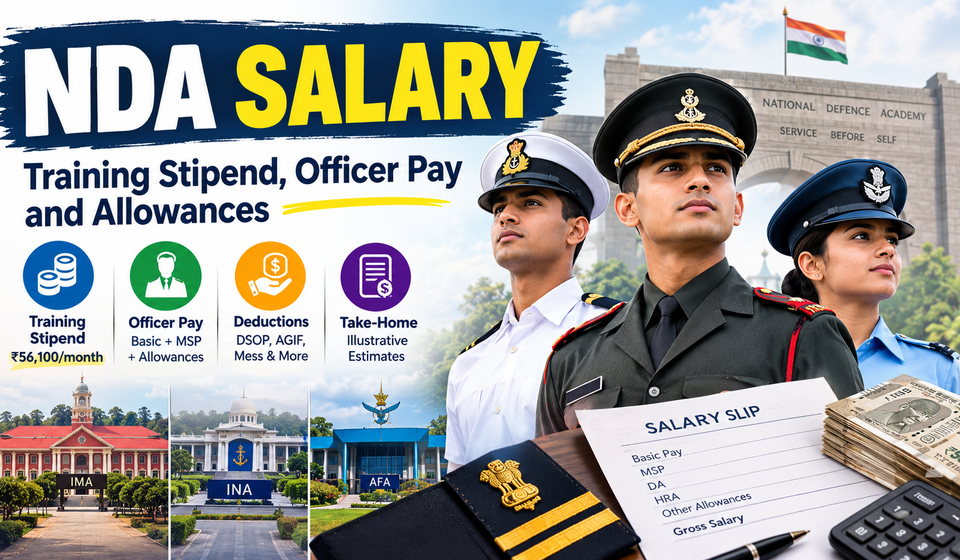
Quick answer: During training at the service academies — the Indian Military Academy, Indian Naval Academy and Air Force Academy — cadets receive a fixed stipend of ₹56,100 per month, corresponding to the first cell of Level 10 in the 7th CPC pay matrix. The official gazette describes the stipend as payable “during the entire duration of training in Service academies i.e. during training period at IMA,” and states that the training period “shall not be treated as commissioned service.” The ₹56,100 stipend is therefore not a three-year NDA salary; it is a service-academy training allowance.
On commissioning as a Lieutenant (Army), Sub-Lieutenant (Navy) or Flying Officer (Air Force), the officer’s basic pay is fixed at ₹56,100 in Level 10, and Military Service Pay (MSP) of ₹15,500 per month is added from the rank of Lieutenant up to Brigadier. Allowances such as DA, HRA and posting-specific pays are additional and depend on the officer’s posting and prevailing government orders. The amount credited to the bank account is always lower than gross pay after deductions — but NPS is not one of those deductions, because the National Pension System explicitly excludes the armed forces. The relevant provident-fund deduction for a defence officer is the DSOP, not the NPS.
NDA Training Stipend: What the Official Record Actually Says
The ₹56,100 monthly stipend is paid during the training period at the service academies — IMA for Army cadets, INA for Navy cadets and AFA for Air Force cadets. The gazette notification is specific: “Stipend to male/female Cadets during the entire duration of training in Service academies i.e. during training period at IMA — Rs 56,100/- p.m. (Starting pay in Level 10)”.
Three clarifications matter here, and they correct a widespread misreading.
First, the stipend is not a three-year NDA salary. The NDA at Khadakwasla is the academic and preliminary training phase. The ₹56,100 stipend attaches to the service-academy phase that follows — IMA, INA or AFA. A secondary source puts this clearly: the stipend “is provided only during the training phase at service academies such as the Indian Military Academy (IMA), Air Force Academy (AFA), or Indian Naval Academy (INA)” and “begins after completing the three-year academic program” at the NDA. An aspirant should not model the full three years at NDA at ₹56,100 per month. During the NDA phase itself, cadets are not commissioned officers and the stipend framework described in the gazette applies to the service-academy period.
Second, the stipend is a training allowance, not commissioned service. The gazette states that the training period “shall not be treated as commissioned service,” and that arrears on account of admissible allowances for the training period are paid after commissioning. This is why DA and regular officer allowances are not added to the ₹56,100 during training.
Third, a significant part of the stipend is consumed by academy expenses. Mess charges, clothing and academy incidentals are deducted, and accommodation, food and medical care are provided free. The amount available for personal use is therefore materially lower than ₹56,100, but the exact disposable figure varies by academy, mess and training stage. This article does not publish a specific cadet take-home range, because deduction schedules vary and secondary ranges conflict. Readers should confirm mess and academy recoveries from their joining instructions.
NDA Officer Salary After Commissioning
On commissioning, officers enter the 7th CPC pay matrix at Level 10. The entry-level ranks across the three services are equivalent for pay purposes: Lieutenant (Army), Sub-Lieutenant (Navy) and Flying Officer (Air Force). All start at the same basic pay: ₹56,100 per month.
The Two Fixed Pillars: Basic Pay and MSP
Basic Pay (Level 10): ₹56,100 per month on commissioning, with annual increments that move the officer through the pay matrix.
Military Service Pay (MSP): A fixed ₹15,500 per month paid to officers from the rank of Lieutenant to Brigadier. MSP is counted for Dearness Allowance and pension calculations, but not for HRA or annual increments.
Together, basic pay and MSP produce a fixed monthly floor of ₹71,600 before any variable allowances are added.
Rank-Wise Basic Pay Progression (7th CPC Defence Pay Matrix)
These are starting basic pay figures at the listed level, not the salary every officer of that rank receives. MSP, DA, HRA and other allowances are additional. MSP of ₹15,500 applies from Lieutenant to Brigadier and not above Brigadier.
| Rank (Army / Navy / Air Force) | Pay Level | Starting Basic Pay (₹/month) | MSP applicable? |
|---|---|---|---|
| Lieutenant / Sub-Lt / Flying Officer | Level 10 | ₹56,100 | Yes |
| Captain / Lieutenant / Flight Lieutenant | Level 10B | ₹61,300 | Yes |
| Major / Lt Commander / Squadron Leader | Level 11 | ₹69,400 | Yes |
| Lieutenant Colonel / Commander / Wing Commander | Level 12A | ₹1,21,200 | Yes |
| Colonel / Captain / Group Captain | Level 13 | ₹1,30,600 | Yes |
| Brigadier / Commodore / Air Commodore | Level 13A | ₹1,39,600 | Yes |
| Major General / Rear Admiral / Air Vice Marshal | Level 14 | ₹1,44,200 | No |
| Lieutenant General (HAG) / Vice Admiral / Air Marshal | Level 15 | ₹1,82,200 | No |
| COAS / CNS / CAS | Level 18 | ₹2,50,000 (fixed) | No |
Source note: The level assignments and starting basic pay align with the gazette pay matrix. The Level 11 range for Major runs from ₹69,400 to ₹2,07,200. The COAS figure is a fixed apex salary and is not comparable to entry-level pay. DA, HRA and other allowances are additional and depend on posting and prevailing government orders.
A note on “NDA salary after 10 years”: Basic pay after ten years depends on the officer’s promotion history and the number of annual increments accumulated in the applicable level. Using the pay matrix as an illustration: an officer promoted to Major enters Level 11 at Cell 1 of ₹69,400. Four annual increments in that level move basic pay to approximately ₹78,100 (the progression is ₹69,400 → ₹71,500 → ₹73,600 → ₹75,800 → ₹78,100). This is a cell-based illustration, not an entitlement — actual pay depends on the exact date of promotion (typically around the six-year mark for Major) and the increment cells accumulated, so the figure could be somewhat lower or higher. Readers should treat any ten-year estimate as conditional on promotion and increment history, not as a fixed range.
Read More: Graphic Designer Salary / Cyber Security Salary / Mail Guard Salary / Enrolled Agent Salary
Allowances: Rates, Categories and Eligibility
Basic pay and MSP are only part of the picture. The gazette notification lists specific allowance rates for defence officers. The figures below are drawn from the official notification and the Indian Army’s published allowance table.
| Allowance | Rate for officers | Notes |
|---|---|---|
| Flying Allowance (Army aviators) | ₹25,000/month | For qualified Army aviation officers |
| Para Allowance | ₹10,500/month | For parachute-qualified personnel |
| Special Forces Allowance | ₹25,000/month | For Special Forces personnel |
| Technical Allowance Tier-I | ₹3,000/month | Tier-II: ₹4,500/month |
| Highly Active Field Area Allowance | ₹16,900/month | For designated highly active field areas |
| Field Area Allowance | ₹10,500/month | For designated field areas |
| Modified Field Area Allowance | ₹6,300/month | For modified field areas |
High-altitude allowance is paid by category. The Indian Army’s official allowance table gives a Lieutenant the following monthly rates: Category III ₹14,000, Category II ₹2,000 and Category I ₹1,325. At the senior end, a Brigadier receives Category III ₹14,000, Category II ₹4,000 and Category I ₹2,650. The Siachen Allowance is ₹17,500 per month across officer ranks. Eligibility depends on the altitude and classification of the posting.
The Three Allowances That Most Affect Gross Pay
Dearness Allowance (DA) is the largest single variable. The confirmed rate effective 1 January 2026 is 60% of basic pay, under Department of Expenditure O.M. No. 1/1(i)/2026-E.II(B) dated 22 April 2026. As of the verification date of 24 October 2026, the July 2026 instalment had not been announced; no newer DA order appeared on the Department of Expenditure circulars page on that date, and reporting through late October 2026 confirms the hike remains pending. The 63% figure is a formula estimate, not a government rate. Any salary model should state the DA rate used and label 63% as an estimate, not a confirmed entitlement.
House Rent Allowance (HRA) is paid at 30% for X-category cities, 20% for Y-category cities and 10% for Z-category cities of basic pay. Officers who occupy government accommodation do not receive HRA.
Transport Allowance depends on city classification and is separate from HRA.
Illustrative Gross Salary Model (Lieutenant, X-Category City)
This is a calculated illustration based on stated assumptions. It is not a salary slip and does not represent a guaranteed entitlement.
Assumptions:
- Basic pay: ₹56,100 (Level 10, first cell).
- MSP: ₹15,500.
- DA: 60% of (basic + MSP), the confirmed rate effective 1 January 2026.
- HRA: 30% of basic pay, assuming an X-category city and no government accommodation.
- No transport allowance, field allowance or special pay included.
| Component | Amount (₹/month) |
|---|---|
| Basic Pay (Level 10) | 56,100 |
| Military Service Pay | 15,500 |
| DA at 60% on (basic + MSP) | 42,960 |
| HRA at 30% of basic (X-category) | 16,830 |
| Illustrative Gross Salary | ~1,31,390 |
Limitations: DA is a percentage revised by government order; at an estimated 63% from July 2026, gross pay would rise, but that rate is not notified. HRA depends on city classification and accommodation status. Field allowances and special pays are excluded. This is gross pay before deductions.
Deductions: What Actually Reduces an Officer’s Pay
NPS does not apply to the armed forces.
The PFRDA states that the National Pension System was launched with effect from 1 January 2004 “excluding personnel from the armed forces”. A defence officer is therefore not subject to the NPS contribution that applies to civilian Central Government employees. Any salary model that deducts NPS from a Lieutenant’s pay is wrong.
The correct deduction categories are:
The practical effect of the NPS correction: Removing a 10% NPS deduction substantially changes the estimated take-home. The correct model uses DSOP at the 6% minimum, AGIF at the reported scheme rate, and mess charges — but the AGIF figure is reported and scheme-dependent, and the result should be treated as an illustrative scenario, not a verified salary figure.
Pay Remaining After DSOP and AGIF, Before Tax and Mess (Illustrative Scenario)
This section was previously headed “net pay.” That label was misleading, because the figure excludes income tax and mess charges. The correct description is pay remaining after the two largest deductions, before tax and mess.
The table below is an illustrative scenario, not a verified entitlement.
| Item | Basis | Approximate amount (₹/month) |
|---|---|---|
| Illustrative gross pay | From the model above | ~1,31,390 |
| Less: DSOP contribution | 6% of basic pay (₹56,100) | 3,366 |
| Less: AGIF premium | Reported regular-officer scheme rate | 12,500 |
| Pay remaining after DSOP and AGIF, before tax and mess | Calculated from stated and reported assumptions | ~1,15,524 |
This is not a verified salary figure. It is sensitive to the DA rate (60% confirmed; 63% estimated but not notified), HRA eligibility (30% in an X-category city, zero in government accommodation), the AGIF premium actually applicable, mess charges, and income tax. A field posting without HRA would produce a lower gross figure, partially offset by field-area or high-altitude allowances where eligible.
On the commonly quoted “₹1.15 lakh–₹1.20 lakh” range: One 2026 compilation states that “monthly take-home pay may be around ₹1.15 lakh to ₹1.20 lakh in a metro city, depending on the officer’s posting and deductions”. That range is broadly consistent with the illustrative scenario above, but it is a third-party reported estimate, not an official figure. This article presents it as a reported range, not as a verified entitlement.
NDA Salary vs IAS Salary: A Component-Level Comparison
NDA officers start at Level 10, and IAS officers also start at Level 10. The comparison is not straightforward because the components differ. A defence officer receives MSP of ₹15,500, which a civil service officer does not. Conversely, a civil service officer is covered by NPS and may receive allowances a defence officer does not.
The pension-contribution comparison is often stated incorrectly. Under NPS for covered Central Government employees, the employee contributes 10% of basic pay plus DA, and the employer (Government) contributes 14% of basic pay plus DA — not a matching 10%. A defence officer, by contrast, contributes to DSOP at a 6% minimum with no employer contribution, subject to a ₹5 lakh annual subscription ceiling. The structural difference is therefore not simply “10% versus 6%”; it is 10% employee plus 14% employer against 6% employee plus no employer contribution. That difference affects long-term retirement outcomes as well as monthly take-home.
The meaningful comparison is at the level of total effective compensation, including non-cash benefits. For the civil-service side, see TheSalaryPoint’s guide to IAS salary.
A note on ECHS: The Ex-Servicemen Contributory Health Scheme is not a serving officer’s medical benefit. ECHS “caters for medical care to all Ex-Servicemen (ESM) pensioners” and their dependants, and eligibility requires ESM status and pension from CDA. Serving officers receive medical care through military hospitals and service medical facilities. Any comparison that counts ECHS as a benefit available to a serving Lieutenant is inaccurate.
Read More: BSc Nautical Science Salary / AME Salary / MNS Salary / IMU CET Salary / Eurasian CEO Salary
NDA Eligibility: Cycle-Specific and Notification-Dependent
NDA entry is open to unmarried male and female candidates who have passed or are appearing for Class 12. The age window is approximately 16.5 to 19.5 years, but the exact birth-date range is set separately for each examination cycle.
Educational stream matters, and it differs by wing. For the Army Wing, candidates from any stream — Science, Commerce or Arts — can apply. For the Air Force, Navy and Naval Academy, Physics, Chemistry and Mathematics (PCM) in Class 12 are compulsory. This is a distinction that secondary salary articles often omit, and it affects whether a candidate is eligible for a particular wing before salary is even relevant.
NDA II 2026 cycle: The UPSC released the notification on 20 May 2026. The last date for applications was extended to 11 June 2026, 6:00 pm. The written examination was held on 13 September 2026. Candidates must be born not earlier than 1 January 2008 and not later than 1 January 2011, both dates inclusive. This range is specific to the NDA II 2026 notification and should not be applied to other cycles.
Why the range changes: The NDA I 2026 cycle used a different range because the course commencement date and age computation differ between cycles. This is not an inconsistency; it is how the UPSC defines eligibility per notification. Do not rely on a secondary summary — check the official UPSC NDA notification for the specific cycle at upsc.gov.in.
Final Takeaway
The NDA salary structure is transparent and predictable at its base — ₹56,100 during service-academy training, and ₹56,100 basic pay plus ₹15,500 MSP on commissioning — but variable and posting-dependent at the gross and take-home levels. Three corrections matter more than any single figure. First, the ₹56,100 stipend is a service-academy allowance, not a three-year NDA salary. Second, NPS does not apply to the armed forces; the relevant deductions are DSOP and AGIF. The DSOP 6% is a minimum contribution, and the ₹5 lakh figure is an annual subscription ceiling, not a cap on the contribution rate. The AGIF ₹12,500 premium is a reported scheme rate, not a pay rule. Third, the July 2026 DA rate is a formula estimate, not a confirmed order as of the date verified. Any take-home figure should be treated as an illustrative scenario based on stated and reported assumptions, and the reader should verify the current DA order, AGIF scheme rate and posting entitlements against official sources before relying on a number.
FAQs
1. Does NPS apply to NDA officers?
Answer: No. The PFRDA states that the National Pension System was launched with effect from 1 January 2004 excluding personnel from the armed forces. A defence officer contributes to the DSOP, which requires a minimum of 6% of basic pay with no employer contribution, effective March 2024 under a PCDA(O) message implementing MoD order No.14(1)/2023-D(Pay/Services) dated 13.03.2024. Any salary article that deducts NPS from an NDA officer’s pay is incorrect.
2. What is the ₹5 lakh DSOP ceiling — is it a limit on contributions?
Answer: It is a ceiling on annual subscription to DSOP, not a cap on the contribution rate. The PCDA(O) message dated 19.03.2024 applies the GPF ceiling of ₹5 lakh per year under DoP&PW O.M. dated 11.10.2022 to DSOP from FY 2024–25, while separately retaining the 6% minimum contribution. Officers may contribute above 6%, subject to the annual subscription ceiling.
3. How much does an NDA cadet actually receive during training?
Answer: The gazette stipend is ₹56,100 per month during service-academy training at IMA, INA or AFA. After mess and academy deductions, the disposable amount is materially lower, but this article does not publish a specific range because deduction schedules vary by academy. Confirm mess and academy recoveries from your joining instructions.
4. Is the ₹56,100 stipend paid for all three years at NDA?
Answer: No. The gazette ties the stipend to “the entire duration of training in Service academies i.e. during training period at IMA.” The three-year NDA phase precedes the service-academy phase.
5. What is the July 2026 DA rate for defence officers?
Answer: The confirmed rate is 60% effective 1 January 2026, under Department of Expenditure O.M. No. 1/1(i)/2026-E.II(B) dated 22 April 2026. As of the verification date of 24 October 2026, the July 2026 revision had not been announced, and reporting through late October 2026 confirms the hike remains pending. The formula points to approximately 63%, but this is an estimate, not a government rate.
6. What is the AGIF premium for a regular Army officer?
Answer: Reported scheme material places the monthly contribution for regular Army officers at ₹12,500, corresponding to ₹1.25 crore insurance cover and ₹25 lakh disability cover. This is a reported scheme rate, not a gazette-notified pay rule. Confirm the applicable premium with your pay office.
7. Can an NDA officer’s take-home salary exceed ₹1 lakh per month?
Answer: In many postings, yes, but not as a guaranteed or verified figure. A Lieutenant in an X-category city with 60% DA and 30% HRA has an illustrative gross pay of approximately ₹1.31 lakh. After the 6% DSOP contribution and the reported AGIF premium, the pay remaining before tax and mess is approximately ₹1.15 lakh. A reported range of ₹1.15 lakh–₹1.20 lakh in a metro city is broadly consistent, but it is an estimate, not an official entitlement.
8. Which stream should I take in Class 12 to be eligible for NDA?
Answer: It depends on the wing. The Army Wing accepts candidates from any stream — Science, Commerce or Arts. The Air Force, Navy and Naval Academy require Physics, Chemistry and Mathematics in Class 12. Check the specific UPSC notification for the cycle you are applying to, because eligibility is defined per notification.
Read More: Electro Technical Officer Salary / WB Primary Teacher Salary / Village Field Assistant Salary



[…] More: NDA Salary / Graphic Designer Salary / Cyber Security Salary / Mail Guard […]
[…] More: SSC CHSL Salary / NDA Salary / Graphic Designer Salary / Cyber Security Salary / Mail Guard […]
[…] More: SSC CHSL Salary / NDA Salary / Graphic Designer Salary / Cyber Security Salary / Mail Guard […]