

Author: Sachin
Reviewer: Salary Research Desk
Published: 25 November 2026
Last Updated: 25 November 2026
Salary Data Checked: 25 November 2026
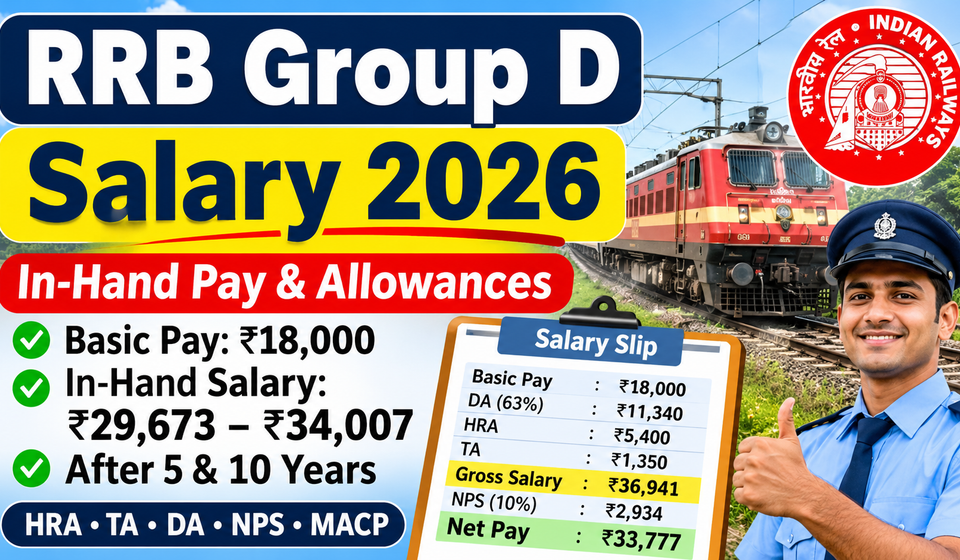
Quick Answer: RRB Group D (Level 1 posts) starts at a basic pay of ₹18,000 per month under the 7th CPC pay matrix. With Dearness Allowance at 63% (effective 1 July 2026), a new employee’s estimated in-hand salary ranges from ₹29,673 in a Z-class town to ₹34,007 in an X-class city, depending on House Rent Allowance and Transport Allowance. These are estimates before minor deductions; actual pay varies by posting location and whether railway quarters are allotted. How we calculated these figures ↓
RRB Group D Salary at a Glance (2026)
| Component | Details |
|---|---|
| Formal designation | Level 1 posts, 7th CPC Pay Matrix (popularly “Group D”) |
| Pay Level | Level 1 |
| Starting Basic Pay | ₹18,000 per month |
| Pay Range (Basic) | ₹18,000 – ₹56,900 |
| Dearness Allowance (DA) | 63% of basic from 1 July 2026, per RBE 91/2026 dated 30.10.2026 |
| HRA (city-dependent) | 30% (X), 20% (Y), 10% (Z) of basic, per RBE 71/2017 |
| Transport Allowance (TA) | Standard: ₹1,350 + DA (higher TPTA city) or ₹900 + DA (other places). Higher slab of ₹3,600/₹1,800 + DA applies once Level 1 basic pay reaches ₹24,200, per RBE 96/2017 |
| Estimated In-Hand (X city, entry) | ₹34,007 (after NPS; typically zero TDS under the assumed new tax regime) |
| Estimated In-Hand (Z town, entry) | ₹29,673 |
| Annual Increment | One cell in the Level 1 pay matrix; the increase is broadly around 3% but is not calculated as a fixed multiplication |
| Recruitment Cycle | CEN 09/2025; 22,195 Level 1 vacancies, as listed by the Ministry of Railways in its July 2026 recruitment update. Railway-wise and post-wise vacancy details are subject to the issued corrigenda. |
Fact label: Basic pay and pay level are from the 7th CPC pay matrix. DA, HRA and TA figures are sourced from the Railway Board circulars linked above. In-hand figures are calculations/estimates based on the assumptions in the Methodology Note; they are not official pay slips.
What Is the In-Hand Salary of RRB Group D?
The in-hand salary is not a single fixed number because HRA and TA change with posting location. At the entry cell (Level 1, Cell 1):
| Component | X City (₹) | Y City (₹) | Z City/Town (₹) |
|---|---|---|---|
| Basic Pay | 18,000 | 18,000 | 18,000 |
| DA (63%) | 11,340 | 11,340 | 11,340 |
| HRA (30% / 20% / 10%) | 5,400 | 3,600 | 1,800 |
| Transport Allowance | 1,350 | 900 | 900 |
| DA on Transport Allowance (63%) | 851 | 567 | 567 |
| Gross Salary | 36,941 | 34,407 | 32,607 |
| Employee NPS (10% of Basic + DA) | 2,934 | 2,934 | 2,934 |
| Estimated Take-Home | 34,007 | 31,473 | 29,673 |
Note on HRA and TA classifications: HRA city classification (X/Y/Z) and higher Transport Allowance city eligibility (designated higher TPTA city) are determined separately under different rules. The estimates above pair an X-class HRA posting with a designated higher-TPTA city and a Z-class HRA posting with an other-place TA rate. The Y-city row uses the ₹900 + DA “other-place” TA rate; a Y-class HRA city does not automatically qualify for the higher TPTA slab. Actual salary depends on the employee’s specific posting and the applicable classifications.
Why actual pay can differ: These figures exclude CGEGIS (typically ₹30–₹50), professional tax (state-specific, usually ₹100–₹200), and post-specific allowances such as Risk & Hardship or Night Duty Allowance. They assume the new tax regime; TDS is typically zero at entry-level gross salary. If railway quarters are allotted, HRA is not paid and the take-home adjusts accordingly.
Read More: Sundar Pichai Salary / BSc Nursing Salary / Data Analyst Salary / RBI Grade B Salary / Agniveer Salary
RRB Group D Salary Structure: Component-by-Component
Basic Pay
Every Level 1 post starts at ₹18,000 in Cell 1 of the 7th CPC pay matrix. The grade pay of ₹1,800 that existed under the 6th CPC was merged into Pay Level 1; it is not an additional amount on top of basic pay.
Dearness Allowance (DA)
DA is revised twice a year to offset inflation. From 1 July 2026, the DA rate is 63% of basic pay, following a 3-percentage-point increase from 60%. Railway Board order RBE No. 91/2026 dated 30.10.2026 implements this revision. DA is a taxable salary component and is included in the calculation base for NPS contributions. Its rate is revised periodically through government orders.
House Rent Allowance (HRA)
HRA depends on the classification of the posting city: 30% of basic in X-class cities, 20% in Y-class cities, and 10% in Z-class cities/towns, per RBE No. 71/2017 dated 19.07.2017. These are the revised rates that apply once DA crosses 50%. At entry level, this means ₹5,400 (X), ₹3,600 (Y), or ₹1,800 (Z). If railway quarters are allotted, HRA is not paid.
Transport Allowance (TA)
TA covers daily commuting. The standard rates for Level 1 employees are ₹1,350 + DA in designated higher TPTA cities and ₹900 + DA at other places.
A higher TA slab applies once basic pay crosses ₹24,200. Under Railway Board RBE No. 96/2017 dated 17.08.2017, Railway employees in Pay Level 1 and Level 2 drawing pay of ₹24,200 and above become eligible for Transport Allowance of ₹3,600 + DA in higher TPTA cities and ₹1,800 + DA at all other places. This threshold is reached at the 10-year stage in Level 1 (basic pay ₹24,200), so the 10-year salary estimate in this article uses the higher TA slab.
Important distinction: The list of designated higher TPTA cities for TA purposes is not identical to the X/Y/Z classification used for HRA. An employee may be posted in a city classified one way for HRA and another way for TA.
Deductions and Pension Arrangement
The primary deduction is NPS: 10% of Basic + DA, which is ₹2,934 at entry. Under NPS, the government contributes 14% of Basic + DA to the employee’s corpus; this is an employer contribution, not part of in-hand salary.
UPS option: Railway Group D employees recruited under the NPS framework may be eligible to choose the Unified Pension Scheme (UPS), subject to applicable Railway Board rules and option conditions. Under UPS — notified by Railway Board as RBE 75/2026 dated 16.09.2026 — the employee contributes 10% of emoluments, but the government contribution structure is different from NPS (reported at 18.5% under UPS, compared with 14% under NPS). The pension arrangement therefore depends on the employee’s selected option and eligibility.
Other deductions include CGEGIS, professional tax (state-specific, usually ₹100–₹200 per month where applicable), and income tax (TDS). TDS is typically zero at entry-level gross salary under the new tax regime, but may become applicable if the employee’s taxable income exceeds the relevant exemption and rebate limits, depending on the applicable tax rules and the employee’s other income and deductions.
RRB Group D Salary After 3, 5, and 10 Years
Basic pay grows by one cell in Level 1 each year. The figures below assume one annual increment per completed year and no promotion. At the 10-year stage, the higher TA slab under RBE 96/2017 applies because basic pay reaches ₹24,200.
| Service Completed | Basic Pay (₹) | Estimated In-Hand — X / Higher TPTA City (₹) | Estimated In-Hand — Z / Other Place (₹) |
|---|---|---|---|
| Joining | 18,000 | 34,007 | 29,673 |
| 3 years | 19,700 | 37,011 | 32,337 |
| 5 years | 20,900 | 39,131 | 34,217 |
| 10 years | 24,200 | 48,629 | 40,855 |
Important assumption: The 10-year estimate shows pay progression within Level 1 only. It assumes no regular promotion and no MACP financial upgradation. An eligible employee may receive MACP after completing the prescribed service period, which can move the employee to a higher pay level (for example, Level 1 to Level 2) and change the salary materially. The ₹48,629 figure is therefore not the automatic 10-year outcome for every Group D employee; it is the outcome for an employee who remains in Level 1 and does not receive MACP.
These figures represent the position of an employee who remains in Level 1 without promotion. Employees who clear departmental examinations and move to Group C enter a higher pay level entirely, which resets basic pay and all allowances upward.
Career Growth and Promotion from RRB Group D
Group D is an entry-level recruitment, not a dead-end role. However, promotion is not automatic, and outcomes depend on departmental rules, eligibility, examinations, and vacancy availability.
Departmental Promotion to Group C
Eligibility periods for promotion to Group C vary by post and department. While a period of around three years of regular service is common for some departmental routes, it should not be read as a universal Railway rule. Promotion is not automatic: it depends on the employee’s department, cadre, qualification, service eligibility, performance in the departmental examination, and the availability of vacancies. Different railway posts have different recruitment rules and selection procedures. Departmental examinations (such as LDCE and GDCE) are the usual route, but the specific posts available vary by department and the vacancies notified. Candidates should consult the recruitment rules for their specific cadre.
MACP (Modified Assured Career Progression)
MACP provides conditional financial upgradation to the next pay level. Under the scheme, three financial upgradations are contemplated on completion of 10, 20, and 30 years of regular service, counted from the direct entry grade, or on completion of 10 years of continuous service in the same level in the pay matrix, whichever is earlier. These upgradations are conditional, not automatic entitlements. Eligibility depends on fulfilment of the applicable service conditions, including the prescribed “Very Good” performance benchmark under Railway Board RBE No. 155/2016 dated 19.12.2016. Employees who have already earned regular promotions have those promotions counted against the MACP upgradations. MACP changes the pay level but does not change the employee’s designation, duties, or seniority.
Is Railway Group D a “Good” Salary?
This depends on the comparison being made.
Strengths: Permanent government employment with a defined pay matrix and annual increments. Non-monetary benefits — subsidised quarters where available, medical care for the employee and dependents, leave benefits, and travel concessions — add substantial effective value beyond the cash salary. The eligibility criteria (typically 10th pass or ITI, depending on the post) make it accessible to a wide candidate pool. At entry-level pay, income tax is effectively zero under the new tax regime, so the in-hand-to-gross ratio is high.
Limitations to weigh honestly: Posting location materially affects take-home pay, and remote postings may offer fewer amenities. Many Group D roles involve physical or shift-based work; the salary reflects the level of the post, not the physical demands. Promotion to Group C requires clearing departmental examinations and depends on vacancy availability; those who do not clear them remain in Level 1 with annual increments and MACP upgradations as applicable.
For a candidate seeking stable government employment with a defined progression path, the RRB Group D salary is competitive at the entry level, particularly when non-cash benefits are included. It is not designed to match private-sector salaries for skilled professionals, but it offers a different risk-and-reward profile.
Read More: Loco Pilot Salary / B Pharmacy Salary / Blinkit Delivery Boy Salary / EMRS TGT Salary / Lawyer Salary
RRB Group D Salary Slip: Sample Breakdown
The following is an illustrative monthly salary slip for an X-class city posting without railway quarters at entry level. It is not an official pay slip.
| Earnings | Amount (₹) | Deductions | Amount (₹) |
|---|---|---|---|
| Basic Pay | 18,000 | NPS (Employee Contribution) | 2,934 |
| Dearness Allowance (63%) | 11,340 | CGEGIS | 30 |
| House Rent Allowance (30%) | 5,400 | Professional Tax | 200 |
| Transport Allowance | 1,350 | ||
| DA on Transport Allowance | 851 | ||
| Gross Earnings | 36,941 | Total Deductions | 3,164 |
| Net Pay (Bank Credit) | 33,777 |
The net pay shown here differs slightly from the “estimated take-home” figure of ₹34,007 because the salary slip includes CGEGIS and professional tax, which the take-home estimate excludes. Actual salary slips may include additional allowances or deductions depending on the specific post, department, and posting location.
RRB Group D Salary vs Other Railway Posts
The comparison below uses the same calculation method (DA at 63%, applicable HRA, NPS at 10% of Basic + DA) and assumes a designated higher TPTA city with the applicable TA slab for each level. These are different recruitment categories, not automatic promotions from Group D.
| Post Category | Pay Level | Starting Basic (₹) | Applicable TA Slab | Estimated In-Hand — Higher TPTA City (₹) |
|---|---|---|---|---|
| Group D | 1 | 18,000 | ₹1,350 + DA (below ₹24,200 threshold) | 34,007 |
| NTPC | 2 | 19,900 | ₹1,350 + DA (below ₹24,200 threshold) | 37,364 |
| NTPC | 3 | 21,700 | ₹3,600 + DA (Level 3 rate) | 44,212 |
| NTPC | 4 | 25,500 | ₹3,600 + DA (Level 4 rate) | 50,927 |
The TA column matters: Level 1 and Level 2 start on the ₹1,350 slab, while Level 3 and Level 4 draw ₹3,600 + DA in higher TPTA cities from the outset. Using a single TA assumption across all levels would understate the Level 3 and Level 4 take-home figures. Recruitment to Level 2 and above is through separate examinations (such as RRB NTPC), not through automatic promotion from Group D.
Methodology Note
The salary estimates in this article use the following assumptions:
- Basic Pay: Cell 1 of Level 1 (₹18,000) for new entrants; successive cells for annual increments, reaching ₹24,200 at the 10-year stage.
- DA: 63% of basic pay, effective 1 July 2026, per Railway Board RBE 91/2026 dated 30.10.2026.
- HRA: 30% (X class), 20% (Y class), 10% (Z class) of basic pay, per RBE 71/2017.
- TA: Standard slab of ₹1,350 + DA (higher TPTA) or ₹900 + DA (other places) for Level 1 below ₹24,200 basic pay; higher slab of ₹3,600 + DA or ₹1,800 + DA applies once basic pay reaches ₹24,200, per RBE 96/2017. The 10-year estimate applies the higher slab.
- NPS: 10% of Basic + DA (employee contribution); government contribution assumed at 14% for the NPS baseline. UPS has a different government contribution structure and is not modelled in the in-hand figures above.
- Tax: New tax regime assumed; TDS is typically zero at the salary levels estimated here. Actual tax depends on the employee’s total income and applicable rules.
- Exclusions: CGEGIS, professional tax, and post-specific allowances are excluded from the “estimated take-home” figures but included in the sample salary slip.
- HRA/TA classification: HRA city classification (X/Y/Z) and higher-TPTA city eligibility for TA are determined separately. The estimates pair an X-class HRA posting with a higher-TPTA city, a Y-class HRA posting with an other-place TA rate, and a Z-class HRA posting with an other-place TA rate.
- MACP: The 10-year projection assumes no MACP financial upgradation. An eligible employee receiving MACP may move to a higher pay level, producing a different salary outcome.
These are illustrative calculations, not official pay slips. Individual pay depends on the posting order, department, and applicable allowances at the time.
FAQs
1. What is the RRB Group D salary per month in 2026?
Answer: Basic pay is ₹18,000. With DA at 63% and city-dependent HRA/TA, the estimated in-hand salary at entry level ranges from ₹29,673 (Z city/town) to ₹34,007 (X city) after NPS, before minor deductions.
2. Is RRB Group D salary after 5 years higher than the starting salary?
Answer: Yes. Annual increments raise basic pay to approximately ₹20,900 after five years (assuming no promotion), and DA is calculated on the higher basic. Estimated in-hand pay after five years is ₹34,217–₹39,131 depending on city class. At 10 years, basic pay reaches ₹24,200 and the higher TA slab applies, producing a larger step-up—unless MACP or a regular promotion intervenes.
3. What is the highest salary in RRB Group D?
Answer: The highest basic pay in Level 1 (without promotion or MACP) is ₹56,900 at the top of the pay matrix. In-hand salary at that level depends on DA at the time, HRA, and TA, but it is substantially higher than the entry figure. Promotion to Group C, MACP upgradation, or both can raise the ceiling further.
4. Is RRB Group D a permanent job?
Answer: Yes. Recruitment through RRB for Level 1 posts is for permanent government posts in Indian Railways, subject to the usual probation period. It is not a contract or temporary position.
5. What is the promotion timeline from Group D to Group C?
Answer: Eligibility periods vary by post and department. A period of around three years of regular service is common for some departmental routes, but it is not a universal rule. Promotion is not automatic; it depends on the employee’s department, cadre, qualification, performance in the departmental examination, and the availability of vacancies. Separately, MACP provides conditional financial upgradation after 10, 20, and 30 years if regular promotion has not been received.
6. Does RRB Group D salary include PF or NPS?
Answer: It includes NPS as the default framework, but eligible employees may opt for the Unified Pension Scheme (UPS) under the applicable Railway Board rules. Under NPS, the employee contributes 10% of Basic + DA and the government contributes 14%. Under UPS, the employee contribution remains 10% of emoluments, but the government contribution structure is different (reported at 18.5%). The pension arrangement therefore depends on the employee’s selected option and eligibility.
7. What happens to Transport Allowance after basic pay crosses ₹24,200?
Answer: Under Railway Board RBE 96/2017, Level 1 and Level 2 employees drawing basic pay of ₹24,200 and above become eligible for the higher TA slab: ₹3,600 + DA in designated higher TPTA cities and ₹1,800 + DA at other places. For a Level 1 employee, this threshold is reached at the 10-year stage with normal annual increments, unless a promotion or MACP intervenes.
Read More: Software Engineer Salary / SSC CHSL Salary / NDA Salary / Graphic Designer Salary / Cyber Security Salary