
BSc Cardiac Technology Salary in India (2026): Per Month Pay, Government vs Private, and Career Scope

Last Updated: September 2026 | Fact Checked: September 2026
Reviewed by: Sachin
Salary data checked: September 2026
Primary sources: Government recruitment notifications + employer salary listings
Important: Market salary figures are indicative; government figures are labeled by employment type.
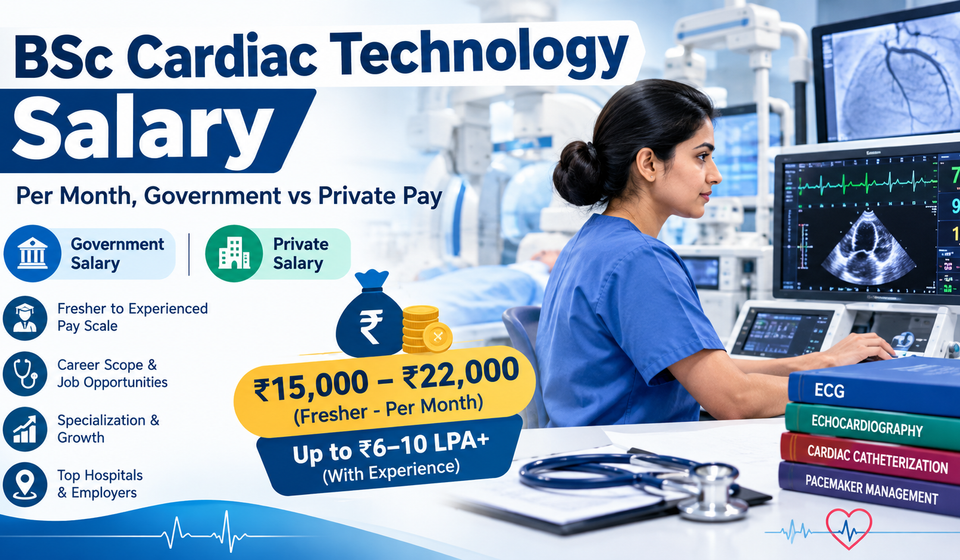
Quick Answer: A BSc Cardiac Technology graduate in India typically earns between ₹15,000 and ₹22,000 per month in the first year after graduation. With 3–5 years of experience, published private-sector salary ranges in this article commonly fall around ₹3–5 LPA, depending on the employer and role. Experienced specialists may reach ₹6–10 LPA or more in some roles and employers. Government contractual posts and permanent pay scales vary widely — a 2026 Kerala PSC notification for Cath Lab Technician Grade II listed a pay scale of ₹31,100–66,800, while a 2026 SVIMS recruitment for an MSc-qualified Cardiovascular Technician offered ₹37,600 per month on a contractual basis.
Salary at a Glance: BSc Cardiac Technology Salary
| Experience | Monthly Salary (Private) | Annual Salary (Private) |
|---|---|---|
| Fresher (0–1 year) | ₹15,000 – ₹22,000 | ₹1.8 – 2.64 LPA |
| Junior (1–3 years) | ₹18,000 – ₹28,000 | ₹2.16 – 3.36 LPA |
| Mid-level (3–5 years) | ₹25,000 – ₹40,000 | ₹3 – 4.8 LPA |
| Senior (5+ years) | ₹35,000 – ₹60,000+ | ₹4.2 – 7.2 LPA+ |
Government salary: varies by post and employment type. Examples in 2026 range from trainee stipends and contractual salaries to permanent scales such as ₹31,100–₹66,800 (Kerala PSC).
What Is BSc Cardiac Technology?
BSc Cardiac Technology, BSc Cardiac Care Technology and BSc Cardiovascular Technology are related programme names used by different institutions, but their curricula and eligibility requirements can differ. Broadly, these are 3-year undergraduate degrees (plus practical training/internship) that train students to assist cardiologists in diagnosing and treating heart conditions. The course covers human anatomy, cardiovascular physiology, electrocardiography (ECG), echocardiography, cardiac catheterization, and pacemaker management.
Graduates work as cardiac technologists, cath lab technicians, echo technologists, ECG technicians, and electrophysiology specialists in hospitals, diagnostic labs, and cardiac device companies.
Course Details and Eligibility
| Parameter | Details |
|---|---|
| Course Duration | Many programs are structured as 3 academic years followed by practical training or internship; duration and internship requirements vary by institution |
| Eligibility | 10+2 with Physics, Chemistry, Biology (PCB); minimum 50% aggregate (varies by institution) |
| Entrance Exam | NEET requirement varies by institution and state. Some universities use Class 12 merit, while others may consider NEET-UG, their own entrance exam, or a state-level admission process. Always check the latest admission rules of the institution you are applying to. |
| Key Subjects | Human Anatomy, Cardiovascular Physiology, ECG, Echocardiography, Cardiac Catheterization, Pharmacology |
| Course Fee (Examples) | Published fees for private institutions range from ₹65,000 per year (Integral University) to ₹1,70,000 per year (JKKN College). Students should check the latest fee structure published by the institution. |
BSc Cardiac Technology Salary Per Month: Fresher to Experienced
The table below presents indicative private-sector salary ranges compiled from employer-provided job listings and employee-reported salary data available for 2026.
| Experience Level | Private Monthly Salary | Approx. Annual Salary (Private) |
|---|---|---|
| Fresher (0–1 year) | ₹15,000 – ₹22,000 | ₹1.8 – 2.64 LPA |
| Junior (1–3 years) | ₹18,000 – ₹28,000 | ₹2.16 – 3.36 LPA |
| Mid-level (3–5 years) | ₹25,000 – ₹40,000 | ₹3 – 4.8 LPA |
| Senior (5+ years) | ₹35,000 – ₹60,000+ | ₹4.2 – 7.2 LPA+ |
Note on data quality: Private hospital salary figures are based on employer-provided ranges published on job portals such as Glassdoor and SimplyHired, as well as employee-reported data from AmbitionBox. These ranges do not include government pay scales, which are presented separately below.
Government Hospital Salary for Cardiac Technologists
Many government-institution recruitment examples for cardiac-technology roles are contractual, project-based, or trainee positions with consolidated pay. Permanent posts, where available, follow the pay scale specified in the individual recruitment notification. Examples from 2026 recruitment notifications include:
Source basis: These figures come directly from official recruitment notifications. These represent specific contractual or trainee positions and do not reflect permanent government pay scales. Direct notification links are provided in the Sources section at the end of this article.
For permanent government posts, the pay level and allowances follow the specifications in the individual recruitment notification. For example, the 2026 Kerala PSC notification (Category No. 29/2026) for Cath Lab Technician Grade II listed a pay scale of ₹31,100–66,800 for candidates with a Bachelor’s degree in Cardio Vascular Technology and one year of experience. Permanent government recruitment varies by state, institution, and post, so candidates should check individual notifications for eligibility, vacancies, and pay scales.
Read More: Army Public School Teacher Salary / BSc Forensic Science Salary / GP Rating Salary / BSc Anesthesia Salary
Private Hospital Salary: What Real Job Listings Show
Private hospital salary data from 2026 job listings reveals the following employer-provided ranges. These are published salary ranges from job portals, not theoretical estimates.
Note: The Meitra Hospital listing is a senior 5+ years role and should not be interpreted as an entry-level BSc Cardiac Technology salary. The DPlus Diagnocare listing is for a Cardiology Technician role in Delhi, with a salary range of ₹18,000–₹30,000 per month.
These are employer-provided ranges published on job portals. They indicate what hospitals are offering in 2026, but they are not a comprehensive national dataset. Direct listing links are provided in the Sources section.
MSc Cardiac Technology Salary
A Master’s degree in Cardiac Technology or Cardiovascular Technology can expand access to advanced roles and may improve earning potential, but salary still depends on experience, specialization, and employer.
According to SVIMS Tirupati’s 2026 recruitment, an MSc-qualified Cardiovascular Technician was offered ₹37,600 per month on a contractual basis. Higher MSc-level salaries are generally associated with more advanced roles and greater experience; the degree itself does not guarantee a particular salary.
Salary by Specialization
Not all cardiac technology roles pay the same. The table below shows indicative market ranges compiled from employer-provided data and industry reporting. These ranges should be treated as indicative market estimates rather than national averages. These specialist ranges should not be compared directly with the fresher salary table because they represent experienced roles, different employers and, in some cases, medical-device positions.
| Specialization | Starting Salary (LPA) | Experienced Salary (LPA) |
|---|---|---|
| Cath Lab Technologist | ₹3 – 4.5 | ₹5 – 10 |
| Echocardiography Technologist | ₹2.5 – 4 | ₹4 – 8 |
| Electrophysiology (EP) Technologist | ₹3.5 – 5 | ₹6 – 12 |
| Cardiac CCU/ICCU Technologist | ₹2.5 – 4 | ₹4 – 7 |
| Clinical Application Specialist (device companies) | ₹4 – 5 | ₹6 – 12+ |
Source: Employer-provided ranges on Glassdoor and AmbitionBox. Higher pay in specialized roles is not automatic and depends on employer, specialization depth, and individual performance.
Factors That Affect BSc Cardiac Technology Salary
1. City and Location
Salary varies by city, employer, hospital type, and local hiring conditions. Metropolitan hospitals and specialized cardiac centres may have different salary structures from smaller-city employers. For example, current Delhi NCR listings show Cardiology Technician roles in the ₹18,000–₹30,000 per month range (DPlus Diagnocare listing, Glassdoor, June 2026).
2. Hospital Type
Compensation can vary significantly by employer. Corporate hospital chains may offer different pay structures than standalone clinics, and government contractual posts may offer competitive consolidated pay without the benefits of permanent employment. The employer-provided listings in this article illustrate this variation.
3. Specialization
Pay can vary by specialization. The ranges in the specialization table above show that different cardiac technology roles have different indicative market ranges.
4. Additional Certifications
International certifications such as Registered Diagnostic Cardiac Sonographer (RDCS) — offered by the American Registry for Diagnostic Medical Sonography (ARDMS) — may be relevant for overseas roles. Eligibility and recognition depend on the credentialing body and country, and certification does not automatically guarantee higher pay.
5. Experience and Negotiation
Relevant procedural skills and role-specific experience may help candidates qualify for more specialized positions and negotiate within an employer’s salary range.
Cardiac Technology vs Cardiac Care Technology vs Cardiovascular Technology
These names are used by different institutions for related BSc-level cardiac-care programmes, and they are often used interchangeably in job listings. Broadly:
- Cardiac Technology / Cardiac Care Technology: Focuses on diagnostic procedures (ECG, echo, TMT, Holter) and assisting in cath lab procedures.
- Cardiovascular Technology: A broader term that may include cardiac catheterization, vascular interventions, and sometimes perfusion. Some institutions use this term for their BSc programs.
- Cardiac Perfusion Technology: A separate specialization focused on operating the heart-lung machine during open-heart surgery. This requires a different skill set and often a separate degree.
Job titles also vary: “Cardiac Technician,” “Cardiac Technologist,” “Cath Lab Technician,” and “Echo Technician” are not automatically interchangeable. Employers may require different qualifications for each role.
Career Scope After BSc Cardiac Technology
Career opportunities for cardiac and cardiovascular technology professionals are available across hospitals, diagnostic facilities, medical-device companies and government health programmes. The demand spans:
- Hospitals and cardiac centres: Cath lab, echo lab, CCU, and EP lab roles
- Diagnostic labs: ECG, Holter, TMT, and echocardiography services
- Medical device companies: Clinical application specialist roles at Medtronic, Abbott, Boston Scientific
- Government health programmes: Contractual and permanent technical posts
- Overseas opportunities: Overseas opportunities may be available in countries such as the UK, UAE, Saudi Arabia and Singapore, but requirements vary by employer, licensing authority, qualification and experience.
Read More: VAO Salary / ICDS Supervisor Salary / Para SF Commando Salary / BAMS Doctor Salary / Ajit Doval Salary
Illustrative ₹25,000 Gross Salary Example
For illustration, consider a private-hospital cardiac technologist earning ₹25,000 gross per month. The following is one possible salary structure; it is not a standard industry breakup.
| Component | Amount (₹) |
|---|---|
| Basic Salary | 12,500 |
| HRA (40% of basic) | 5,000 |
| Special Allowance | 7,500 |
| Gross Monthly Salary | 25,000 |
| Employee PF (12% of basic) | 1,500 |
| Professional Tax | 200 |
| Estimated In-Hand | ₹23,300 |
Important: This is an illustrative example only. There is no standard salary breakup applicable to all hospitals. Actual in-hand salary depends on the employer’s CTC structure, tax regime, and location. Many hospitals do not follow this exact breakup.
Frequently Asked Questions
1. Is BSc Cardiac Technology a good career?
Answer: It can be a suitable career for students interested in allied health sciences and cardiac-care procedures. Entry-level salaries are generally modest, while specialization, experience, and employer type can affect later earnings.
2. Is NEET required for BSc Cardiac Technology?
Answer: NEET is not universally required for BSc Cardiac Technology. Admission requirements vary by university and state. Some institutions use Class 12 merit, while others may require NEET-UG, their own entrance exams, or state-level entrance processes. Prospective students should check the specific requirements of their target institution.
3. What is the highest salary after BSc Cardiac Technology?
Answer: There is no fixed maximum salary after BSc Cardiac Technology. Published market ranges show that some experienced specialist and medical-device roles can reach around ₹10–12 LPA or higher, but compensation varies considerably by employer, specialization, experience and location. Some senior Cath Lab Technologist listings advertise up to ₹12 LPA (Meitra Hospital, Glassdoor, July 2026).
4. Can I become a cardiologist after BSc Cardiac Technology?
Answer: No. BSc Cardiac Technology is an allied-health degree and does not itself qualify someone to practise as a cardiologist. Becoming a cardiologist requires the medical education pathway — MBBS followed by MD in General Medicine and then DM in Cardiology. BSc Cardiac Technology graduates work as technologists who assist cardiologists, not as doctors.
5. What is the starting salary after BSc Cardiac Technology?
Answer: Freshers typically start at ₹15,000 to ₹22,000 per month in private hospitals.
6. Does an MSc increase salary significantly?
Answer: An MSc can expand access to advanced roles and may improve earning potential, but salary still depends on experience, specialization, and employer. An MSc-qualified Cardiovascular Technician at SVIMS was offered ₹37,600 per month in 2026, compared to entry-level BSc salaries of ₹15,000–22,000 per month.
Final Takeaway
BSc Cardiac Technology provides career opportunities across hospitals, diagnostic services, cardiac centres and medical-device companies. Entry-level private-hospital salaries are generally around ₹15,000–₹22,000 per month, although individual employer listings can be higher. Compensation can increase with experience, specialization, employer and location. Government and public-institution compensation varies substantially by employment type. Examples include a ₹9,600 trainee stipend at SCTIMST, ₹23,000–₹37,600 monthly contractual roles, and permanent pay scales such as Kerala PSC’s ₹31,100–₹66,800 scale. Experienced specialists may reach ₹6–10 LPA or more in some roles and employers. For students willing to build procedural expertise, cardiac technology offers a defined career pathway with opportunities for growth.
Methodology Note: Salary ranges in this article were compiled from employer-provided job listings on Glassdoor and SimplyHired, employee-reported data on AmbitionBox, official recruitment notifications from government institutions (Kerala PSC, TATA Memorial Centre, SVIMS Tirupati, SCTIMST), and institutional career outcome data. Monthly and annual figures are mathematically consistent within each row. Government figures are labeled as contractual, trainee, or permanent where applicable. Estimates are distinguished from official figures throughout.
Read More: D Pharmacy Salary / SBI PO Salary / Commercial Pilot Salary / Pashu Paricharak Salary / CA Salary



[…] More: BSc Cardiac Technology Salary / Army Public School Teacher Salary / BSc Forensic Science […]
[…] More: BSc Optometry Salary / BSc Cardiac Technology Salary / Army Public School Teacher […]