

- Author: Sachin
- Published: 17 November 2026
- Last Updated: 17 November 2026
- Salary Data Checked: 17 November 2026
- Tax provisions referenced: FY 2026–27 (AY 2027–28), new regime — Income-tax Act, 2025: Section 202 (rates), Section 19 (standard deduction ₹75,000), Section 156 (rebate, formerly 87A). 4% health and education cess applies.
Quick Answer
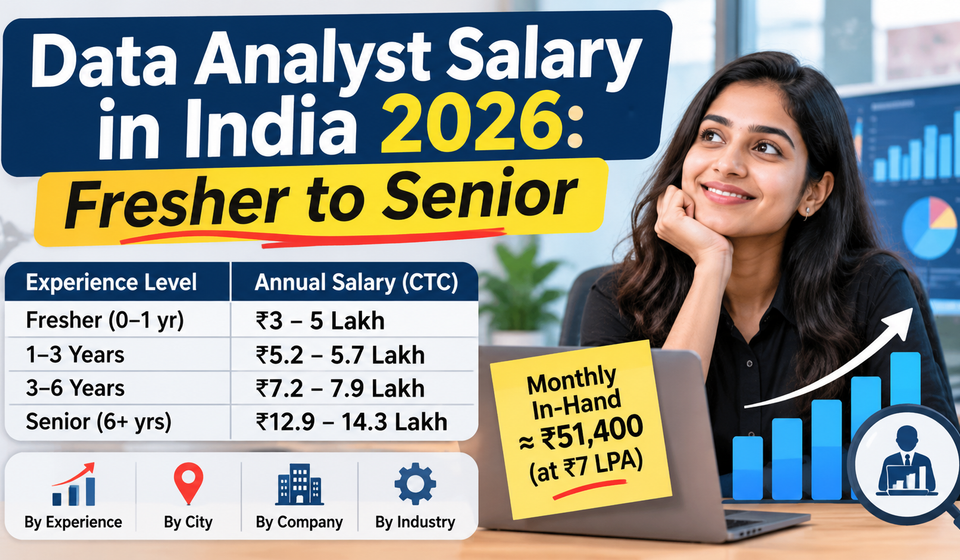
Most data analysts in India earn ₹4 lakh to ₹8 lakh a year. The middle of the market — analysts with 0–6 years of experience — sits at ₹6.5–7.2 lakh CTC, freshers typically start at ₹3–5 lakh, and the Senior Data Analyst title carries ₹12.9–14.3 lakh.
Those are CTC figures. A ₹7 lakh package usually delivers roughly ₹51,400 a month in hand for a salaried resident individual under the new tax regime, because income tax at that level is nil once the ₹75,000 standard deduction under Section 19 and the Section 156 rebate are applied. A CTC that bundles variable pay will pay less each month.
Every figure on this page is either self-reported by employees, derived from job postings, or calculated from a stated assumption. None is a guaranteed salary. Salary and tax rules change; verify anything decision-critical against official sources before acting on it.
What a Data Analyst Actually Does
Salary numbers mean little without knowing what the job pays for. A data analyst turns raw business data into something a manager can act on. In practice that means four recurring activities:
- Pulling data — writing SQL against a warehouse or production database to answer a specific question.
- Cleaning and validating — reconciling duplicates, missing values and definitional mismatches before anything is reported.
- Building and maintaining reporting — dashboards in Power BI or Tableau, recurring MIS packs, self-serve views for business teams.
- Interpreting — explaining why a metric moved, not just that it moved.
The fourth activity is where pay separates. Analysts who only produce numbers sit in the ₹4–6 lakh band. Analysts who are trusted to explain a churn spike, a pricing anomaly or a funnel leak sit in the ₹8–15 lakh band. Employers are not paying for SQL syntax; they are paying for judgement applied to ambiguous data.
This distinction explains almost every pay variance discussed below.
Average Data Analyst Salary in India
| Source | Average | Range / percentile | Sample | Basis | As of |
|---|---|---|---|---|---|
| AmbitionBox | ₹6.5–7.2 lakh (0–6 yrs) | Title bands, see below | ~1.5 lakh | Employee salary reports | 19 Oct 2026 |
| PayScale | ₹5.8 lakh | ₹2.9 lakh (10th pct) – ₹10 lakh (90th pct) | 2,081 profiles | Self-reported profiles | Oct 2026 |
| Indeed | ₹6.2 lakh | ₹3.0–12.6 lakh | 470 salaries | Job postings | Nov 2026 |
| Glassdoor | ~₹6.5 lakh | ~₹4–10 lakh typical | 11,236 salaries | Employee reports | Mar 2026 |
Source links and bases. AmbitionBox Data Analyst salaries in India (employee salary reports; page updated 19 Oct 2026, read 22 Oct 2026 via Skillcept’s compilation). PayScale India Data Analyst salary (self-reported profiles, updated Oct 2026). Indeed India Data Analyst salaries (advertised posting ranges, checked Nov 2026). Glassdoor India Data Analyst salary (anonymous employee reports, 11,236 submissions as of March 2026).
Four independent methodologies land within roughly ₹1 lakh of each other, which is a reasonable signal that the central tendency is real. The spread within each source — PayScale’s 10th-to-90th percentile gap is about 3.4× — is the more useful fact. The average tells you what the market pays; the spread tells you what the market pays people like you.
Why the sources disagree
AmbitionBox and Glassdoor rely on self-submitted salaries, which skew toward larger employers whose employees are more likely to report. PayScale collects profile-level data tied to job titles as users self-describe them, so “Data Analyst” there sometimes captures people doing BI development or reporting work. Indeed’s figures come from postings, which reflect advertised ranges rather than actual offers — and advertised upper bounds are frequently aspirational.
None of these is wrong. They are measuring different things, and a reader comparing their own salary should look at the source whose sampling most closely resembles their situation.
Read More: RBI Grade B Salary / Agniveer Salary / Loco Pilot Salary / B Pharmacy Salary / Blinkit Delivery Boy Salary
Data Analyst Salary by Experience
This is the table most readers actually need, and it is the one most salary pages handle badly by substituting job titles for experience.
| Experience | Published band | Sample | Reliability |
|---|---|---|---|
| 0–1 year | ₹3.5–5.2 lakh | 30 | Small sample — treat as indicative |
| 1–3 years | ₹5.2–5.7 lakh | 84,200 | Source-published; robust sample |
| 3–6 years | ₹7.2–7.9 lakh | 66,500 | Source-published; robust sample |
| 6–9 years | ₹7.7–11.3 lakh | 58 | Small sample — do not rely on the band |
| 0–6 years (overall) | ₹6.5–7.2 lakh | ~1.5 lakh | Typical range |
Source: AmbitionBox, Data Analyst salaries in India, updated 19 October 2026, read 22 October 2026, as published in Skillcept’s Data Analyst salary guide (sources checked 22 Oct 2026). All figures are employee salary reports.
The 1–3 and 3–6 year bands are directly published, experience-bucketed AmbitionBox bands, not derived estimates. The earlier draft labelled them derived because the compiling source’s presentation was ambiguous; the published table discloses 84,200 and 66,500 salaries behind those two bands respectively. They can be cited as AmbitionBox’s experience-wise figures.
The small-sample flags are not cosmetic. The 0–1 year band rests on 30 salaries and the 6–9 year band on 58. AmbitionBox itself notes that the title changes as people grow: freshers are often hired as Junior Data Analysts or MIS Analysts, and experienced analysts carry Senior or Lead titles. That is why the 6–9 year band looks anomalously wide and why title-based bands, below, are more reliable guides at that level. A reader with 7 years of experience should read the Senior Analyst and Lead rows rather than the 6–9 year row.
The experience curve, as a multiple
- 1–3 years ≈ 1.5× the fresher band’s lower bound — the first step up.
- 3–6 years ≈ 2.1× the fresher band’s lower bound — the second.
- Senior title ≈ 3.2× the junior title (directly reported title bands) — the single largest jump.
The early years are flatter than the multiples suggest at the upper end of each range, and the Senior title jump is driven by scope, not tenure. A reported industry increment of roughly 9% (see below) compounds far too slowly to move an analyst from ₹4 lakh to ₹13 lakh on tenure alone.
Title bands for reference
| Title | Typical band (₹ lakh/yr) | Experience in sample | Reports |
|---|---|---|---|
| Junior Data Analyst | 4.0–4.4 | 0–4 years | 6,900 |
| Associate Data Analyst | 6.5–7.1 | 0–5 years | 3,800 |
| Data Analyst | 6.5–7.2 | 0–6 years | ~1.5 lakh |
| Senior Data Analyst | 12.9–14.3 | 2–9 years | 26,100 |
| Lead Data Analyst | 17.8–19.7 | 3–12 years | 3,300 |
| Analytics Manager | 25.8–28.5 | 4–14 years | 3,600 |
Source: AmbitionBox Data Analyst salaries, checked 17 November 2026. Employee salary reports.
Note the overlap: the Senior band’s sample starts at two years of experience. Title, not tenure, is doing the work here — which is why chasing the title matters more than waiting out the calendar.
Data Analyst Salary Per Month
Annual bands are hard to compare against a monthly budget. This table converts CTC into an estimated monthly figure using one consistent formula, stated below and applied identically to every row. All figures in this table have been independently recalculated and verified against the formula.
The formula
- Basic salary = 40% of CTC
- Employer PF = 12% of basic = 4.8% of CTC
- Gratuity provision = 4.81% of basic = 1.924% of CTC
- Monthly gross = (CTC − employer PF − gratuity) ÷ 12
- Employee PF = same rupee amount as employer PF
- Professional tax = ₹2,400/year (₹200/month) — state-dependent; nil in some states
- Income tax = new regime, FY 2026–27, Section 202 rates, ₹75,000 Section 19 standard deduction, Section 156 rebate, plus 4% health and education cess
- Monthly in-hand = (Gross − employee PF − professional tax − income tax) ÷ 12
| Level | Annual CTC | Monthly gross | Est. monthly in-hand |
|---|---|---|---|
| Fresher (0–1 yr) | ₹4.0 lakh | ₹31,092 | ₹29,292 |
| Junior (1–2 yrs) | ₹5.0 lakh | ₹38,865 | ₹36,665 |
| Mid (3–4 yrs) | ₹6.5 lakh | ₹50,525 | ₹47,725 |
| Analyst (4–6 yrs) | ₹7.2 lakh | ₹55,966 | ₹52,886 |
| Senior (6–9 yrs) | ₹13.6 lakh | ₹1,05,713 | ₹1,00,073 |
| Lead | ₹18.7 lakh | ₹1,45,355 | ₹1,26,075 |
Reconciliation check. At ₹4 lakh: employer PF ₹19,200 + gratuity ₹7,696 → annual gross ₹3,73,104 → monthly gross ₹31,092. Taxable income after ₹75,000 standard deduction is below the Section 156 rebate threshold, so tax is nil; in-hand = ₹31,092 − ₹1,600 employee PF − ₹200 professional tax = ₹29,292. At ₹18.7 lakh: employer PF ₹89,760 + gratuity ₹35,979 → annual gross ₹17,44,261 → monthly gross ₹1,45,355. Taxable income after standard deduction exceeds ₹12 lakh, so the Section 156 rebate does not apply; estimated tax including 4% cess is approximately ₹1,39,206, leaving monthly in-hand of ₹1,26,075.
The senior and lead rows deserve particular caution. At ₹13.6 lakh, taxable income remains below the ₹12 lakh rebate threshold under these assumptions, so normal income tax is nil — which is why the in-hand figure is unusually close to gross. At ₹18.7 lakh the rebate no longer applies and tax becomes the dominant deduction. Both rows assume the entire CTC is fixed and paid in twelve equal instalments, which is rarely true at senior levels: performance bonuses, annual incentives, retention payments and stock awards all delay or reduce monthly cash. These are illustrative fixed-pay estimates, not payroll outputs.
Variable pay correction. A ₹7 lakh CTC with 10% variable pay gives approximately ₹46,250 monthly in-hand on the fixed component (fixed CTC ₹6.3 lakh), not the ₹47,000 stated in the earlier draft. The difference is small but the direction matters: variable pay reduces monthly cash flow until it is paid.
Data Analyst Salary for Freshers
Fresher pay clusters at ₹3–5 lakh, with the label on the offer mattering as much as the figure.
| Source and title | Figure | Sample | Basis | As of |
|---|---|---|---|---|
| AmbitionBox, Data Analyst, 0–1 yr | ₹3.5–5.2 lakh | 30 | Employee reports — small sample | 19 Oct 2026 |
| AmbitionBox, Associate Data Analyst, 0–1 yr | ₹4.7–5.2 lakh | 528 | Employee reports | Nov 2026 |
| AmbitionBox, Junior Data Analyst, 0–4 yrs | ₹4.0–4.4 lakh | 6,900 | Employee reports | Nov 2026 |
| PayScale, under 1 year | Average ₹4.13 lakh | 576 | Self-reported profiles | 5 Oct 2026 |
| Indeed, low end of postings | ₹3.0 lakh | 470 (all levels) | Job postings | Nov 2026 |
Source links: AmbitionBox (checked 17 Nov 2026); Skillcept compilation (AmbitionBox 0–1 year band and 30-salary sample, 22 Oct 2026); PayScale India (576 salaries under 1 year); Indeed India.
The structural split is by employer type, not by city or college tier:
- IT services and BPO/KPO (TCS, Infosys, Wipro, Accenture, Genpact) typically offer ₹3.5–6 lakh. High hiring volume, structured training, slower pay growth.
- Global Capability Centres and product companies offer more, but expect demonstrable independent SQL work and often a portfolio or assessment. Precise bands vary too much by employer and year to publish responsibly without a verifiable source.
- Startups are the widest variable. Offers range from below-market to well above it, usually correlated with funding stage.
For readers benchmarking a specific offer, the honest advice is that a placement-cell average is not a market average. Institutional placement reports describe the students who passed through one programme; they do not describe the national market. Treat any single fresher number — including those in this table — as one data point.
Data Analyst Salary by Industry
Industry is the strongest divider of pay after title and demonstrated skill.
| Industry | Typical band (₹ lakh/yr) | Reports | vs IT services |
|---|---|---|---|
| Financial services / banking | 9.1–10.2 | 6,300 | ≈1.6× |
| Management consulting | 8.1–8.9 | 12,700 | ≈1.4× |
| Internet companies | 7.4–8.2 | 7,000 | ≈1.3× |
| Analytics and KPO | 5.7–6.3 | 7,200 | ≈1.0× |
| IT services and consulting | 5.6–6.3 | 48,900 | baseline |
Source: AmbitionBox Data Analyst salaries by industry, checked 17 November 2026. Employee salary reports. Skillcept’s October 2026 compilation, also drawing on AmbitionBox, reports banking at ₹9.2–10.2 lakh and IT services at ₹5.7–6.3 lakh.
The ratio column is the analysis, not the data. Financial services pays roughly 60% more than IT services for work that carries the same job title. An analyst moving from an IT services firm to a bank’s risk or fraud analytics team can capture more in one switch than several years of increments would deliver.
The mechanism is domain scarcity. Analysts who understand credit risk, regulatory reporting, fraud patterns or pricing carry knowledge that cannot be hired off a generic analytics bench. That scarcity premium is durable in a way that tool-specific premiums are not.
IT services employs the largest number of analysts and pays the least on average, largely because much of that work is recurring reporting and dashboard maintenance rather than decision-shaping analysis — which returns us to the point made in the first section.
Data Analyst Salary by City
City premiums are real but consistently smaller than industry premiums.
| City | Typical band (₹ lakh/yr) | Reports | Lower bound vs Chennai |
|---|---|---|---|
| Bengaluru | 6.9–7.6 | 35,200 | +₹0.5 lakh |
| Hyderabad | 6.7–7.4 | 18,400 | +₹0.3 lakh |
| New Delhi | 6.6–7.3 | 11,100 | +₹0.2 lakh |
| Pune | 6.4–7.0 | 17,200 | ₹0 |
| Chennai | 6.4–7.1 | 11,000 | baseline |
Source: AmbitionBox Data Analyst salaries by city, checked 17 November 2026. Employee salary reports.
An important qualification on this table. The difference between the lower ends of the Bengaluru and Chennai bands is approximately ₹50,000 a year. However, the ranges overlap substantially — Chennai’s upper bound exceeds Bengaluru’s lower bound — so these figures do not establish a consistent city-wide salary premium. The ordering of the lower bounds is suggestive of a Bengaluru lead, not proof of one.
That caution matters because the comparison readers actually make is between industries, not cities. The gap between IT services and financial services in the industry table above is ₹3–4 lakh — several times larger than any defensible city effect.
Bengaluru’s leading position is usually attributed to the concentration of product firms, startups and GCCs that benchmark against global internal bands, with Hyderabad and Pune narrowing the gap by hosting large GCCs. Those are plausible mechanisms, not measured ones. A relocation purely for a city premium rarely pays for itself once moving costs, rent differentials and disruption are counted — but a relocation combined with an industry and role change can.
Read More: EMRS TGT Salary / Lawyer Salary / Software Engineer Salary / SSC CHSL Salary / NDA Salary
Data Analyst Salary by Company
Company-level data is self-selected and thinner than industry data. Directionally, for analysts at these employers, AmbitionBox reports typical bands of ₹7.3–8.1 lakh at Deloitte (1,100 salaries), ₹5.1–5.6 lakh at Accenture (1,400) and ₹4.1–4.6 lakh at TCS (3,100).
Source: AmbitionBox company salary pages, checked 17 November 2026. Employee salary reports; samples mix experience levels.
These figures illustrate the spread rather than define it. They are employee-reported, they mix experience levels, and they say nothing about any individual’s offer. A specific offer from any of these employers should be evaluated on its own components — fixed pay, variable, benefits, progression — not against an aggregate.
Where big-tech and product-company offers are concerned, published figures vary widely by year, role and location, and reliable sample sizes are rarely disclosed. This page does not publish specific numbers for those employers because doing so would require presenting an estimate as a fact. Readers evaluating such an offer should ask the recruiter directly for the fixed/variable split and the level, and cross-check against current employee reports on a platform that discloses sample sizes.
₹7 LPA In-Hand Salary: A Worked Example
₹7 lakh is the midpoint of the most common analyst band, so it makes a useful worked example. The calculation below is fully transparent so you can substitute your own structure.
Financial year and legal basis
This calculation applies the new tax regime for FY 2026–27 (assessment year 2027–28) under the Income-tax Act, 2025, which replaces the 1961 Act from 1 April 2026.
The section numbering has changed, and this matters for accuracy:
- Section 202 — new-regime tax rates (slabs: nil to ₹4 lakh; 5% ₹4–8 lakh; 10% ₹8–12 lakh; 15% ₹12–16 lakh; 20% ₹16–20 lakh; 25% ₹20–24 lakh; 30% above ₹24 lakh). Union Budget 2026–27 made no changes to these slabs.
- Section 19 — standard deduction of ₹75,000 for salaried taxpayers (formerly Section 16(ia)).
- Section 156 — rebate for eligible resident individuals (formerly Section 87A), which makes tax nil where normal taxable income is up to ₹12 lakh.
- 4% health and education cess applies on tax where any is payable.
Section 87A no longer exists as the operative reference for this year. Articles that cite it in a FY 2026–27 context are using the pre-2026 Act numbering. This page uses the current numbering.
Verify against the Income Tax Department’s current published guidance before relying on any number here for planning.
Assumptions
| Assumption | Value | Note |
|---|---|---|
| CTC | ₹7,00,000 | Fully fixed, no variable |
| Basic salary | ₹2,80,000 (40% of CTC) | Common range is 35–50% |
| HRA | ₹1,40,000 (50% of basic) | Metro, non-metro differs |
| Special allowance | ₹2,32,932 | Balancing figure |
| Employer PF | ₹33,600 (12% of basic) | Part of CTC, not paid to you monthly |
| Gratuity provision | ₹13,468 (4.81% of basic) | Part of CTC, vests after 5 years |
| Professional tax | ₹2,400/yr | State-dependent; nil in some states |
| Tax regime | New regime, FY 2026–27 (AY 2027–28) | Resident individual, salaried |
| Other income / deductions | Nil | — |
| Cess | 4% on tax payable | Health and education cess |
The calculation
Step 1 — Gross salary
CTC ₹7,00,000 − employer PF ₹33,600 − gratuity ₹13,468 = ₹6,52,932
Step 2 — Taxable income
Gross ₹6,52,932 − Section 19 standard deduction ₹75,000 = ₹5,77,932
Step 3 — Income tax
Taxable income falls below the ₹12 lakh Section 156 rebate threshold, so income tax is ₹0 (and therefore cess is also ₹0).
Step 4 — In-hand
₹6,52,932 − employee PF ₹33,600 − professional tax ₹2,400 − tax ₹0 = ₹6,16,932 per year
Result
| Bases | Annual | Monthly |
|---|---|---|
| Gross salary | ₹6,52,932 | ₹54,411 |
| Less: employee PF | ₹33,600 | ₹2,800 |
| Less: professional tax | ₹2,400 | ₹200 |
| Less: income tax | ₹0 | ₹0 |
| Net take-home | ₹6,16,932 | ≈₹51,411 |
This corrects a common error. Many salary pages still apply pre-rebate tax slabs and deduct ₹25,000–₹30,000 of income tax from a ₹7 lakh package. Under the Section 156 rebate for FY 2026–27, a salaried resident individual at this income level pays nil. Articles that deduct tax here understate take-home by roughly ₹2,000–₹2,500 a month.
Why your actual figure will differ
- Basic pay ratio. A 50% basic raises PF contributions and lowers monthly cash; a 30% basic does the opposite.
- Variable pay. A 10% variable component cuts fixed monthly gross and net in hand to roughly ₹46,250 on the fixed component until the variable is paid.
- Gratuity treatment. Some employers exclude gratuity from CTC, which raises the gross figure.
- Tax regime and declarations. Old-regime taxpayers with large 80C and 80D claims may pay less; those with other income may pay more.
- Professional tax. Nil in some states, higher in Maharashtra and Karnataka.
- ESI. Applies only below the wage ceiling and would add a small deduction.
Sample Monthly Payslip
The same ₹7 LPA structure, presented as it would appear on a payslip:
| Component | Monthly (₹) |
|---|---|
| Earnings | |
| Basic salary | 23,333 |
| House rent allowance | 11,667 |
| Special allowance | 19,411 |
| Gross earnings | 54,411 |
| Deductions | |
| Employee PF | 2,800 |
| Professional tax | 200 |
| Income tax (TDS) | 0 |
| Total deductions | 3,000 |
| Net pay | 51,411 |
| Employer contributions (not paid to you) | |
| Employer PF | 2,800 |
| Gratuity provision | 1,122 |
Rounding footnote: basic (₹2,80,000 ÷ 12) and HRA (₹1,40,000 ÷ 12) are not whole rupees. The monthly figures above are rounded to the nearest rupee, so the components may differ from the annual figures by up to ₹1. The annual figures are the controlling numbers; the monthly column is a presentation convenience.
Two things to notice. First, the ₹51,411 net pay is real cash; the employer PF and gratuity lines below it are part of your CTC but never appear in your account this month. Second, the gap between the ₹58,333 headline monthly CTC and the ₹51,411 you receive is ₹6,922 — roughly 12% — absorbed by retirals and taxes. That gap is why CTC and take-home should never be compared directly.
Skills That Affect Salary
No public dataset cleanly isolates a per-tool salary premium, and any claim that a specific certification “adds ₹X” should be treated as marketing until a source is shown. What the data does support is a hierarchy by skill type, visible in AmbitionBox tool-titled roles and in PayScale skill-listed averages.
| Skill | Indicative average (PayScale) | Role-titled band (AmbitionBox) |
|---|---|---|
| Excel | ₹4.95 lakh | — |
| MySQL | ₹6.26 lakh | SQL Developer: ₹5.2–5.8 lakh |
| Power BI | ₹6.86 lakh | Power BI Developer: ₹6.7–7.4 lakh |
| SQL Server | ₹7.93 lakh | — |
| Tableau | ₹9.10 lakh | Tableau Developer: ₹7.3–8.1 lakh |
Source: PayScale India skill-based salary pages and AmbitionBox tool-titled role pages, checked 17 November 2026. PayScale figures are self-reported profile averages; AmbitionBox figures are employee salary reports.
Skill averages are confounded by seniority — people who list Tableau tend to be more experienced than people who list Excel — so the absolute numbers overstate the tool’s own contribution. The ordering is the usable signal.
The pattern that holds up across sources:
- SQL is the floor. Without it you are not a data analyst; you are a reporting user.
- One BI tool is the entry ticket. Power BI or Tableau, not both.
- Python signals investigation. It separates analysts who answer questions from analysts who maintain reports.
- Cloud warehouse exposure (Snowflake, BigQuery, Databricks) is increasingly expected in the upper bands.
- Domain knowledge is the multiplier. Fraud, risk, pricing, product metrics — this is what converts a generic analyst into a specialised, better-paid one.
Data Analyst vs Other Data Careers
| Role | AmbitionBox band (₹ lakh/yr) | PayScale avg | Indeed avg |
|---|---|---|---|
| Data Analyst | 6.5–7.2 (0–6 yrs) | ₹5.8 lakh | ₹6.2 lakh |
| Business Analyst | 9.6–10.6 (1–9 yrs) | ₹7.5 lakh | ₹9.1 lakh |
| Data Engineer | 11.5–12.7 (1–7 yrs) | ₹9.9 lakh | ₹9.7 lakh |
| Data Scientist | 15.2–16.8 (1–8 yrs) | ₹10.1 lakh | ₹11.9 lakh |
Source: AmbitionBox, PayScale India and Indeed India, checked 17 November 2026. AmbitionBox = employee reports; PayScale = self-reported profiles; Indeed = job postings.
Two things this table shows that a simple ranking hides.
First, the entry-level gap is modest. A fresher data scientist and a fresher analyst at comparable employers are often within a few lakh of each other, because freshers are paid for potential more than for specialisation. The gap widens sharply with experience.
Second, the Business Analyst band starting at 9.6 lakh is not a promotion from Data Analyst — it is a different job family with different entry requirements, often an MBA route. Reading it as “business analysts earn more than data analysts” would be a category error.
For readers choosing between analyst and scientist paths: the scientist role adds statistics, experiment design and modelling. The analyst role is a legitimate entry point into data work, not a fallback, and many analysts move across after two to three years.
Career Progression and Negotiation
The standard path runs Junior Analyst → Data Analyst → Senior Analyst → Lead Analyst → Analytics Manager, with pay moving from the ₹4 lakh band to the ₹17–28 lakh range. Progression is not automatic and not primarily tenure-driven.
Evaluating an offer
When comparing two offers, four questions matter more than the headline CTC:
1. What is the fixed/variable split? A ₹9 lakh offer with 20% variable is comparable to a ₹7.5 lakh fixed offer that pays out reliably. Ask what percentage of variable was paid out to the team last year.
2. What is the basic pay ratio? A high basic inflates PF (good for retirement, worse for monthly cash). A low basic inflates monthly cash and reduces retirement savings. Neither is inherently better; know which you are choosing.
3. What is the actual level? “Data Analyst” at one employer equals “Senior Data Analyst” at another. Compare scope — do you own a business metric, or do you service tickets?
4. What does the band look like two levels up? Ask what a Senior Analyst earns internally. If the internal ceiling is close to your entry offer, the role has no headroom and you will be job-hunting within two years.
Timing a move
Given the published experience bands (1–3 years at ₹5.2–5.7 lakh, 3–6 years at ₹7.2–7.9 lakh), the highest-return moves are typically:
- Years 2–4: move from a services/reporting role to an analytics role where you own a question, not a queue.
- Years 4–7: move industry, not just employer — this is where the 1.6× financial-services premium is captured.
- Any time: move from a title with no internal headroom to one with a visible next level.
Aon’s 32nd Annual Salary Increase and Turnover Survey 2025–26 India projects average salary increases of 9.1% for 2026, up marginally from 8.9% in 2025, based on data from more than 1,400 organisations across 45 industries. That rate will not accomplish what a single well-timed switch does. The survey was reported by The Economic Times on 24 February 2026.
FAQs
1. Is data analyst a high-paying job in India?
Answer: It is moderately high-paying. The ₹6.5–7.2 lakh central band sits above most generalist graduate roles but below data science, engineering and product management. It becomes genuinely high-paying at Senior, Lead and Manager levels, and at employers in financial services or consulting.
2. What is a data analyst’s salary per month?
Answer: At ₹7 LPA, roughly ₹51,400 a month in hand under the new regime — income tax is effectively nil at this level. Fresher packages of ₹4–5 lakh typically deliver ₹29,292–₹36,665 on the corrected calculation. These are estimates based on stated assumptions, not payroll guarantees.
3. Can a fresher become a data analyst with no experience?
Answer: Yes. The realistic entry route is SQL plus Excel plus one BI tool, demonstrated through three to five projects on real datasets where you can explain the business decision behind the analysis. IT services, KPO and analytics firms hire at ₹3.5–6 lakh on this basis. Product companies and GCCs generally require evidence of independent analysis, not just coursework.
4. Which city pays data analysts the most?
Answer: Bengaluru shows the highest lower bound of the reported city bands, but the city ranges overlap, so the data does not establish a consistent city-wide premium. The industry effect — roughly 60% between IT services and financial services — is far larger and better evidenced than any city effect.
5. Is SQL enough to get a data analyst job?
Answer: SQL is necessary but rarely sufficient on its own. Most postings also expect a BI tool and Excel. Python becomes relevant for investigation-heavy roles, and cloud warehouse exposure matters for upper-band roles. SQL gets you the interview; the other skills set the band.
6. Why do different salary websites give different numbers?
Answer: Because they measure different things. AmbitionBox and Glassdoor use self-submitted salaries; Indeed uses advertised posting ranges; PayScale uses self-described profiles. Each has a different sampling bias. Four sources agreeing within ₹1 lakh is a reasonable confidence signal; a single source’s precise figure is not.
Final Takeaway
The useful version of this question is not “what does a data analyst earn” but “what does the band look like at my title, my experience, my industry — and how far is my current pay from it.” That gap is the negotiation target, the promotion case, or the reason to move.
The data points to three levers, in order of leverage. Industry moves pay by roughly 60% between IT services and financial services. Title and scope move it by 3.2× from junior to senior, and title arrives faster than tenure. Location is the weakest lever — the city bands overlap, and the case for a city premium is suggestive rather than established. Skill depth is the underlying enabler of all three — specifically, whether you are trusted to explain a number rather than produce it.
Every figure here is a self-reported, posting-based or calculated estimate. The only authoritative number is the one on your offer letter, and the only reliable growth is the one you negotiate.
Read More: Graphic Designer Salary / Cyber Security Salary / Mail Guard Salary / BSc Nautical Science Salary



[…] More: Data Analyst Salary / RBI Grade B Salary / Agniveer Salary / Loco Pilot Salary / B Pharmacy […]
[…] More: BSc Nursing Salary / Data Analyst Salary / RBI Grade B Salary / Agniveer Salary / Loco Pilot […]