

Last Updated: September 2026 | Salary Data Checked: September 2026 | Written by: Sachin
Primary sources: Department of Public Enterprises (DPE) and official PSU recruitment notifications
Quick Answer: PSU Salary in 2026
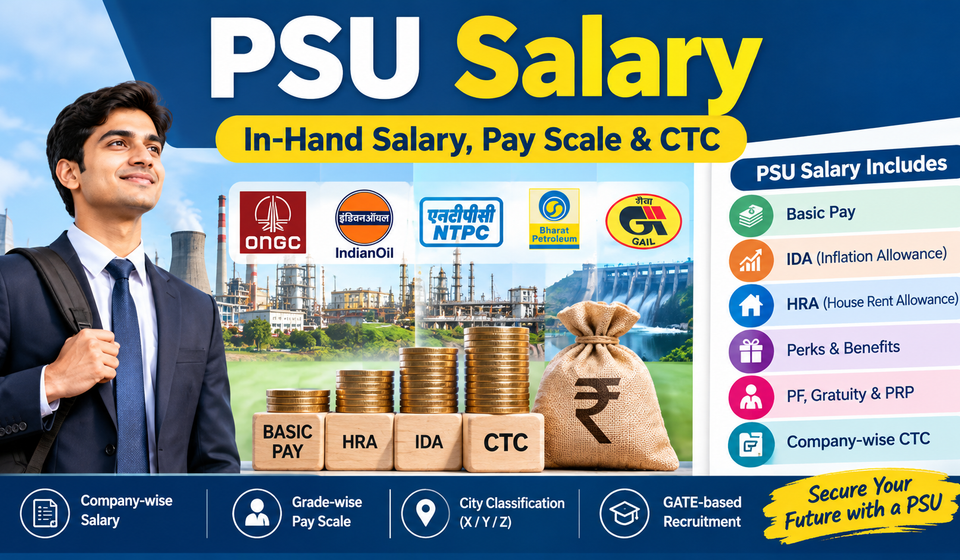
Many 2026 PSU executive recruitment notifications advertise starting basic pay in the ₹40,000–₹60,000 range, although the amount varies by company, post, and grade. With IDA at 55.7% (effective 1 July 2026, per DPE Office Memorandum No. W-02/0037/2025-DPE(WC)/FTS-14505 dated 17 July 2026, as reproduced in CPSE implementation circulars) and HRA at 30% for X-class cities where the applicable DPE/PSU rules provide that rate, the monthly cash gross for a ₹60,000 basic-pay example is approximately ₹1,11,420 before deductions. Depending on PF, tax, professional tax, and other deductions, the illustrative in-hand salary in the worked example below is approximately ₹92,000–₹97,000.
This figure is not universal. PSU salary depends on four moving parts: the company (individual CPSE recruitment notifications specify the basic pay and pay scale for each post, generally within the applicable 2017 IDA pay framework), the sector, the grade (E-1 through E-9), and the city classification (X, Y, or Z). The exact starting basic pay and CTC depend on the PSU, post, and recruitment notification.
PSU Salary: Basic Pay vs Gross Salary vs In-Hand vs CTC
| Salary Term | Meaning |
|---|---|
| Basic Pay | Fixed foundational component used to calculate several allowances |
| IDA | Inflation-linked allowance under the applicable IDA structure |
| Gross Salary | Salary components payable before employee deductions |
| In-Hand Salary | Amount credited after applicable deductions |
| CTC | Total employer cost, which can include benefits and employer contributions |
This distinction matters because a PSU offer letter usually mentions CTC, while your bank account receives in-hand salary. The two figures can differ substantially because CTC may include employer contributions, benefits, and variable components.
What Determines a PSU Salary?
Most CPSE executives covered by the IDA pattern are not paid under the 7th Central Pay Commission framework used for central government employees; their pay follows the applicable CPSE/DPE pay structure. Central Public Sector Enterprises (CPSEs) follow guidelines issued by the Department of Public Enterprises (DPE) under the Ministry of Finance, using the Industrial Dearness Allowance (IDA) pattern.
The current framework is based on the 3rd Pay Revision Committee (3rd PRC), effective from 1 January 2017. It remains the prevailing pay structure for most CPSEs as of 2026. The 2017 IDA pay-revision framework remains the relevant framework discussed in this article; future pay revisions may change salary structures.
Four factors determine what a PSU employee actually earns:
1. Company. Individual CPSE recruitment notifications specify the basic pay and pay scale for each post, generally within the applicable 2017 IDA pay framework. ONGC, GAIL, Coal India, and EIL use ₹60,000 as the E-1 starting basic, while NTPC uses ₹40,000 and IOCL uses ₹50,000 for Grade A officers. The pay scale framework is standardised, but the actual scale attached to a particular post is determined by individual recruitment notifications.
2. Sector. Total compensation can differ across sectors and companies because of company-specific allowances, location or hardship benefits, variable pay, and the compensation structure applicable to the post.
3. Grade. E-1 is entry-level for fresh engineers and management trainees. E-2 through E-9 represent progressively senior executive grades. The applicable 2017 IDA pay-scale framework provides for a 3% annual increment, subject to the employee’s applicable service and PSU rules, with promotions bringing additional grade-level increases.
4. Location. HRA is linked to the applicable city classification and IDA thresholds. Under the CPSE 2017 framework, HRA is 24%/16%/8% initially, rising to 27%/18%/9% when IDA crosses 25%, and further to 30%/20%/10% for X/Y/Z cities when IDA crosses 50%. The applicable HRA rate — including whether the 30% rate applies to a specific post — should be checked against the latest DPE order and the individual PSU’s rules. City classifications are determined by the government’s prescribed criteria and are not simply “metro/urban/rural” categories.
PSU Salary Structure
A PSU salary slip contains several distinct components. Confusing them with each other is one of the most common mistakes made by candidates comparing offers.
Basic Pay
The foundation of the salary structure. For E-1 grade (Management Trainee / Engineer), it ranges from ₹40,000–₹60,000 per month depending on the PSU and post, with a 3% annual increment under the applicable 2017 IDA pay-scale framework.
Industrial Dearness Allowance (IDA)
The inflation-linked component. Per DPE Office Memorandum No. W-02/0037/2025-DPE(WC)/FTS-14505 dated 17 July 2026 (as reproduced in CPSE implementation circulars), the IDA rate for the 2017 pay scale is 55.7% effective from 1 July 2026. For a basic pay of ₹60,000, IDA adds approximately ₹33,420 per month.
House Rent Allowance (HRA)
Calculated on basic pay and linked to IDA thresholds under the applicable CPSE/DPE rules. Under the CPSE 2017 framework, HRA moves to 27%/18%/9% when IDA crosses 25%, and further to 30%/20%/10% for X/Y/Z cities when IDA crosses 50%. Whether the 30% rate is applicable to a specific post depends on the latest DPE order and the individual PSU’s rules. For an X-class posting with ₹60,000 basic where the 30% rate applies, HRA works out to approximately ₹18,000 per month (illustrative).
Cafeteria Perks
Some CPSEs provide cafeteria-style perks and allowances within applicable ceilings; the exact entitlement depends on the company’s rules and grade. ONGC’s 2026 notification mentions a cafeteria allowance at 35% of basic pay. These are reimbursement-based benefits that reduce out-of-pocket expenses. They are not monthly cash-in-hand and should not be added to monthly gross salary calculations.
Performance Related Pay (PRP)
An annual bonus linked to company profits and MoU ratings. DPE maintains specific 2017 PRP guidelines. Actual payout depends on annual performance and is paid annually, not monthly. PRP may form part of CTC but does not normally appear as monthly take-home pay.
Employer PF Contribution and Gratuity
Employer PF contributions and gratuity may form part of CTC, subject to the applicable statutory provisions and the PSU’s salary structure. These amounts do not normally appear as monthly take-home pay.
Read More: MSc Nursing Salary / BSc Optometry Salary / BSc Cardiac Technology Salary / BSc Forensic Science Salary
PSU Salary by Company: 2026 Recruitment Data
The table below presents pay scales and CTC figures from 2026 recruitment notifications. All figures are for entry-level executive posts.
| PSU | Post | Basic Pay (₹/month) | Pay Scale | Approx. CTC | Source |
|---|---|---|---|---|---|
| ONGC | Graduate Trainee (E-1) | ₹60,000 | ₹60,000–₹1,80,000 | ₹26 LPA | ONGC Advt. No. 2/2026 (R&P) — see ONGC careers portal |
| IOCL | Engineer (Grade A) | ₹50,000 | ₹50,000–₹1,60,000 | ₹18.4 LPA | IOCL Advt. No. IOCL/CO-HR/Rectt/2026/01 — see IOCL careers portal |
| NTPC | Executive Trainee (E-1) | ₹40,000 | ₹40,000–₹1,40,000 | — | NTPC Advt. No. 07/26 — see NTPC careers portal |
| HPCL | Junior Executive | ₹30,000 | ₹30,000–₹1,20,000 | ₹10.99 LPA | HPCL Advt. No. HPCL/OPEN/HR/1/2026-27 — see HPCL careers portal |
| BPCL | Associate Executive | ₹40,000 | ₹40,000–₹1,40,000 | ₹17.11 LPA | BPCL Entry Level Recruitment 2026 — see BPCL careers portal |
| EIL | Management Trainee | ₹60,000 | ₹60,000–₹1,80,000 | ₹20.31 LPA | EIL HRD/Rectt./Advt./2025-26/18 — see EIL careers portal |
| PGCIL | Executive Trainee (E-2) | ₹50,000 | ₹50,000–₹1,60,000 | ₹22.50 LPA (post-training) | PGCIL Advt. No. CC/04/2025 — see POWERGRID careers portal |
| NHPC | Executive Trainee (E-2) | ₹50,000 | ₹50,000–₹1,60,000 | ₹13–16 LPA | NHPC 2026 Recruitment — see NHPC careers portal |
| GAIL | Executive Trainee (E-2) | ₹60,000 | ₹60,000–₹1,80,000 | ₹15–18 LPA | GAIL Executive Trainee 2026 — see GAIL careers portal |
| SAIL | Management Trainee (E-1) | ₹50,000 | ₹50,000–₹1,60,000 | ₹16–17 LPA | SAIL MT 2026 Notification — see SAIL careers portal |
The source column identifies each advertisement by number so readers can locate the exact official recruitment notification on the respective PSU careers portal. Figures are taken from or based on the respective recruitment notifications. CTC definitions differ among PSUs and should not be treated as directly comparable. Always verify with the official recruitment notification for your specific post.
PSU Salary at a Glance
| Salary Component | Typical/Illustrative Figure |
|---|---|
| Entry-level basic pay | ₹40,000–₹60,000+ depending on post |
| IDA | 55.7% for the stated July 2026 example |
| X-class HRA | 30% of basic, where applicable DPE/PSU rules provide this rate |
| Illustrative cash gross on ₹60k basic | ₹1,11,420 |
| Illustrative in-hand | ₹92,000–₹97,000, depending on tax and other deductions |
| CTC | Varies significantly by PSU and post |
PSU Salary by Maharatna, Navratna and Miniratna
| Category | Examples | What It Means |
|---|---|---|
| Maharatna | Selected large CPSEs (e.g., IOCL, ONGC, NTPC, SAIL, BHEL, GAIL) | Greater operational and financial autonomy under government criteria |
| Navratna | Selected CPSEs (e.g., BEL, HAL, PowerGrid, NALCO, NHPC) | Higher autonomy than Miniratna under government criteria |
| Miniratna | Selected CPSEs (e.g., IRCON, MECON, BEML, ECIL, NBCC) | Classification based on government criteria |
PSU category does not automatically determine salary. Individual company recruitment notifications determine the actual pay scale and CTC for each post. Pay scales are based on the 3rd PRC (2017) IDA pattern, adjusted for 2026 IDA rates.
Indicative PSU Salary by Experience
The table below provides editorial estimates for comparison, not a universal CPSE pay scale. Actual basic pay follows the employee’s PSU, grade, pay scale, and promotion history.
| Experience Level | Typical Grade | Indicative Basic Pay Range (₹/month) | Notes |
|---|---|---|---|
| Fresher (0–1 year) | E-1 / E-2 | ₹40,000–₹60,000 | Entry-level executive trainee or management trainee |
| 2–5 years | E-2 / E-3 | ₹50,000–₹80,000 | Grade progression depends on the PSU’s promotion policy, service requirements, and individual career progression |
| 5–10 years | E-4 / E-5 | ₹80,000–₹1,20,000 | Senior engineer or manager roles |
| 10+ years | E-6 and above | ₹1,20,000–₹2,80,000 | Senior management, deputy general manager and above |
Basic pay increases by 3% annually under the applicable framework, in addition to grade promotions. Actual figures vary by company and performance.
PSU Salary After GATE 2026
GATE remains the primary route for engineering graduates into executive PSU roles. The 2026 recruitment cycle has seen notifications from IOCL (470 vacancies), ONGC (52 vacancies), NTPC (515 vacancies), and GAIL, among others.
During the one-year training period, selected candidates receive a monthly stipend of ₹40,000–₹74,000, depending on the PSU. EIL offers ₹60,000 per month during training, with an additional ₹15,000 if accommodation is not provided. After successful absorption, candidates are placed in the E-1 or E-2 grade with full salary structure.
GATE shortlisting varies considerably by PSU, discipline, category, vacancy, and recruitment year. Some PSUs publish discipline-specific shortlisting criteria, so candidates should check the individual recruitment notification rather than rely on a universal GATE-rank cutoff.
PSU In-Hand Salary Calculation
The following calculation is illustrative for a PSU with a ₹60,000 basic pay, posted in an X-class city, as of July 2026. Actual figures will differ based on the PSU’s PF rules, tax regime, individual investments, and company-specific allowances.
| Component | Monthly Amount (₹) | Basis |
|---|---|---|
| Basic Pay | 60,000 | E-1 starting basic |
| IDA | 33,420 | 55.7% of basic (July 2026) |
| HRA | 18,000 | Illustrative 30% of basic, where the applicable PSU/city/IDA rules provide the 30% rate |
| Monthly Cash Gross | ₹1,11,420 | Basic + IDA + HRA |
| Employee PF | ~₹11,210 | 12% of basic + DA for this illustration; actual employee PF deduction depends on the applicable PSU/statutory rules |
| Professional Tax | ~₹200 | State-specific |
| TDS (estimated) | ~₹3,000–₹8,000 | Depends on regime and declarations |
| Illustrative In-Hand | approximately ₹92,000–₹97,000 | Net bank credit, depending on tax and other deductions |
For this illustration, employee PF has been calculated at 12% of basic pay plus DA. The actual PF deduction should be checked against the applicable rules of the recruiting PSU.
This calculation excludes cafeteria perks, employer PF, gratuity, and PRP, as these are not monthly cash components. Cafeteria perks are reimbursed against bills and should not be treated as monthly salary. PRP is paid annually and is taxed in the year of receipt.
Note: The in-hand figure above is illustrative, not a universal PSU salary. Actual in-hand salary depends on the PSU’s applicable PF rules, tax regime, professional tax, and other deductions. For specific PSUs, refer to the official salary structure in their recruitment notification.
What Does PSU CTC Include?
Employer PF contributions, gratuity accrual, the annual PRP payout, and cafeteria perks may form part of the CTC figure you see in offer letters, but they do not normally appear in your monthly bank credit.
An ₹18 LPA PSU CTC does not necessarily mean ₹1.5 lakh per month in hand. The actual bank credit depends on basic pay, allowances, employer contributions, PRP, perks, tax, and other deductions.
This is the most important distinction to understand before comparing a PSU offer with a private-sector offer. A private company offering ₹18 LPA fixed may have a different in-hand outcome than a PSU offering ₹18 LPA CTC, because a PSU CTC may include employer contributions, benefits, PRP, and non-cash or deferred components that are not equivalent to fixed monthly cash salary.
PSU vs Private Sector Salary
| Component | PSU (IDA Pattern) | Private Sector |
|---|---|---|
| Basic Pay | Structured, per DPE 3rd PRC | Company-specific |
| DA/IDA | Quarterly revision, inflation-linked | Usually not comparable |
| HRA | 30%/20%/10% of basic (city-dependent, where IDA crosses 50%) | Company-specific; structure varies by employer |
| PRP/Bonus | Profit-linked, per applicable guidelines | Variable, performance-linked |
| Employer PF | Subject to applicable EPF rules and employer salary structure | Subject to applicable EPF rules and employer salary structure |
| Gratuity | Subject to applicable gratuity law and employment conditions | Subject to applicable gratuity law and employment conditions |
| Medical | Varies by PSU and employee category | Insurance-based, often limited |
| CTC Composition | Includes non-cash perks and employer contributions | CTC structure varies substantially by employer |
A PSU CTC and a private-sector CTC of the same nominal value can have very different compositions. Always compare the fixed cash component and in-hand salary, not just CTC.
Read More: Army Public School Teacher Salary / GP Rating Salary / ICDS Supervisor Salary / Para SF Commando Salary
PSU Perks and Benefits
PSU compensation can also include benefits beyond monthly salary. These vary by employer, employee category, location, and applicable service rules:
Medical benefits vary by PSU and employee category and may include coverage for employees and eligible dependants under the employer’s medical scheme. For example, Coal India’s Contributory Post Retirement Medicare Scheme provides coverage of up to ₹25 lakh for retired executives, and SAIL’s Mediclaim Scheme has been extended to all retired employees and their spouses. Eligibility and coverage vary by employer and employee category.
Subsidised or preferential loans: Some PSUs provide subsidised or preferential loans for eligible employees, such as housing or vehicle loans. Availability, interest rates, and eligibility depend on the employer’s rules.
Residential accommodation: Some PSUs provide residential accommodation or township facilities at selected locations. Where accommodation is provided, the treatment of HRA depends on the employer’s applicable rules.
Pension and retirement benefits vary by PSU, employee category, joining date, and applicable retirement/medical scheme. Some CPSEs provide company-specific pension or post-retirement medical schemes, while others follow EPS-95 or NPS. Eligibility and coverage vary by employer and employee category.
Factors Affecting PSU In-Hand Salary
No single online calculator can give you a precise in-hand figure without knowing your employer’s specific structure. The following factors create variation:
Tax regime choice. Tax liability differs between the new and old regimes because the available exemptions and deductions differ. Employees should calculate their tax position using the rules applicable to the relevant financial year.
Cafeteria perk utilization. Perks are reimbursed against bills. If you do not submit bills for medical, canteen, or conveyance, you may lose part of the perk value.
PRP timing and amount. PRP is paid annually, not monthly. Your monthly in-hand does not include PRP. When PRP is paid, it is taxed as salary income in that financial year.
Posting location. The HRA differential between X-class and Z-class cities is 20 percentage points of basic pay where the 30%/10% rates apply. For ₹60,000 basic, that is ₹12,000 per month — a significant difference in take-home.
Company profitability. PRP and some allowances are profit-linked. A PSU with lower MoU ratings may pay less PRP than a top-performing Maharatna, even at the same grade and basic pay.
Frequently Asked Questions
1. Is a PSU job a government job?
Answer: CPSEs are enterprises in which the Central Government has a majority ownership stake, while state-owned public sector enterprises are controlled by state governments. PSU ownership structures can therefore differ. Employees of central CPSEs are not central government employees under the 7th CPC framework; they follow DPE guidelines and IDA-based pay scales.
2. Can I get a PSU job without GATE?
Answer: Yes. While GATE is the primary route for engineering executive roles, PSUs also recruit through their own written exams, campus placements, and direct recruitment for non-engineering roles (finance, HR, law, company secretary). Non-executive roles (technicians, supervisors, clerical) are recruited through separate processes.
3. What is the starting salary in a PSU?
Answer: Many 2026 PSU executive recruitment notifications advertise starting basic pay in the ₹40,000–₹60,000 range depending on the company and post. With IDA at 55.7% and HRA at 30% (X-class city, where applicable), monthly cash gross earnings are approximately ₹1,11,420 for a ₹60,000 basic. The illustrative in-hand in the worked example above is approximately ₹92,000–₹97,000.
4. Does PSU salary increase every year?
Answer: The applicable 2017 IDA pay-scale framework provides for a 3% annual increment, subject to the employee’s applicable service and PSU rules. IDA is revised quarterly based on AICPI-IW. PRP is paid annually based on company performance. Promotions to higher grades bring additional basic pay increases and higher perk ceilings.
5. Which PSU pays the highest salary?
Answer: There is no single “highest paying” PSU across all grades and roles. CTC varies significantly by sector, posting location, and role. For entry-level engineering roles, ONGC’s 2026 notification states an approximate CTC of ₹26 LPA for Graduate Trainees, PGCIL offers ₹22.50 LPA after training, and EIL offers approximately ₹20.31 LPA. These figures are illustrative examples from individual recruitment notifications, not a ranking. The relevant comparison is the specific post, basic pay, fixed allowances, variable pay, employer contributions, and CTC stated in the recruitment notification.
Final Takeaway
PSU salary in 2026 combines structured pay, IDA-linked salary components, employer benefits, and company-specific retirement or medical schemes. For a fresher engineer entering through GATE, the illustrative in-hand salary for a PSU with ₹60,000 basic in an X-class posting is approximately ₹92,000–₹97,000 per month, with annual CTC varying significantly by PSU, post, grade, allowances, and the way each employer calculates CTC.
The most important step you can take is to read your offer letter carefully — distinguish between CTC, gross salary, and in-hand salary, and ask your HR department for a breakdown of the fixed and variable components before you make a decision.
Read More: BAMS Doctor Salary / Ajit Doval Salary / D Pharmacy Salary / SBI PO Salary / Commercial Pilot Salary



[…] More: Territorial Army Salary / PSU Salary / MSc Nursing Salary / BSc Optometry Salary / BSc Cardiac Technology […]