

Last Updated: September 2026
Quick Answer: What is Gross Salary?
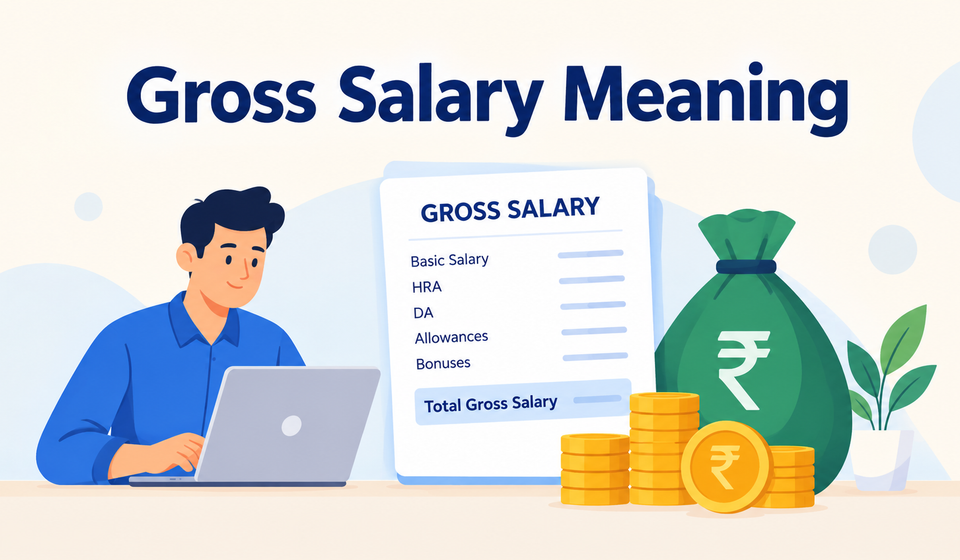
Gross salary is the total amount of money an employee earns before any mandatory deductions are applied. It includes your basic pay, House Rent Allowance (HRA), Dearness Allowance (DA), special allowances, and bonuses.
Crucially: Your gross salary is not your in-hand salary. The amount that actually reaches your bank account (net salary) is always lower because deductions like Income Tax (TDS), Employee Provident Fund (EPF), and Professional Tax are subtracted from your gross earnings.
What Is Gross Salary? (Definition)
In the Indian payroll context, gross salary generally refers to the total salary earnings before employee-side deductions.
Depending on the employer’s payroll structure, it may include:
- Fixed pay components (Basic, HRA, DA)
- Variable pay components (Bonuses, incentives)
- Certain taxable benefits (perquisites)
Important Clarification: Payroll terminology can vary significantly. “Gross salary,” “gross earnings,” “taxable salary,” “CTC,” and “total compensation” are not interchangeable terms. What an employer classifies as “gross” in an offer letter may differ from how the Income Tax Act defines “salary” for tax purposes. This article explains the most common industry practice for salaried employees in India.
What Are the Components of Gross Salary?
The exact structure varies by employer, industry, and employment contract. However, gross salary is typically composed of these categories:
Fixed Components
Variable Components
What Is NOT Included in Gross Salary?
While many items are part of your CTC, they are excluded from your gross salary because they are either employer-side costs or reimbursements:
- Gratuity: An employer-provided retirement/separation benefit that is generally payable when applicable conditions under gratuity law are met. It may form part of CTC rather than regular monthly gross earnings.
- Employer PF Contribution: The 12% (or applicable rate) contributed by the employer is an additional cost to the company; it does not form part of your gross earnings.
- Medical Reimbursements: Actual bills reimbursed against expenses are treated as claims/benefits, not as a fixed part of gross salary.
- Insurance Premiums: Group health/life insurance paid by the employer is a benefit, not a cash salary component.
How to Calculate Gross Salary: Formula & Example
General Formula
Gross Salary = Basic Salary + HRA + DA + All Other Allowances + Bonuses + Taxable Perquisites
Illustrative Calculation (CTC of ₹6 Lakh)
To understand this clearly, let’s break down a typical annual CTC structure:
| Salary Component | Annual Amount (₹) | Nature |
|---|---|---|
| Basic Salary | 3,00,000 | Fixed Cash |
| House Rent Allowance (HRA) | 1,20,000 | Fixed Cash |
| Special/Conveyance Allowance | 1,00,000 | Fixed Cash |
| Performance Bonus | 30,000 | Variable Cash |
| Total Gross Salary | 5,50,000 | Cash Earnings |
| Employer PF Contribution | 43,200 | Employer Cost |
| Gratuity Provision | 6,800 | Employer Cost |
| Total CTC | 6,00,000 | Total Employer Cost |
*Note: This is an illustrative salary structure. Actual employer calculations and CTC components may differ based on company policy, industry standards, and applicable employment rules. This is not a universal formula for all Indian workplaces.
Key Insight: In this example, your gross salary is ₹5.5 Lakhs, but your CTC is ₹6 Lakhs. The ₹50,000 difference is the employer’s contribution toward your future benefits, which never hits your bank account.
Gross Salary vs. Net Salary (In-Hand Salary)
This is the most common point of confusion. The difference is simply deductions.
| Feature | Gross Salary | Net Salary (In-Hand) |
|---|---|---|
| Definition | Total earnings before deductions | The amount credited to your bank account |
| Deductions | None applied | PF, TDS (Tax), Professional Tax, ESI |
| Real-world Use | Used for loan eligibility and tax reporting | Used for monthly budgeting |
Example (Continuing from above):
- Monthly Gross = ₹5,50,000 ÷ 12 = ₹45,833
- Deductions (PF, TDS, Professional Tax, etc.) = varies
- Monthly Net Salary (In-Hand) ≈ ₹41,433 (illustrative)
*Illustrative deductions only; actual PF, TDS and professional tax depend on the employee’s salary structure, tax regime, state and other applicable factors.
Gross Salary vs. CTC (Cost to Company)
CTC is generally higher than gross salary because it may include employer contributions and other benefits or costs that aren’t part of your gross earnings.
- CTC (Cost to Company): The total expense a company bears to employ you. CTC may include gross salary, employer PF contributions, gratuity, insurance, and other employer-provided benefits or costs, depending on the company’s compensation structure.
- Gross Salary: The portion of CTC that is classified as your earnings before deductions.
Rule of thumb: If a recruiter offers you ₹10 LPA CTC, do not assume ₹83,333 is your monthly take-home. Always ask for the salary breakup to see the Gross Salary and Employer contributions clearly. In a typical structure, the gross salary will be lower than the headline CTC number.
Is Gross Salary Taxable? (Rules for FY 2026-27 / AY 2027-28)
Yes, but how it is taxed depends entirely on which tax regime you choose. (Note: The following is based on Budget 2026 provisions currently applicable for the ongoing financial year 2026-27, which governs salary payouts in this period.)
Taxable Income Flow
- Gross Salary (as per your payslip).
- Less: Eligible Exemptions (critically depends on the regime chosen).
- Equals: Taxable Salary Income (this is what goes in your ITR).
- Less: Deductions (under Chapter VI-A) only if you choose the Old Regime.
- Equals: Total Income (on which tax is calculated).
Crucial Distinction: Old vs. New Tax Regime
Your Takeaway: Your gross salary is the starting point, but your taxable salary can be reduced significantly depending on your regime. Because the New Regime removes HRA and most Chapter VI-A deductions, it may be less beneficial for employees with high rent, significant investments, or large insurance premiums, despite the higher standard deduction.
The better tax regime ultimately depends on your income, eligible deductions, exemptions, and individual circumstances. Compare both regimes using a tax calculator or consult a professional before making a choice.
How PF (Employee Provident Fund) Affects Gross Salary
Employee EPF contribution is generally deducted from salary where EPF applies; the contribution is calculated on the applicable PF wage base (Basic Wages + Dearness Allowance + Retaining Allowance) rather than automatically on the entire gross salary.
- Impact: This contribution reduces your in-hand salary but builds your retirement corpus.
Monthly vs. Annual Gross Salary
- Annual Gross Salary: The total for the financial year (e.g., ₹5.5 Lakhs).
- Monthly Gross Salary: The annual amount divided by 12 (e.g., ₹45,833).
- Variable Pay: For some private-sector roles, performance bonuses are paid annually or quarterly, which means your monthly gross may be fixed, but the annual gross fluctuates based on the final bonus payout.
Sources & References
For the most current and authoritative information, always refer to official government sources:
- Income Tax Department, Government of India – For tax slabs, regime rules, and exemption provisions under the Income Tax Act.
(incometaxindia.gov.in) - Employees’ Provident Fund Organisation (EPFO) – For PF wage ceilings, calculation rules, and statutory updates.
(epfo.gov.in)
Frequently Asked Questions (FAQs)
1. Is gross salary the same as basic salary?
Answer: No. Basic salary is just one component of gross salary. Gross salary includes basic + all allowances + bonuses.
2. Is PF deducted from gross salary or basic?
3. Why is my in-hand salary much lower than my CTC?
Answer: Because your CTC includes employer-side costs (Employer PF, Gratuity, Insurance) that you never receive in cash, plus your own deductions (TDS, Employee PF) that are subtracted from your gross.
4. Can my gross salary change every month?
Answer: Yes, if your salary structure includes variable components like performance incentives, overtime, or shift allowances. Fixed components usually remain constant.
5. Is the ₹75,000 standard deduction available for everyone?
Answer: The ₹75,000 standard deduction is available specifically if you opt for the New Tax Regime. If you choose the Old Tax Regime, the standard deduction is ₹50,000.
Final Takeaway: Know Your Worth
When evaluating a job offer in India, do not focus solely on the big CTC number.
Always ask the HR team for a detailed salary breakup that specifies:
- Basic Pay
- HRA
- Special Allowances
- Expected Bonus
- Employer PF & Gratuity allocation
This will allow you to calculate your actual Gross Salary and realistic In-Hand Salary. Knowing these numbers—and understanding how the tax regime affects them—is the first step toward effective financial planning and salary negotiation.


-
-
-
-
-
-
-
-
-
-
-
-
-
-
-
-
Show Comments[…] gross salary instead of […]
[…] is an illustrative gross salary, not a universal guarantee. Actual gross salary varies by posting location, government accommodation availability, and individual entitlements. […]
[…] salary can differ based on posting, eligibility, and individual circumstances. Gross salary is an illustrative estimate, not a guaranteed government […]
[…] the quoted LPA figure represents CTC (Cost to Company) , although some employers may quote gross salary or fixed compensation instead. This is an important distinction — CTC includes components that […]
[…] following deductions are typically applied to your gross salary in this […]
[…] the gross salary, the following deductions are subtracted to arrive at the in-hand (net) […]
[…] pay are included in CTC but are not part of your monthly take-home. Always distinguish between CTC, gross salary, and net in-hand salary when evaluating any salary […]
[…] Methodology: Basic pay and pay-level information are based on Rajasthan government pay rules. Gross salary figures are calculated estimates using the DA and HRA assumptions stated in this article. Actual […]
[…] line: The commonly cited ₹2.5 lakh figure should not be treated as Doval’s current official gross salary. A calculation using the stated current DA and HRA rates produces a higher estimate, but the PMO […]
[…] Gross Salary Meaning […]
[…] basic pay) for Junior Scientific Assistant exists in some state government structures, but actual gross salary after adding DA and HRA varies by state and city […]
[…] reduce out-of-pocket expenses. They are not monthly cash-in-hand and should not be added to monthly gross salary […]
[…] What is Military Service Pay (MSP)? MSP is a fixed monthly allowance of ₹15,500 paid to armed forces officers in addition to basic pay, from the rank of Lieutenant up to Brigadier. It is not counted as basic pay for pension calculation but is a significant component of gross salary. […]
[…] Dearness Allowance is revised periodically by the government. An increase in DA directly increases gross salary as well as the NPS deduction (since NPS is calculated on Basic Pay + […]
[…] table below shows the typical monthly gross salary range by role, compiled from employee-reported data on AmbitionBox and […]
[…] PF, gratuity, and variable pay, which are not paid out monthly. See our guide on CTC full form and gross salary meaning for the full […]